







Question: 1. In this problem we address simplified model of flapping wings system hovering (no forward speed). Estimate wing's frequency, i.e. number of flapping cycles per
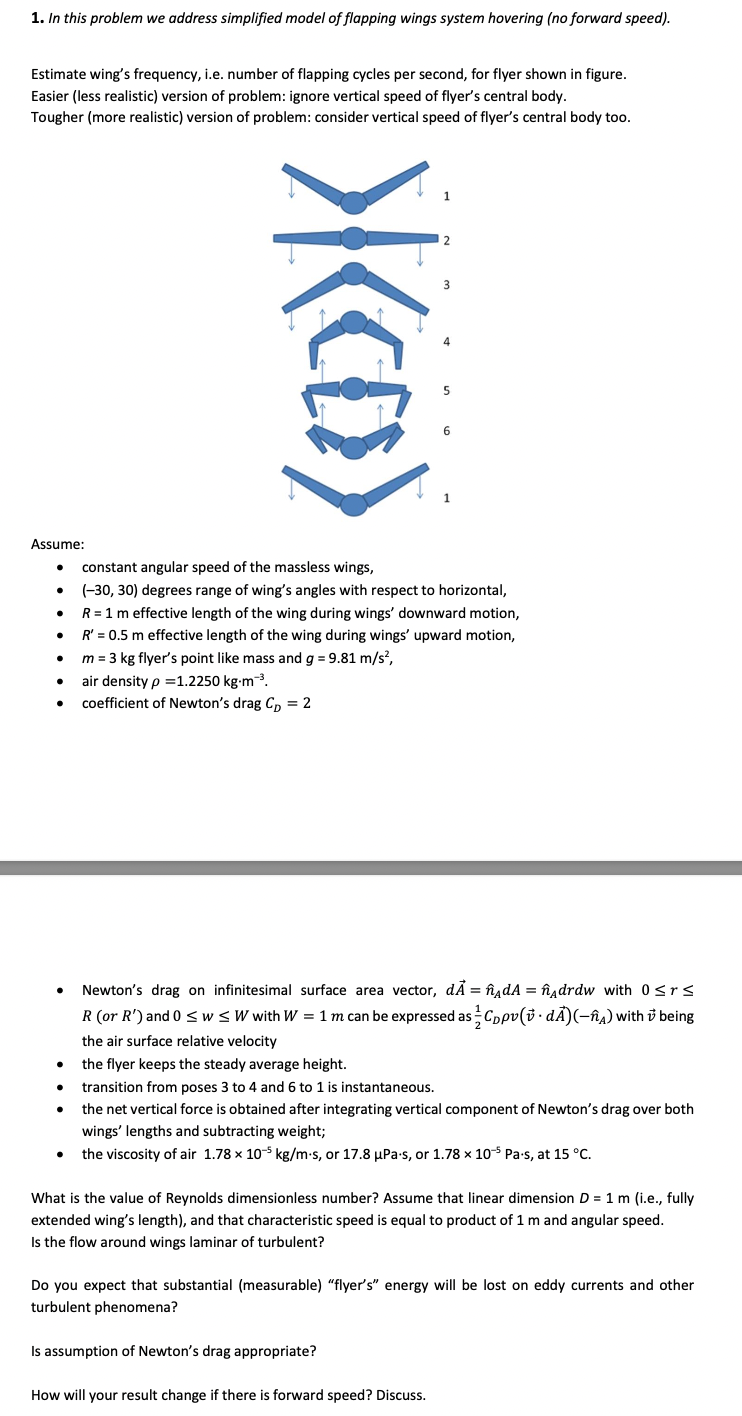
1. In this problem we address simplified model of flapping wings system hovering (no forward speed). Estimate wing's frequency, i.e. number of flapping cycles per second, for flyer shown in figure. Easier (less realistic) version of problem: ignore vertical speed of flyer's central body. Tougher (more realistic) version of problem: consider vertical speed of flyer's central body too. >{{cc) 5 6 . . . Assume: constant angular speed of the massless wings, (-30, 30) degrees range of wing's angles with respect to horizontal, R = 1 m effective length of the wing during wings' downward motion, R' = 0.5 m effective length of the wing during wings' upward motion, m = 3 kg flyer's point like mass and g = 9.81 m/s?, air density p =1.2250 kg.m3. coefficient of Newton's drag Cp = 2 . . . . . Newton's drag on infinitesimal surface area vector, d = AdA = Adrdw with o srs R (or R') and 0 sw s W with W = 1 m can be expressed as Cpprli.d) (-a) with being the air surface relative velocity the flyer keeps the steady average height. transition from poses 3 to 4 and 6 to 1 is instantaneous. the net vertical force is obtained after integrating vertical component of Newton's drag over both wings' lengths and subtracting weight; the viscosity of air 1.78 x 10⁻⁵ kg/m.s, or 17.8 uPa-s, or 1.78 x 10⁻⁵Pas, at 15 C. . . . What is the value of Reynolds dimensionless number? Assume that linear dimension D = 1 m (i.e., fully extended wing's length), and that characteristic speed is equal to product of 1 m and angular speed. Is the flow around wings laminar of turbulent? Do you expect that substantial (measurable) "flyer's" energy will be lost on eddy currents and other turbulent phenomena? Is assumption of Newton's drag appropriate? How will your result change if there is forward speed? Discuss. 1. In this problem we address simplified model of flapping wings system hovering (no forward speed). Estimate wing's frequency, i.e. number of flapping cycles per second, for flyer shown in figure. Easier (less realistic) version of problem: ignore vertical speed of flyer's central body. Tougher (more realistic) version of problem: consider vertical speed of flyer's central body too. >{{cc) 5 6 . . . Assume: constant angular speed of the massless wings, (-30, 30) degrees range of wing's angles with respect to horizontal, R = 1 m effective length of the wing during wings' downward motion, R' = 0.5 m effective length of the wing during wings' upward motion, m = 3 kg flyer's point like mass and g = 9.81 m/s?, air density p =1.2250 kg.m3. coefficient of Newton's drag Cp = 2 . . . . . Newton's drag on infinitesimal surface area vector, d = AdA = Adrdw with o srs R (or R') and 0 sw s W with W = 1 m can be expressed as Cpprli.d) (-a) with being the air surface relative velocity the flyer keeps the steady average height. transition from poses 3 to 4 and 6 to 1 is instantaneous. the net vertical force is obtained after integrating vertical component of Newton's drag over both wings' lengths and subtracting weight; the viscosity of air 1.78 x 10⁻⁵ kg/m.s, or 17.8 uPa-s, or 1.78 x 10⁻⁵Pas, at 15 C. . . . What is the value of Reynolds dimensionless number? Assume that linear dimension D = 1 m (i.e., fully extended wing's length), and that characteristic speed is equal to product of 1 m and angular speed. Is the flow around wings laminar of turbulent? Do you expect that substantial (measurable) "flyer's" energy will be lost on eddy currents and other turbulent phenomena? Is assumption of Newton's drag appropriate? How will your result change if there is forward speed? Discuss
Step by Step Solution
There are 3 Steps involved in it

Get step-by-step solutions from verified subject matter experts
 Study Help