





Question: 1. Let us consider a discrete stochastic process. (Here, discrete means the time can be 1, 2, 3,... (not continuous). The state of the process
1. Let us consider a discrete stochastic process.
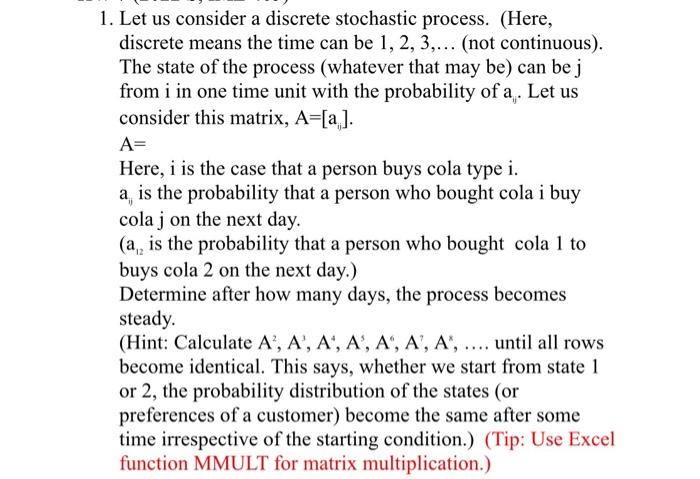
1. Let us consider a discrete stochastic process. (Here, discrete means the time can be 1, 2, 3,... (not continuous). The state of the process (whatever that may be) can be j from i in one time unit with the probability of a,. Let us consider this matrix, A=[a]. A= Here, i is the case that a person buys cola type i. a, is the probability that a person who bought cola i buy colaj on the next day. (a, is the probability that a person who bought cola 1 to buys cola 2 on the next day.) Determine after how many days, the process becomes steady (Hint: Calculate A', A', A, A', A', A', A', .... until all rows become identical. This says, whether we start from state 1 or 2, the probability distribution of the states (or preferences of a customer) become the same after some time irrespective of the starting condition.) (Tip: Use Excel function MMULT for matrix multiplication.)

Step by Step Solution

There are 3 Steps involved in it

1 Expert Approved Answer
Step: 1 Unlock blur-text-image

Question Has Been Solved by an Expert!

Get step-by-step solutions from verified subject matter experts

Step: 2 Unlock
Step: 3 Unlock

Students Have Also Explored These Related General Management Questions!