







Question: 1) Maximum likelihood estimation, likelihood-ratio test (LRT), Neyman-Pearson detector (20 pts.) A designed system needs to be tested under certain conditions. Denote the ideal measurements
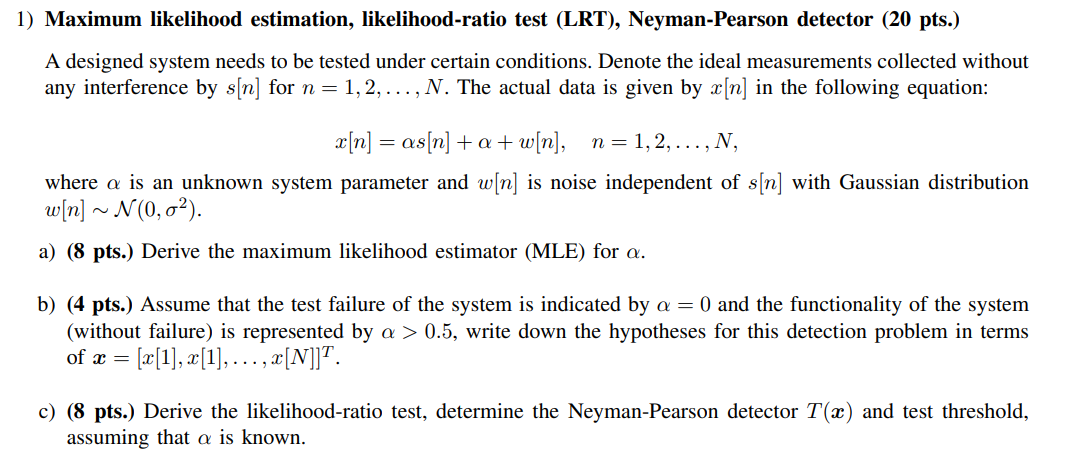
1) Maximum likelihood estimation, likelihood-ratio test (LRT), Neyman-Pearson detector (20 pts.) A designed system needs to be tested under certain conditions. Denote the ideal measurements collected without any interference by s(n] for n = 1, 2, ..., N. The actual data is given by a[n] in the following equation: x[n] = as[n] + at wn], n=1,2, ..., N, where o is an unknown system parameter and win] is noise independent of s with Gaussian distribution win] ~ N(0, 52). a) (8 pts.) Derive the maximum likelihood estimator (MLE) for a. b) (4 pts.) Assume that the test failure of the system is indicated by o = 0 and the functionality of the system (without failure) is represented by a > 0.5, write down the hypotheses for this detection problem in terms of a = [x[1], x[1], . .., x [N]]T. c) (8 pts.) Derive the likelihood-ratio test, determine the Neyman-Pearson detector T(a) and test threshold, assuming that o is known
Step by Step Solution
There are 3 Steps involved in it

Get step-by-step solutions from verified subject matter experts
 Study Help