







Question: 1. Multiple Choice. (10 points total) Choose the best answer and code the exact letter in the blank. Incorrect letter or answer not placed in
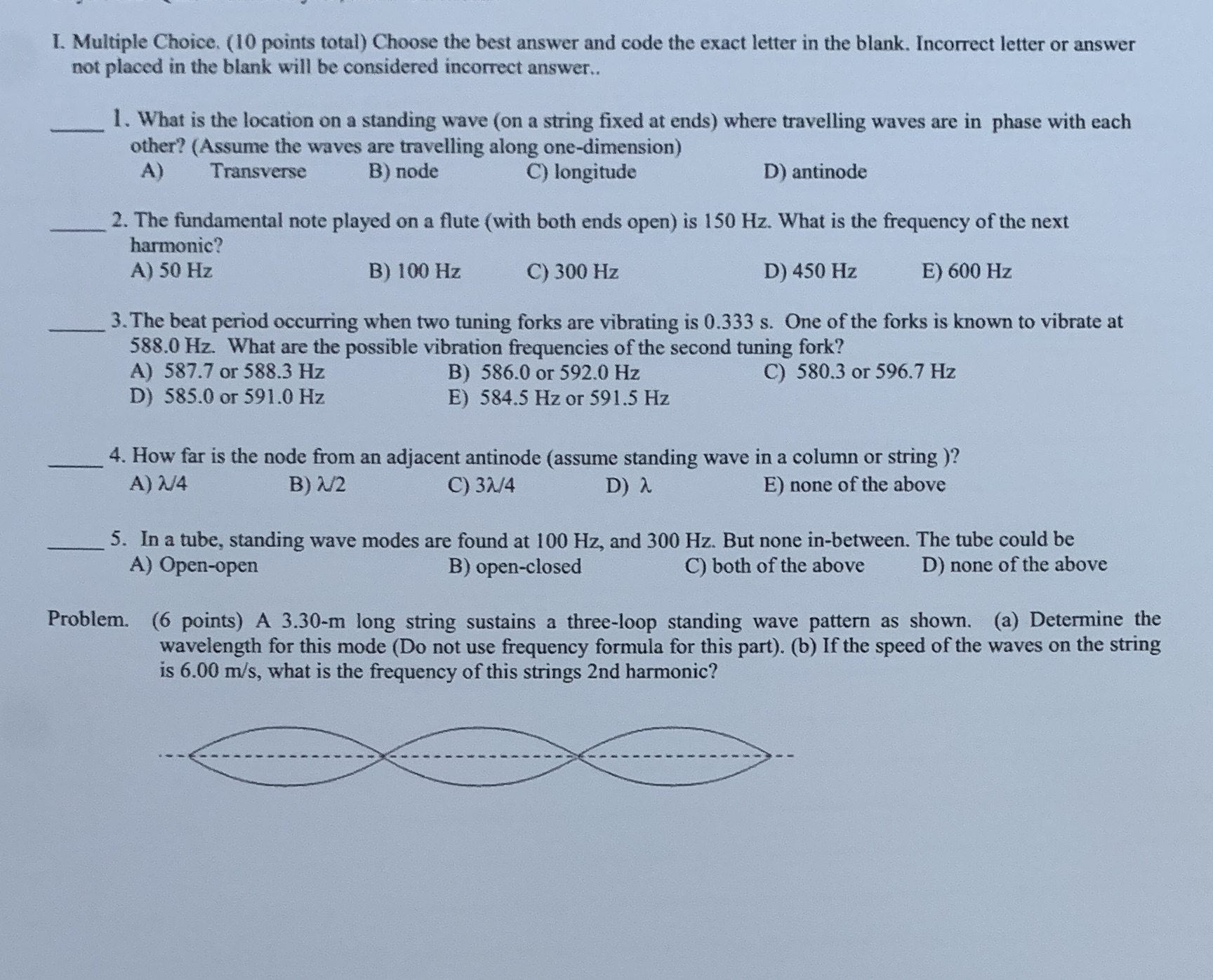
1. Multiple Choice. (10 points total) Choose the best answer and code the exact letter in the blank. Incorrect letter or answer not placed in the blank will be considered incorrect answer.. 1. What is the location on a standing wave (on a string fixed at ends) where travelling waves are in phase with each other? (Assume the waves are travelling along one-dimension) A) Transverse B) node C) longitude D) antinode 2. The fundamental note played on a flute (with both ends open) is 150 Hz. What is the frequency of the next harmonic? A) 50 Hz B) 100 Hz C) 300 Hz D) 450 Hz E) 600 Hz 3. The beat period occurring when two tuning forks are vibrating is 0.333 s. One of the forks is known to vibrate at 588.0 Hz. What are the possible vibration frequencies of the second tuning fork? A) 587.7 or 588.3 Hz B) 586.0 or 592.0 Hz C) 580.3 or 596.7 Hz D) 585.0 or 591.0 Hz E) 584.5 Hz or 591.5 Hz 4. How far is the node from an adjacent antinode (assume standing wave in a column or string )? A) 2/4 B) 2/2 C) 32/4 D) 2 E) none of the above 5. In a tube, standing wave modes are found at 100 Hz, and 300 Hz. But none in-between. The tube could be A) Open-open B) open-closed C) both of the above D) none of the above Problem. (6 points) A 3.30-m long string sustains a three-loop standing wave pattern as shown. (a) Determine the wavelength for this mode (Do not use frequency formula for this part). (b) If the speed of the waves on the string is 6.00 m/s, what is the frequency of this strings 2nd harmonic
Step by Step Solution
There are 3 Steps involved in it

Get step-by-step solutions from verified subject matter experts
 Study Help