







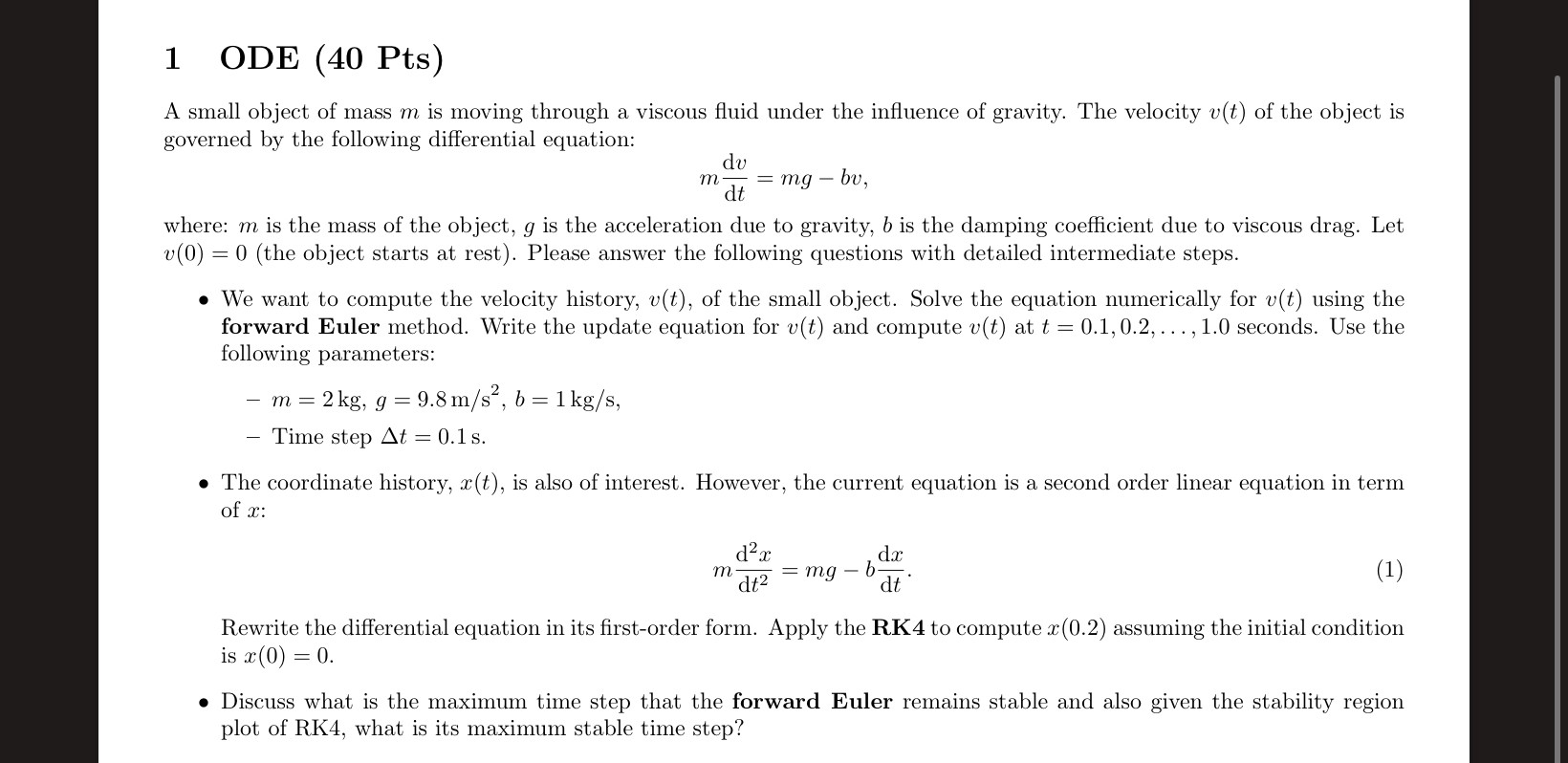
Question: 1 ODE ( 4 0 Pts ) A small object of mass m is moving through a viscous fluid under the influence of gravity. The
ODE Pts
A small object of mass is moving through a viscous fluid under the influence of gravity. The velocity of the object is governed by the following differential equation:
where: is the mass of the object, is the acceleration due to gravity, is the damping coefficient due to viscous drag. Let the object starts at rest Please answer the following questions with detailed intermediate steps.
We want to compute the velocity history, of the small object. Solve the equation numerically for using the forward Euler method. Write the update equation for and compute at dots, seconds. Use the following parameters:
Time step
The coordinate history, is also of interest. However, the current equation is a second order linear equation in term of :
Rewrite the differential equation in its firstorder form. Apply the RK to compute assuming the initial condition is
Discuss what is the maximum time step that the forward Euler remains stable and also given the stability region plot of RK what is its maximum stable time step?
Step by Step Solution
There are 3 Steps involved in it
1 Expert Approved Answer
Step: 1 Unlock

Question Has Been Solved by an Expert!
Get step-by-step solutions from verified subject matter experts
Step: 2 Unlock
Step: 3 Unlock
 Study Help