







Question: 1. present the main key issues of the case study. 2. Describe the main facts given in the case study (if given), STATE The general
1. present the main key issues of the case study.
2. Describe the main facts given in the case study (if given), STATE The general information (General (GEN) (history, actors/protagonists, etc., Describe the information given about the Industry (IND), Describe the information given about the Competition (COM) , Describe the Strengths (STR) and Weakness (WEA) of the business
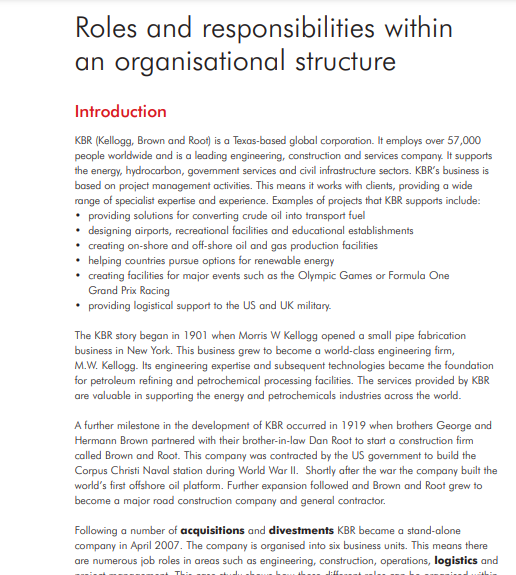
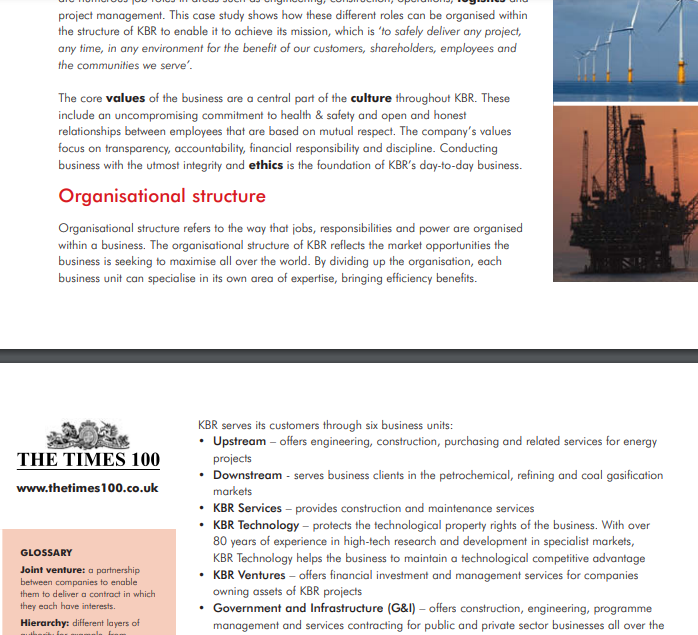
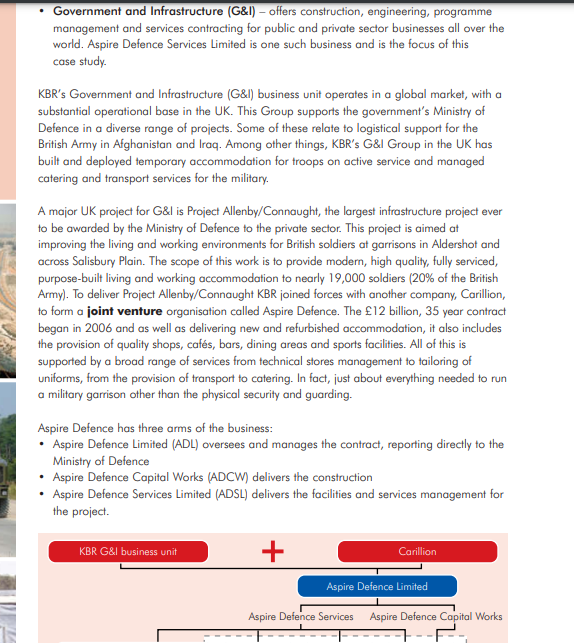
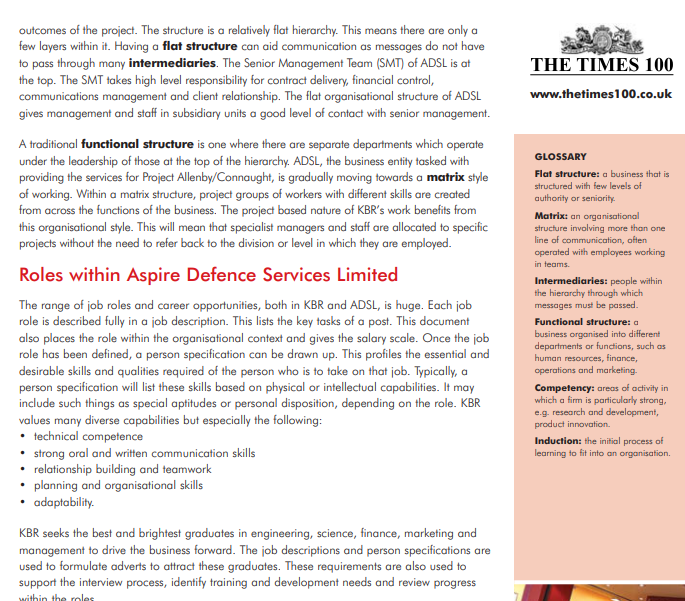
Roles and responsibilities within an organisational structure Introduction KBR (Kellogg, Brown and Root) is a Texas-based global corporation. It employs over 57,000 people worldwide and is a leading engineering, construction and services company. It supports the energy, hydrocarbon, goverment services and civil infrastructure sectors. KBR's business is based on project management activities. This means it works with clients, providing a wide range of specialist expertise and experience. Examples of projects that KBR supports include: providing solutions for converting crude oil into transport fuel designing airports, recreational facilities and educational establishments creating on-shore and off-shore oil and gas production facilities helping countries pursue options for renewable energy creating facilities for major events such as the Olympic Games or Formula One Grand Prix Racing providing logistical support to the US and UK military The KBR story began in 1901 when Morris W Kellogg opened a small pipe fabrication business in New York. This business grew to become a world-class engineering firm, M.W. Kellogg. Its engineering expertise and subsequent technologies became the foundation for petroleum refining and petrochemical processing facilities. The services provided by KBR are valuable in supporting the energy and petrochemicals industries across the world. A further milestone in the development of KBR occurred in 1919 when brothers George and Hermann Brown partnered with their brother-in-law Dan Root to start a construction firm called Brown and Root. This company was contracted by the US government to build the Corpus Christi Naval station during World War II. Shortly after the war the company built the world's first offshore oil platform. Further expansion followed and Brown and Root grew to become a major road construction company and general contractor. Following a number of acquisitions and divestments KBR became a stand-alone company in April 2007. The company is organised into six business units. This means there are numerous job roles in areas such as engineering, construction, operations, logistics and project management. This case study shows how these different roles can be organised within the structure of KBR to enable it to achieve its mission, which is 'to safely deliver any project, any time, in any environment for the benefit of our customers, shareholders, employees and the communities we serve'. The core values of the business are a central part of the culture throughout KBR. These include an uncompromising commitment to health & safety and open and honest relationships between employees that are based on mutual respect. The company's values focus on transparency, accountability, financial responsibility and discipline. Conducting business with the utmost integrity and ethics is the foundation of KBR's day-to-day business. Organisational structure Organisational structure refers to the way that jobs, responsibilities and power are organised within a business. The organisational structure of KBR reflects the market opportunities the business is seeking to maximise all over the world. By dividing up the organisation, each business unit can specialise in its own area of expertise, bringing efficiency benefits. THE TIMES 100 www.thetimes 100.co.uk KBR serves its customers through six business units: Upstream - offers engineering, construction, purchasing and related services for energy projects Downstream - serves business clients in the petrochemical, refining and coal gasification markets KBR Services - provides construction and maintenance services KBR Technology - protects the technological property rights of the business. With over 80 years of experience in high-tech research and development in specialist markets, KBR Technology helps the business to maintain a technological competitive advantage KBR Ventures - offers financial investment and management services for companies owning assets of KBR projects . Government and Infrastructure (G&I) - offers construction, engineering, programme management and services contracting for public and private sector businesses all over the GLOSSARY Joint venture: a partnership between companies to enable them to deliver a contract in which they each have interests. Hierarchy: different layers of Government and Infrastructure (G&I) - offers construction, engineering, programme management and services contracting for public and private sector businesses all over the world. Aspire Defence Services Limited is one such business and is the focus of this case study. KBR's Government and Infrastructure (G&I) business unit operates in a global market, with a substantial operational base in the UK. This Group supports the government's Ministry of Defence in a diverse range of projects. Some of these relate to logistical support for the British Army in Afghanistan and Iraq. Among other things, KBR's G&I Group in the UK has built and deployed temporary accommodation for troops on active service and managed catering and transport services for the military A major UK project for G&l is Project Allenby/Connaught, the largest infrastructure project ever to be awarded by the Ministry of Defence to the private sector. This project is aimed at improving the living and working environments for British soldiers at garrisons in Aldershot and across Salisbury Plain. The scope of this work is to provide modern, high quality, fully serviced, purpose-built living and working accommodation to nearly 19,000 soldiers (20% of the British Army). To deliver Project Allenby/Connaught KBR joined forces with another company, Carillion, to form a joint venture organisation called Aspire Defence. The 12 billion, 35 year contract began in 2006 and as well as delivering new and refurbished accommodation, it also includes the provision of quality shops, cafs, bars, dining areas and sports facilities. All of this is supported by a broad range of services from technical stores management to tailoring of uniforms, from the provision of transport to catering. In fact, just about everything needed to run a military garrison other than the physical security and guarding. Aspire Defence has three arms of the business: Aspire Defence Limited (ADL) oversees and manages the contract, reporting directly to the Ministry of Defence Aspire Defence Capital Works (ADCW) delivers the construction Aspire Defence Services Limited (ADSL) delivers the facilities and services management for the project. KBR G&l business unit + Carillion Aspire Defence Limited Aspire Defence Services Aspire Defence Capital Works outcomes of the project. The structure is a relatively flat hierarchy. This means there are only a few layers within it. Having a flat structure can aid communication as messages do not have to pass through many intermediaries. The Senior Management Team (SMT) of ADSL is at the top. The SMT takes high level responsibility for contract delivery, financial control, communications management and client relationship. The flat organisational structure of ADSL gives management and staff in subsidiary units a good level of contact with senior management. THE TIMES 100 www.thetimes100.co.uk GLOSSARY Flat structure: a business that is structured with few levels of A traditional functional structure is one where there are separate departments which operate under the leadership of those at the top of the hierarchy. ADSL, the business entity tasked with providing the services for Project Allenby/Connaught, is gradually moving towards a matrix style of working. Within a matrix structure, project groups of workers with different skills are created from across the functions of the business. The project based nature of KBR's work benefits from this organisational style. This will mean that specialist managers and staff are allocated to specific projects without the need to refer back to the division or level in which they are employed. authority or seniority Matrix: an organisational structure involving more than one line of communication, often operated with employees working in teams. Roles within Aspire Defence Services Limited Intermediaries: people within the hierarchy through which messages must be passed. Functional structure: a business organised into different departments or functions, such as human resources, finance, operations and marketing. The range of job roles and career opportunities, both in KBR and ADSL, is huge. Each job role is described fully in a job description. This lists the key tasks of a post. This document also places the role within the organisational context and gives the salary scale. Once the job role has been defined, a person specification can be drawn up. This profiles the essential and desirable skills and qualities required of the person who is to take on that job. Typically, a person specification will list these skills based on physical or intellectual capabilities. It may include such things as special aptitudes or personal disposition, depending on the role. KBR values many diverse capabilities but especially the following: technical competence strong oral and written communication skills relationship building and teamwork planning and organisational skills adaptability. Competency: areas of activity in which a firm is particularly strong, e.g. research and development, product innovation Induction: the initial process of learning to fit into an organisation. KBR seeks the best and brightest graduates in engineering, science, finance, marketing and management to drive the business forward. The job descriptions and person specifications are used to formulate adverts to attract these graduates. These requirements are also used to support the interview process, identify training and development needs and review progress within the rolesStep by Step Solution
There are 3 Steps involved in it
1 Expert Approved Answer
Step: 1 Unlock

Question Has Been Solved by an Expert!
Get step-by-step solutions from verified subject matter experts
Step: 2 Unlock
Step: 3 Unlock
 Study Help