







Question: 1. What are the key problems/issues in this case? 2. What could/should be the thesis statement, or what are the outcomes of the analysis? (
1. What are the key problems/issues in this case?
2. What could/should be the thesis statement, or what are the outcomes of the analysis? ( 1-2 sentences)
3. What are the relevant/important issues and facts in this case?
4. What could be alternatives solutions. Why are the alternatives rejected?
5. What could be one specific solution on how to decide which city to chose, since all the cities all look promising. ( It is tough to chose )
6. What are the recommendations and determine the strategies and what actions to take in order to decide which city is the best?
7. Out of these 5 cities, which 2 cities would you chose for being the new NHL team? Why? Why are they better than the other ones?
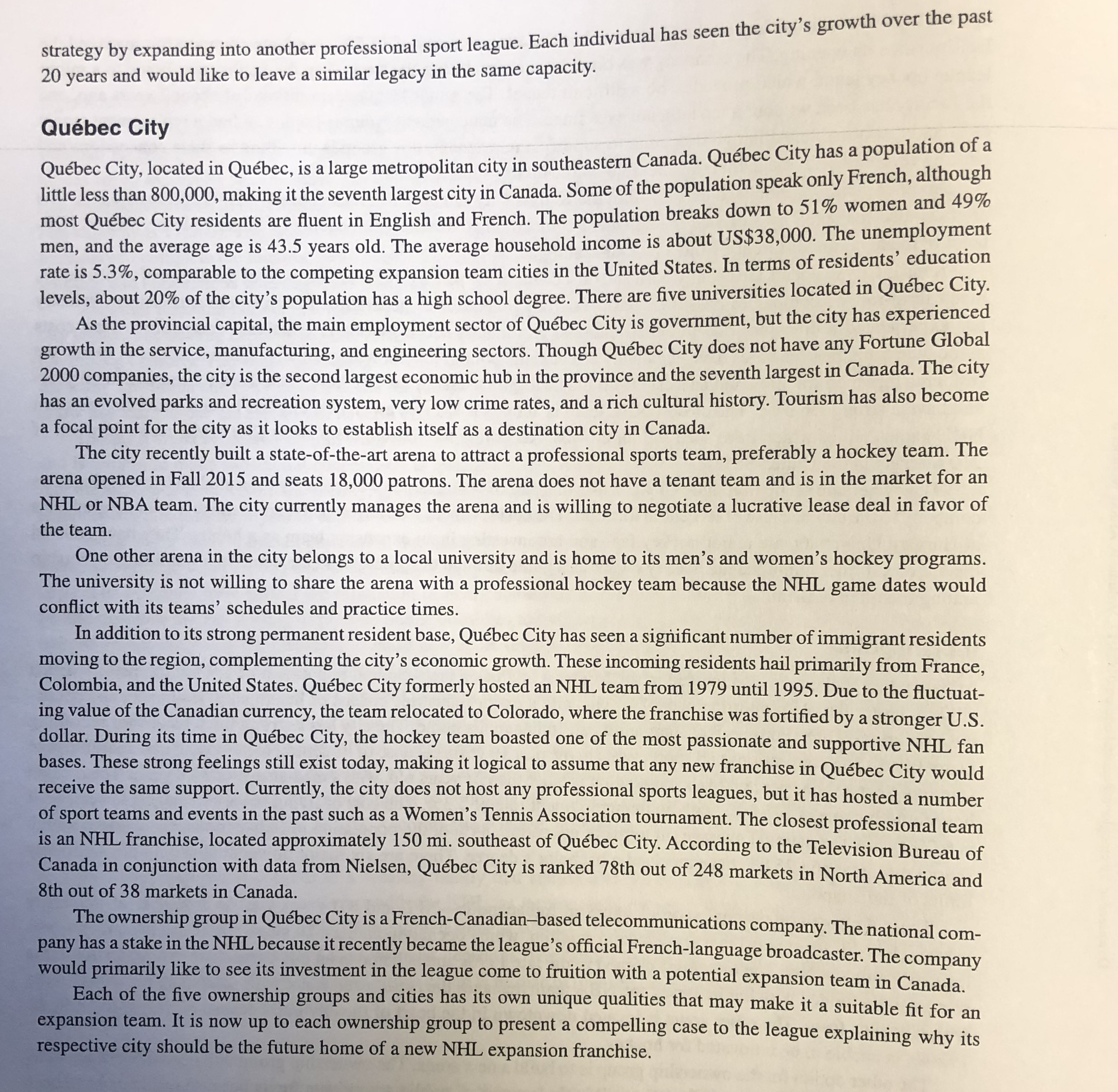
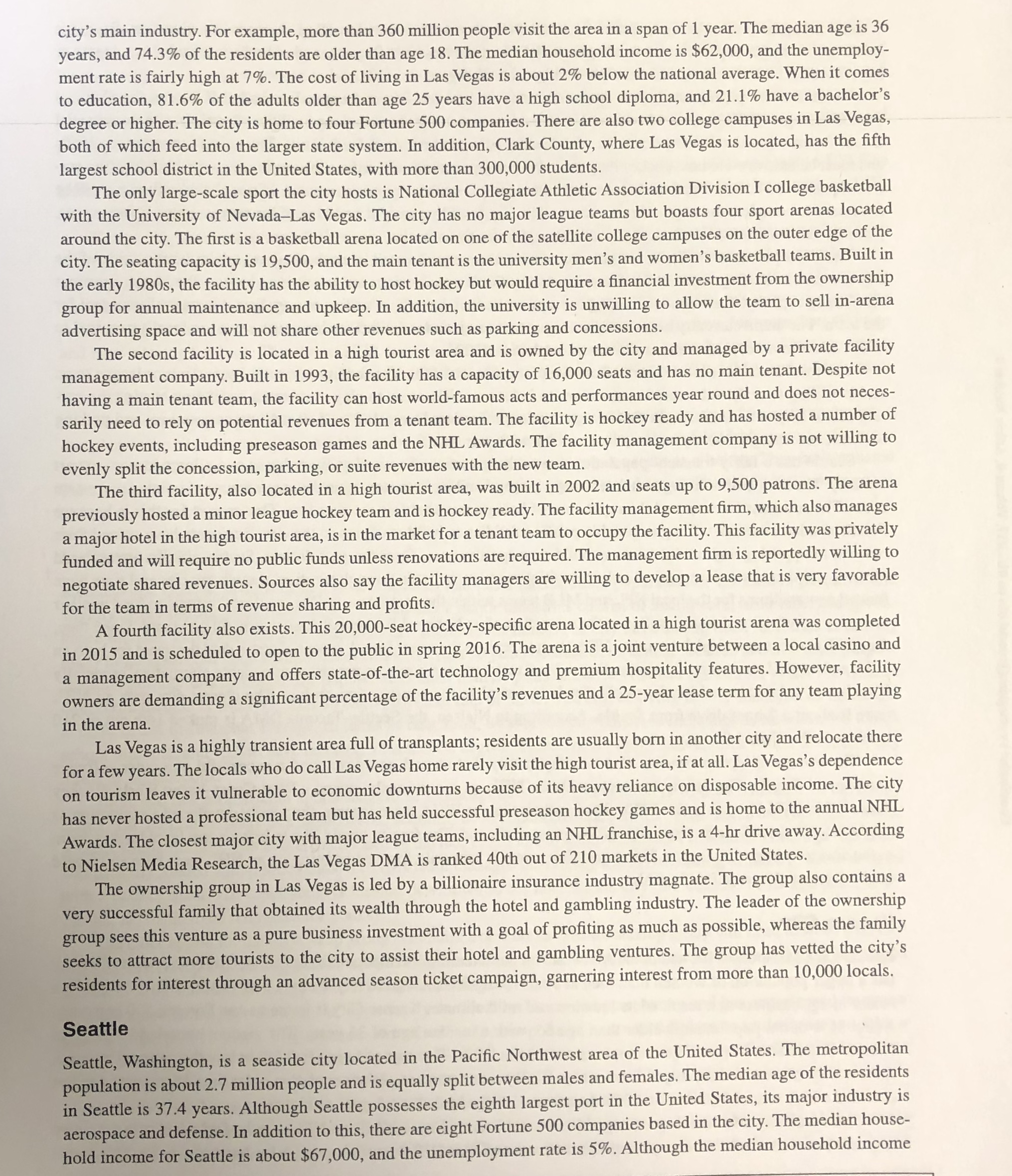
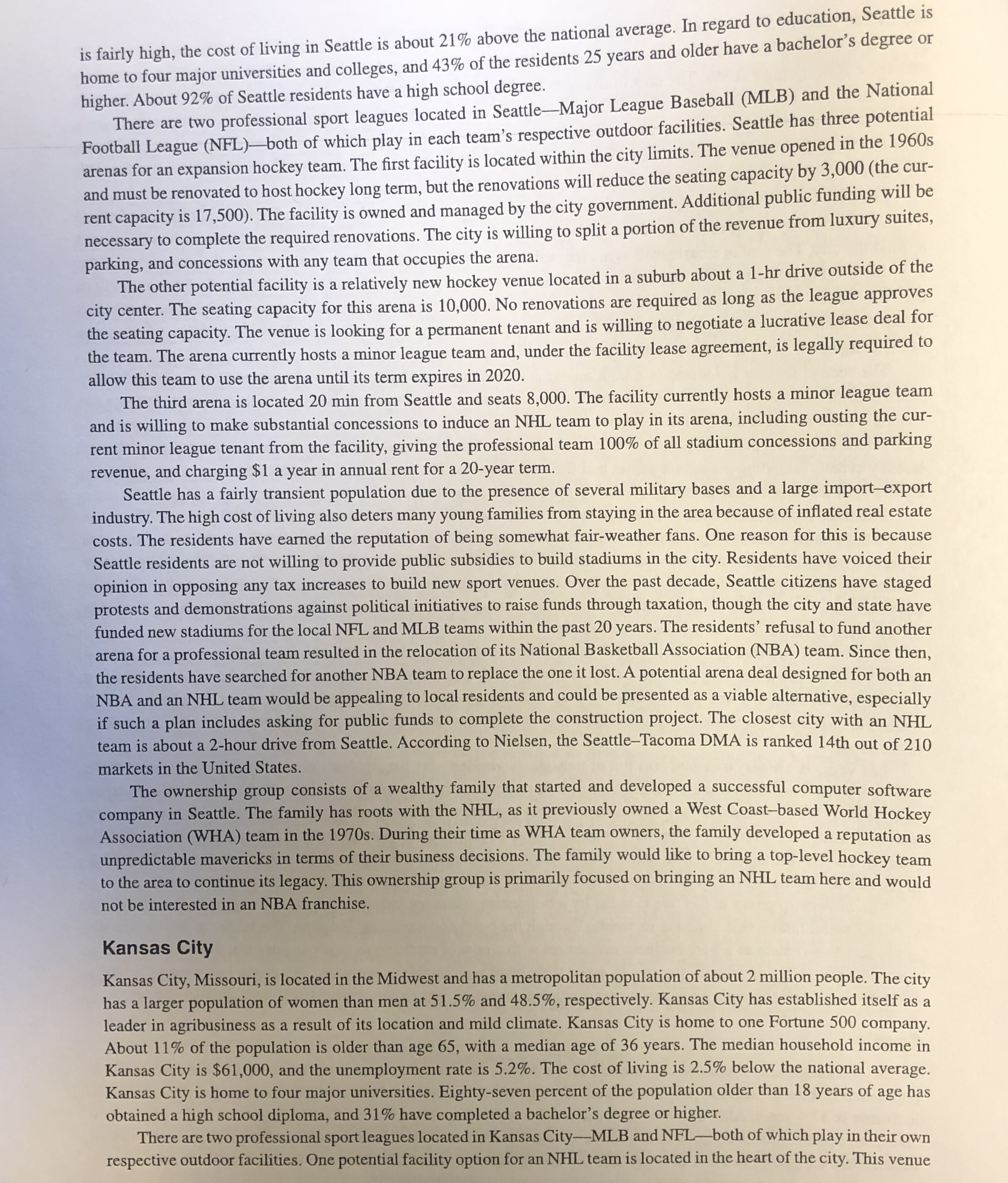
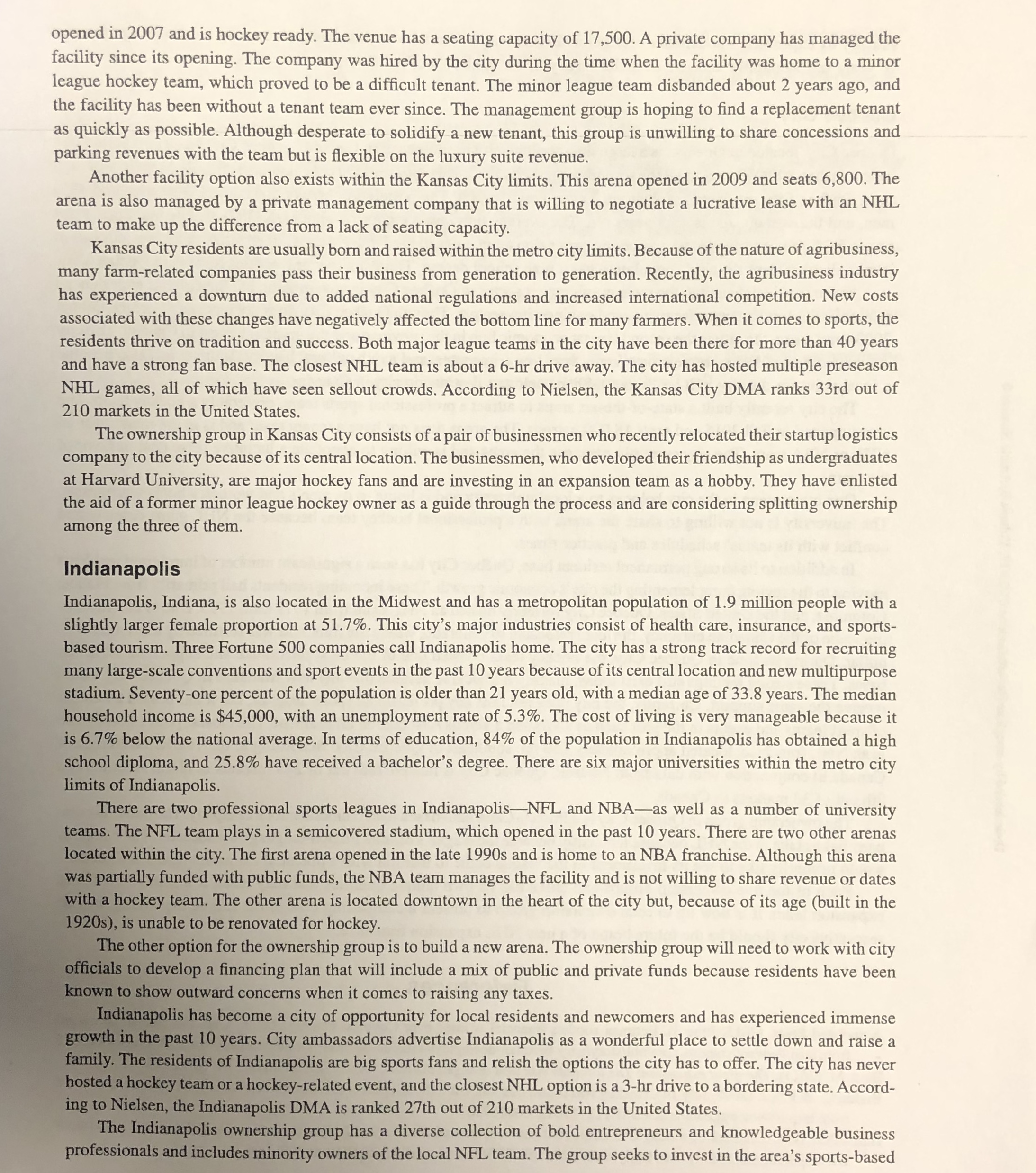
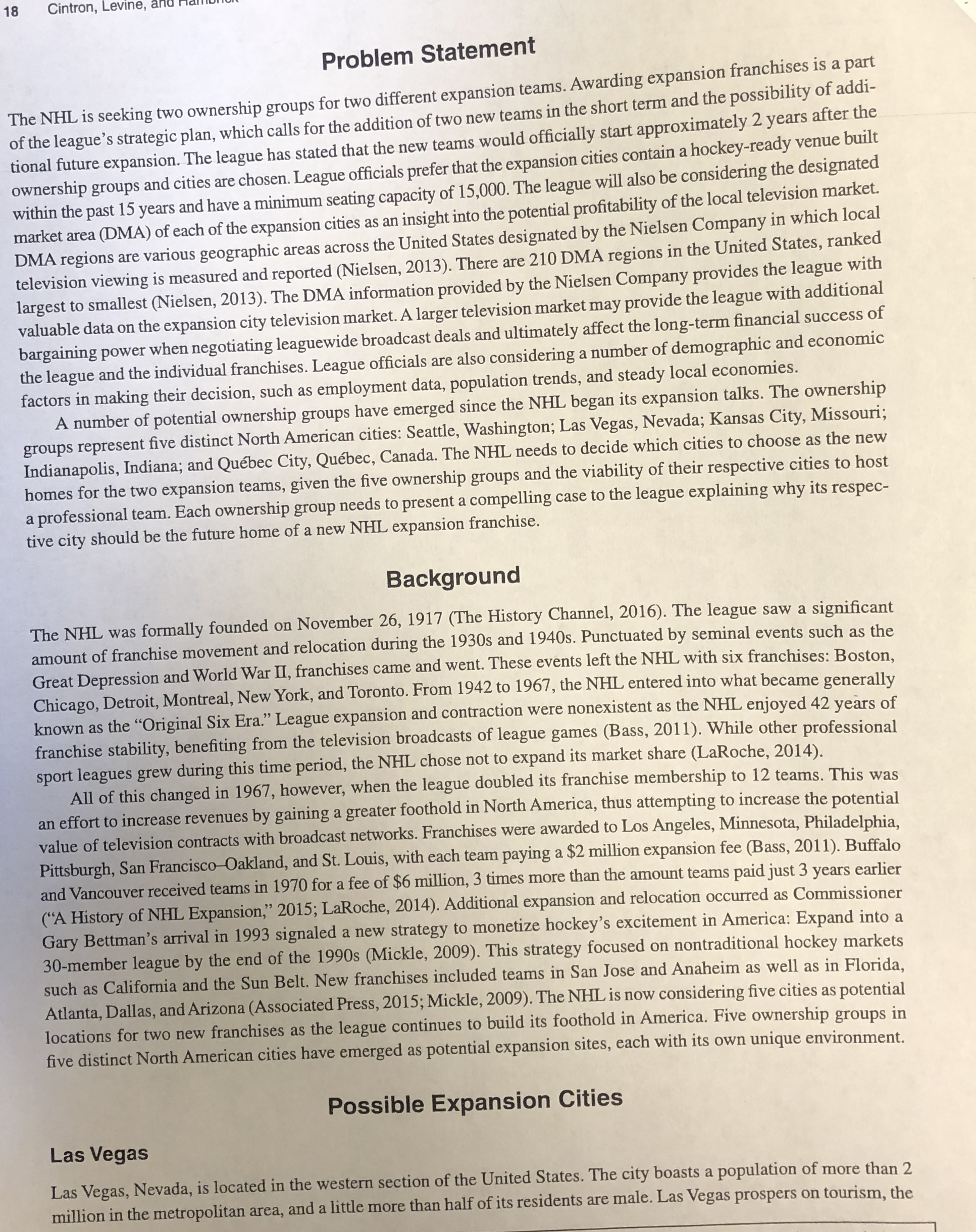
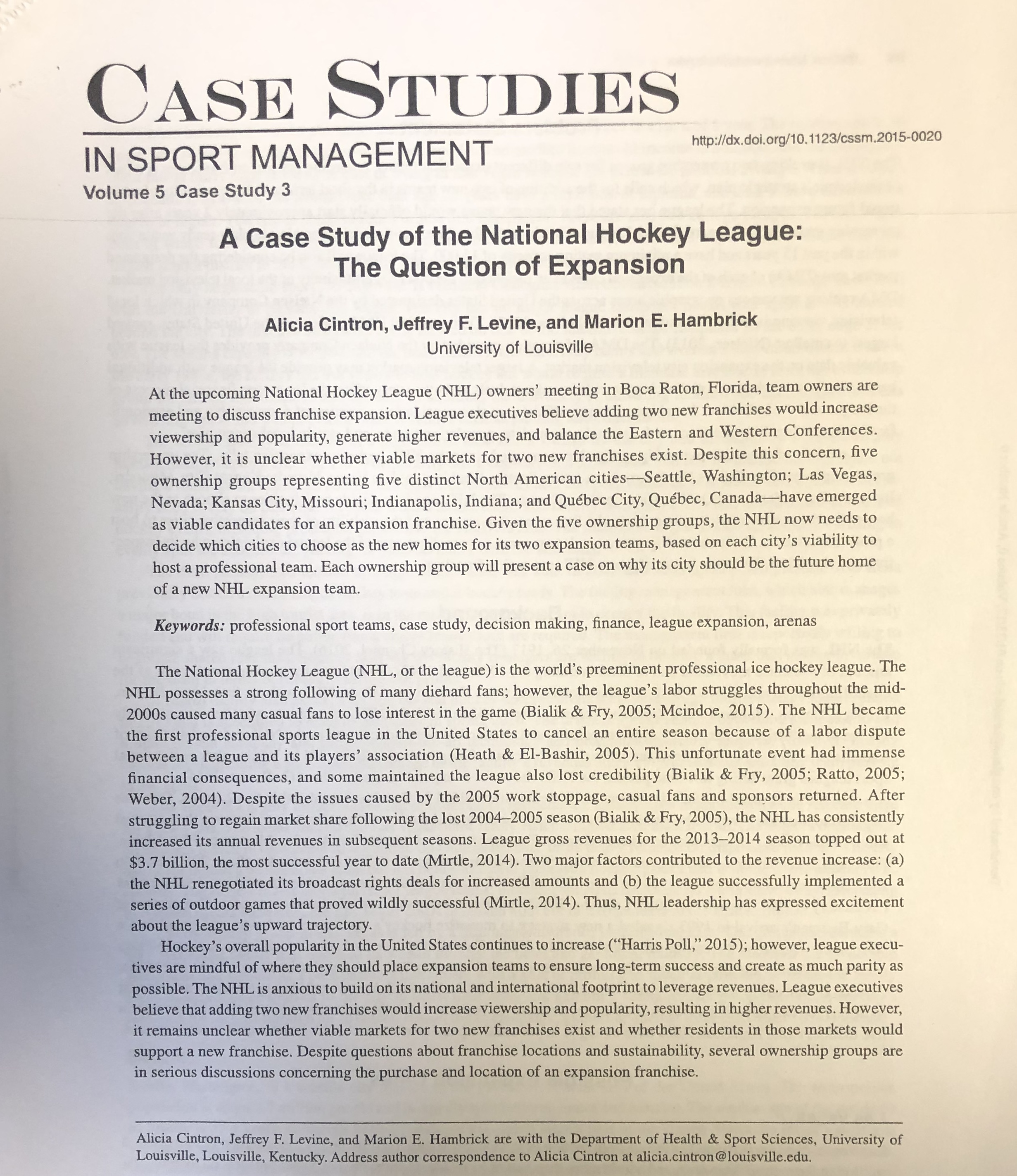
strategy by expanding into another professional sport league. Each individual has seen the city's growth over the past 20 years and would like to leave a similar legacy in the same capacity. Quebec City Quebec City, located in Quebec, is a large metropolitan city in southeastern Canada. Quebec City has a population of a little less than 800,000, making it the seventh largest city in Canada. Some of the population speak only French, although most Quebec City residents are fluent in English and French. The population breaks down to 51% women and 49% men, and the average age is 43.5 years old. The average household income is about US$38,000. The unemployment rate is 5.3%, comparable to the competing expansion team cities in the United States. In terms of residents' education levels, about 20% of the city's population has a high school degree. There are five universities located in Quebec City. As the provincial capital, the main employment sector of Quebec City is government, but the city has experienced growth in the service, manufacturing, and engineering sectors. Though Quebec City does not have any Fortune Global 2000 companies, the city is the second largest economic hub in the province and the seventh largest in Canada. The city has an evolved parks and recreation system, very low crime rates, and a rich cultural history. Tourism has also become a focal point for the city as it looks to establish itself as a destination city in Canada. The city recently built a state-of-the-art arena to attract a professional sports team, preferably a hockey team. The arena opened in Fall 2015 and seats 18,000 patrons. The arena does not have a tenant team and is in the market for an NHL or NBA team. The city currently manages the arena and is willing to negotiate a lucrative lease deal in favor of the team. One other arena in the city belongs to a local university and is home to its men's and women's hockey programs. The university is not willing to share the arena with a professional hockey team because the NHL game dates would conflict with its teams' schedules and practice times. In addition to its strong permanent resident base, Quebec City has seen a significant number of immigrant residents moving to the region, complementing the city's economic growth. These incoming residents hail primarily from France, Colombia, and the United States. Quebec City formerly hosted an NHL team from 1979 until 1995. Due to the fluctuat- ing value of the Canadian currency, the team relocated to Colorado, where the franchise was fortified by a stronger U.S. dollar. During its time in Quebec City, the hockey team boasted one of the most passionate and supportive NHL fan bases. These strong feelings still exist today, making it logical to assume that any new franchise in Quebec City would receive the same support. Currently, the city does not host any professional sports leagues, but it has hosted a number of sport teams and events in the past such as a Women's Tennis Association tournament. The closest professional team is an NHL franchise, located approximately 150 mi. southeast of Quebec City. According to the Television Bureau of Canada in conjunction with data from Nielsen, Quebec City is ranked 78th out of 248 markets in North America and 8th out of 38 markets in Canada. The ownership group in Quebec City is a French-Canadian-based telecommunications company. The national com- pany has a stake in the NHL because it recently became the league's official French-language broadcaster. The company would primarily like to see its investment in the league come to fruition with a potential expansion team in Canada. Each of the five ownership groups and cities has its own unique qualities that may make it a suitable fit for an expansion team. It is now up to each ownership group to present a compelling case to the league explaining why its respective city should be the future home of a new NHL expansion franchise.city's main industry. For example, more than 360 million people visit the area in a span of 1 year. The median age is 36 years, and 74.3% of the residents are older than age 18. The median household income is $62,000, and the unemploy- ment rate is fairly high at 7%. The cost of living in Las Vegas is about 2% below the national average. When it comes to education, 81.6% of the adults older than age 25 years have a high school diploma, and 21.1% have a bachelor's degree or higher. The city is home to four Fortune 500 companies. There are also two college campuses in Las Vegas, both of which feed into the larger state system. In addition, Clark County, where Las Vegas is located, has the fifth largest school district in the United States, with more than 300,000 students. The only large-scale sport the city hosts is National Collegiate Athletic Association Division I college basketball with the University of Nevada-Las Vegas. The city has no major league teams but boasts four sport arenas located around the city. The first is a basketball arena located on one of the satellite college campuses on the outer edge of the city. The seating capacity is 19,500, and the main tenant is the university men's and women's basketball teams. Built in the early 1980s, the facility has the ability to host hockey but would require a financial investment from the ownership group for annual maintenance and upkeep. In addition, the university is unwilling to allow the team to sell in-arena advertising space and will not share other revenues such as parking and concessions. The second facility is located in a high tourist area and is owned by the city and managed by a private facility management company. Built in 1993, the facility has a capacity of 16,000 seats and has no main tenant. Despite not having a main tenant team, the facility can host world-famous acts and performances year round and does not neces sarily need to rely on potential revenues from a tenant team. The facility is hockey ready and has hosted a number of hockey events, including preseason games and the NHL Awards. The facility management company is not willing to evenly split the concession, parking, or suite revenues with the new team. The third facility, also located in a high tourist area, was built in 2002 and seats up to 9,500 patrons. The arena previously hosted a minor league hockey team and is hockey ready. The facility management firm, which also manages a major hotel in the high tourist area, is in the market for a tenant team to occupy the facility. This facility was privately funded and will require no public funds unless renovations are required. The management firm is reportedly willing to negotiate shared revenues. Sources also say the facility managers are willing to develop a lease that is very favorable for the team in terms of revenue sharing and profits. A fourth facility also exists. This 20,000-seat hockey-specific arena located in a high tourist arena was completed in 2015 and is scheduled to open to the public in spring 2016. The arena is a joint venture between a local casino and a management company and offers state-of-the-art technology and premium hospitality features. However, facility owners are demanding a significant percentage of the facility's revenues and a 25-year lease term for any team playing in the arena. Las Vegas is a highly transient area full of transplants; residents are usually born in another city and relocate there for a few years. The locals who do call Las Vegas home rarely visit the high tourist area, if at all. Las Vegas's dependence on tourism leaves it vulnerable to economic downturns because of its heavy reliance on disposable income. The city has never hosted a professional team but has held successful preseason hockey games and is home to the annual NHL Awards. The closest major city with major league teams, including an NHL franchise, is a 4-hr drive away. According to Nielsen Media Research, the Las Vegas DMA is ranked 40th out of 210 markets in the United States. The ownership group in Las Vegas is led by a billionaire insurance industry magnate. The group also contains a very successful family that obtained its wealth through the hotel and gambling industry. The leader of the ownership group sees this venture as a pure business investment with a goal of profiting as much as possible, whereas the family seeks to attract more tourists to the city to assist their hotel and gambling ventures. The group has vetted the city's residents for interest through an advanced season ticket campaign, garnering interest from more than 10,000 locals. Seattle Seattle, Washington, is a seaside city located in the Pacific Northwest area of the United States. The metropolitan population is about 2.7 million people and is equally split between males and females. The median age of the residents in Seattle is 37.4 years. Although Seattle possesses the eighth largest port in the United States, its major industry is aerospace and defense. In addition to this, there are eight Fortune 500 companies based in the city. The median house- hold income for Seattle is about $67,000, and the unemployment rate is 5%. Although the median household incomeis fairly high, the cost of living in Seattle is about 21% above the national average. In regard to education, Seattle is home to four major universities and colleges, and 43% of the residents 25 years and older have a bachelor's degree or higher. About 92% of Seattle residents have a high school degree. There are two professional sport leagues located in Seattle-Major League Baseball (MLB) and the National Football League (NFL)-both of which play in each team's respective outdoor facilities. Seattle has three potential arenas for an expansion hockey team. The first facility is located within the city limits. The venue opened in the 1960s and must be renovated to host hockey long term, but the renovations will reduce the seating capacity by 3,000 (the cur- rent capacity is 17,500). The facility is owned and managed by the city government. Additional public funding will be necessary to complete the required renovations. The city is willing to split a portion of the revenue from luxury suites, parking, and concessions with any team that occupies the arena. The other potential facility is a relatively new hockey venue located in a suburb about a 1-hr drive outside of the city center. The seating capacity for this arena is 10,000. No renovations are required as long as the league approves the seating capacity. The venue is looking for a permanent tenant and is willing to negotiate a lucrative lease deal for the team. The arena currently hosts a minor league team and, under the facility lease agreement, is legally required to allow this team to use the arena until its term expires in 2020. The third arena is located 20 min from Seattle and seats 8,000. The facility currently hosts a minor league team and is willing to make substantial concessions to induce an NHL team to play in its arena, including ousting the cur- rent minor league tenant from the facility, giving the professional team 100% of all stadium concessions and parking revenue, and charging $1 a year in annual rent for a 20-year term. Seattle has a fairly transient population due to the presence of several military bases and a large import-export industry. The high cost of living also deters many young families from staying in the area because of inflated real estate costs. The residents have earned the reputation of being somewhat fair-weather fans. One reason for this is because Seattle residents are not willing to provide public subsidies to build stadiums in the city. Residents have voiced their opinion in opposing any tax increases to build new sport venues. Over the past decade, Seattle citizens have staged protests and demonstrations against political initiatives to raise funds through taxation, though the city and state have funded new stadiums for the local NFL and MLB teams within the past 20 years. The residents' refusal to fund another arena for a professional team resulted in the relocation of its National Basketball Association (NBA) team. Since then, the residents have searched for another NBA team to replace the one it lost. A potential arena deal designed for both an NBA and an NHL team would be appealing to local residents and could be presented as a viable alternative, especially if such a plan includes asking for public funds to complete the construction project. The closest city with an NHL team is about a 2-hour drive from Seattle. According to Nielsen, the Seattle-Tacoma DMA is ranked 14th out of 210 markets in the United States. The ownership group consists of a wealthy family that started and developed a successful computer software company in Seattle. The family has roots with the NHL, as it previously owned a West Coast-based World Hockey Association (WHA) team in the 1970s. During their time as WHA team owners, the family developed a reputation as unpredictable mavericks in terms of their business decisions. The family would like to bring a top-level hockey team to the area to continue its legacy. This ownership group is primarily focused on bringing an NHL team here and would not be interested in an NBA franchise. Kansas City Kansas City, Missouri, is located in the Midwest and has a metropolitan population of about 2 million people. The city has a larger population of women than men at 51.5% and 48.5%, respectively. Kansas City has established itself as a leader in agribusiness as a result of its location and mild climate. Kansas City is home to one Fortune 500 company. About 11% of the population is older than age 65, with a median age of 36 years. The median household income in Kansas City is $61,000, and the unemployment rate is 5.2%. The cost of living is 2.5% below the national average. Kansas City is home to four major universities. Eighty-seven percent of the population older than 18 years of age has obtained a high school diploma, and 31% have completed a bachelor's degree or higher. There are two professional sport leagues located in Kansas City-MLB and NFL-both of which play in their own respective outdoor facilities. One potential facility option for an NHL team is located in the heart of the city. This venueopened in 2007 and is hockey ready. The venue has a seating capacity of 17,500. A private company has managed the facility since its opening. The company was hired by the city during the time when the facility was home to a minor league hockey team, which proved to be a difficult tenant. The minor league team disbanded about 2 years ago, and the facility has been without a tenant team ever since. The management group is hoping to find a replacement tenant as quickly as possible. Although desperate to solidify a new tenant, this group is unwilling to share concessions and parking revenues with the team but is flexible on the luxury suite revenue. Another facility option also exists within the Kansas City limits. This arena opened in 2009 and seats 6,800. The arena is also managed by a private management company that is willing to negotiate a lucrative lease with an NHL team to make up the difference from a lack of seating capacity. Kansas City residents are usually born and raised within the metro city limits. Because of the nature of agribusiness, many farm-related companies pass their business from generation to generation. Recently, the agribusiness industry has experienced a downturn due to added national regulations and increased international competition. New costs associated with these changes have negatively affected the bottom line for many farmers. When it comes to sports, the residents thrive on tradition and success. Both major league teams in the city have been there for more than 40 years and have a strong fan base. The closest NHL team is about a 6-hr drive away. The city has hosted multiple preseason NHL games, all of which have seen sellout crowds. According to Nielsen, the Kansas City DMA ranks 33rd out of 210 markets in the United States. The ownership group in Kansas City consists of a pair of businessmen who recently relocated their startup logistics company to the city because of its central location. The businessmen, who developed their friendship as undergraduates at Harvard University, are major hockey fans and are investing in an expansion team as a hobby. They have enlisted the aid of a former minor league hockey owner as a guide through the process and are considering splitting ownership among the three of them. Indianapolis Indianapolis, Indiana, is also located in the Midwest and has a metropolitan population of 1.9 million people with a slightly larger female proportion at 51.7%. This city's major industries consist of health care, insurance, and sports- based tourism. Three Fortune 500 companies call Indianapolis home. The city has a strong track record for recruiting many large-scale conventions and sport events in the past 10 years because of its central location and new multipurpose stadium. Seventy-one percent of the population is older than 21 years old, with a median age of 33.8 years. The median household income is $45,000, with an unemployment rate of 5.3%. The cost of living is very manageable because it is 6.7% below the national average. In terms of education, 84% of the population in Indianapolis has obtained a high school diploma, and 25.8% have received a bachelor's degree. There are six major universities within the metro city limits of Indianapolis. There are two professional sports leagues in Indianapolis-NFL and NBA-as well as a number of university teams. The NFL team plays in a semicovered stadium, which opened in the past 10 years. There are two other arenas located within the city. The first arena opened in the late 1990s and is home to an NBA franchise. Although this arena was partially funded with public funds, the NBA team manages the facility and is not willing to share revenue or dates with a hockey team. The other arena is located downtown in the heart of the city but, because of its age (built in the 1920s), is unable to be renovated for hockey. The other option for the ownership group is to build a new arena. The ownership group will need to work with city officials to develop a financing plan that will include a mix of public and private funds because residents have been known to show outward concerns when it comes to raising any taxes. Indianapolis has become a city of opportunity for local residents and newcomers and has experienced immense growth in the past 10 years. City ambassadors advertise Indianapolis as a wonderful place to settle down and raise a family. The residents of Indianapolis are big sports fans and relish the options the city has to offer. The city has never hosted a hockey team or a hockey-related event, and the closest NHL option is a 3-hr drive to a bordering state. Accord- ing to Nielsen, the Indianapolis DMA is ranked 27th out of 210 markets in the United States. The Indianapolis ownership group has a diverse collection of bold entrepreneurs and knowledgeable business professionals and includes minority owners of the local NFL team. The group seeks to invest in the area's sports-based18 Cintron, Levine, Problem Statement The NHL is seeking two ownership groups for two different expansion teams. Awarding expansion franchises is a part of the league's strategic plan, which calls for the addition of two new teams in the short term and the possibility of addi- tional future expansion. The league has stated that the new teams would officially start approximately 2 years after the ownership groups and cities are chosen. League officials prefer that the expansion cities contain a hockey-ready venue built within the past 15 years and have a minimum seating capacity of 15,000. The league will also be considering the designated market area (DMA) of each of the expansion cities as an insight into the potential profitability of the local television market. DMA regions are various geographic areas across the United States designated by the Nielsen Company in which local television viewing is measured and reported (Nielsen, 2013). There are 210 DMA regions in the United States, ranked largest to smallest (Nielsen, 2013). The DMA information provided by the Nielsen Company provides the league with valuable data on the expansion city television market. A larger television market may provide the league with additional bargaining power when negotiating leaguewide broadcast deals and ultimately affect the long-term financial success of the league and the individual franchises. League officials are also considering a number of demographic and economic factors in making their decision, such as employment data, population trends, and steady local economies. A number of potential ownership groups have emerged since the NHL began its expansion talks. The ownership groups represent five distinct North American cities: Seattle, Washington; Las Vegas, Nevada; Kansas City, Missouri; Indianapolis, Indiana; and Quebec City, Quebec, Canada. The NHL needs to decide which cities to choose as the new homes for the two expansion teams, given the five ownership groups and the viability of their respective cities to host a professional team. Each ownership group needs to present a compelling case to the league explaining why its respec- tive city should be the future home of a new NHL expansion franchise. Background The NHL was formally founded on November 26, 1917 (The History Channel, 2016). The league saw a significant amount of franchise movement and relocation during the 1930s and 1940s. Punctuated by seminal events such as the Great Depression and World War II, franchises came and went. These events left the NHL with six franchises: Boston, Chicago, Detroit, Montreal, New York, and Toronto. From 1942 to 1967, the NHL entered into what became generally known as the "Original Six Era." League expansion and contraction were nonexistent as the NHL enjoyed 42 years of franchise stability, benefiting from the television broadcasts of league games (Bass, 2011). While other professional sport leagues grew during this time period, the NHL chose not to expand its market share (LaRoche, 2014). All of this changed in 1967, however, when the league doubled its franchise membership to 12 teams. This was an effort to increase revenues by gaining a greater foothold in North America, thus attempting to increase the potential value of television contracts with broadcast networks. Franchises were awarded to Los Angeles, Minnesota, Philadelphia, Pittsburgh, San Francisco Oakland, and St. Louis, with each team paying a $2 million expansion fee (Bass, 2011). Buffalo and Vancouver received teams in 1970 for a fee of $6 million, 3 times more than the amount teams paid just 3 years earlier ("A History of NHL Expansion," 2015; LaRoche, 2014). Additional expansion and relocation occurred as Commissioner Gary Bettman's arrival in 1993 signaled a new strategy to monetize hockey's excitement in America: Expand into a 30-member league by the end of the 1990s (Mickle, 2009). This strategy focused on nontraditional hockey markets such as California and the Sun Belt. New franchises included teams in San Jose and Anaheim as well as in Florida, Atlanta, Dallas, and Arizona (Associated Press, 2015; Mickle, 2009). The NHL is now considering five cities as potential locations for two new franchises as the league continues to build its foothold in America. Five ownership groups in five distinct North American cities have emerged as potential expansion sites, each with its own unique environment. Possible Expansion Cities Las Vegas Las Vegas, Nevada, is located in the western section of the United States. The city boasts a population of more than 2 million in the metropolitan area, and a little more than half of its residents are male. Las Vegas prospers on tourism, theCASE STUDIES IN SPORT MANAGEMENT http://dx.doi.org/10.1123/cssm.2015-0020 Volume 5 Case Study 3 A Case Study of the National Hockey League: The Question of Expansion Alicia Cintron, Jeffrey F. Levine, and Marion E. Hambrick University of Louisville At the upcoming National Hockey League (NHL) owners' meeting in Boca Raton, Florida, team owners are meeting to discuss franchise expansion. League executives believe adding two new franchises would increase viewership and popularity, generate higher revenues, and balance the Eastern and Western Conferences. However, it is unclear whether viable markets for two new franchises exist. Despite this concern, five ownership groups representing five distinct North American cities-Seattle, Washington; Las Vegas, Nevada; Kansas City, Missouri; Indianapolis, Indiana; and Quebec City, Quebec, Canada-have emerged as viable candidates for an expansion franchise. Given the five ownership groups, the NHL now needs to decide which cities to choose as the new homes for its two expansion teams, based on each city's viability to host a professional team. Each ownership group will present a case on why its city should be the future home of a new NHL expansion team. Keywords: professional sport teams, case study, decision making, finance, league expansion, arenas The National Hockey League (NHL, or the league) is the world's preeminent professional ice hockey league. The NHL possesses a strong following of many diehard fans; however, the league's labor struggles throughout the mid- 2000s caused many casual fans to lose interest in the game (Bialik & Fry, 2005; Mcindoe, 2015). The NHL became the first professional sports league in the United States to cancel an entire season because of a labor dispute between a league and its players' association (Heath & El-Bashir, 2005). This unfortunate event had immense financial consequences, and some maintained the league also lost credibility (Bialik & Fry, 2005; Ratto, 2005; Weber, 2004). Despite the issues caused by the 2005 work stoppage, casual fans and sponsors returned. After struggling to regain market share following the lost 2004-2005 season (Bialik & Fry, 2005), the NHL has consistently increased its annual revenues in subsequent seasons. League gross revenues for the 2013-2014 season topped out at $3.7 billion, the most successful year to date (Mirtle, 2014). Two major factors contributed to the revenue increase: (a) the NHL renegotiated its broadcast rights deals for increased amounts and (b) the league successfully implemented a series of outdoor games that proved wildly successful (Mirtle, 2014). Thus, NHL leadership has expressed excitement about the league's upward trajectory. Hockey's overall popularity in the United States continues to increase ("Harris Poll," 2015); however, league execu- tives are mindful of where they should place expansion teams to ensure long-term success and create as much parity as possible. The NHL is anxious to build on its national and international footprint to leverage revenues. League executives believe that adding two new franchises would increase viewership and popularity, resulting in higher revenues. However, it remains unclear whether viable markets for two new franchises exist and whether residents in those markets would support a new franchise. Despite questions about franchise locations and sustainability, several ownership groups are in serious discussions concerning the purchase and location of an expansion franchise. Alicia Cintron, Jeffrey F. Levine, and Marion E. Hambrick are with the Department of Health & Sport Sciences, University of Louisville, Louisville, Kentucky. Address author correspondence to Alicia Cintron at alicia.cintron @louisville.edu
Step by Step Solution
There are 3 Steps involved in it

Get step-by-step solutions from verified subject matter experts
 Study Help