







Question: 1) - Protected View Saved to this PC - Search ences Mailings Review View Help contain viruses. Unless you need to edit, it's safer to
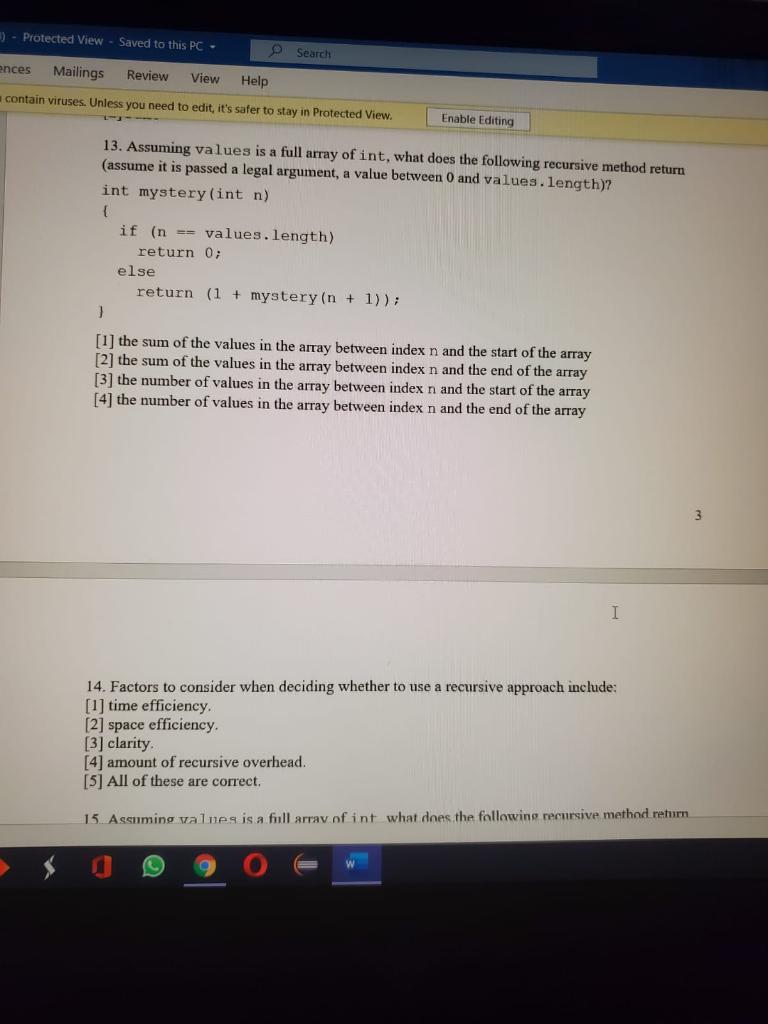
1) - Protected View Saved to this PC - Search ences Mailings Review View Help contain viruses. Unless you need to edit, it's safer to stay in Protected View. Enable Editing 13. Assuming values is a full array of int, what does the following recursive method return (assume it is passed a legal argument, a value between 0 and values.length)? int mystery (int n) { if (n == values.length) return 0; else return (1 + mystery (n + 1)); 1 [1] the sum of the values in the array between index n and the start of the array [2] the sum of the values in the array between index n and the end of the array [3] the number of values in the array between index n and the start of the array [4] the number of values in the array between index n and the end of the array 3 I 14. Factors to consider when deciding whether to use a recursive approach include: [1] time efficiency [2] space efficiency. [3] clarity [4] amount of recursive overhead. [5] All of these are correct 15. Assuming values is a full array of int what does the following recursive method return
Step by Step Solution
There are 3 Steps involved in it

Get step-by-step solutions from verified subject matter experts
 Study Help