Question: 1- Push or pull strategy 2- Continuous or radical 3- Product or process 4- Timing of entry a. Technology b. Competition c. Market (the idea
1- Push or pull strategy
2- Continuous or radical
3- Product or process
4- Timing of entry
a. Technology
b. Competition
c. Market (the idea or the concept)
5- Sources of innovation
a. Internal
b. External
6- If the company wants to do business with another company, what is the best form and why?
a. Strategic alliance (short term)
b. Joint venture (short term)
c. Merger/acquisition (long term)
7- Horizontal / vertical or related/unrelated diversification.
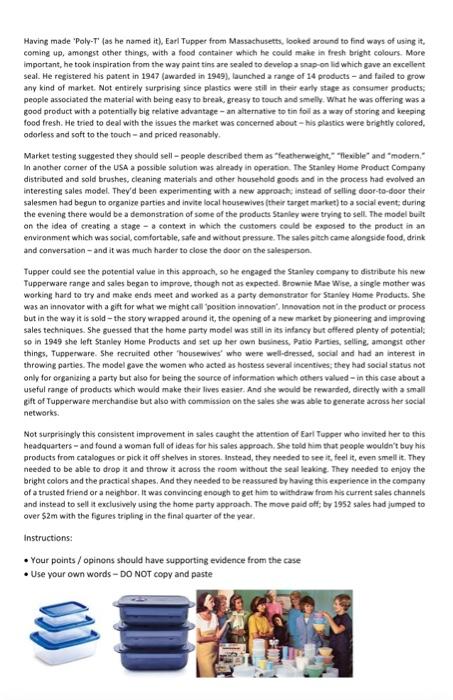
Having made 'Poly-T' (as he named it). Earl Tupper from Massachusetts, looked around to find ways of using it, coming up, amongst other things, with a food container which he could make in fresh bright colours. More important, he took inspiration from the way paint tins are sealed to develop a snap-on lid which gave an excellent seal. He registered his patent in 1947 (awarded in 1949 ). launched a range of 14 products - and failed to grow any kind of market. Not entirely surprising since plastics were stil in their early stage as consumer groducts; people associated the material with being easy to break, greasy to touch and smelly. What he was offering was a good product with a potentially big relative advantage - an alternative to tin foll as a way of storing and heeping food fresh. He tried to deal with the issues the market was concerned about - his plantics were brightly colored. odorless and soft to the touch - and priced reasonably. Market testing suggested they should sell - people described them as "Featherweicht," "Hienble" and "modern." In another corner of the USA a possible solution was already in operation. The Stanley Home Product Company distributed and sold brushes, cleaning materials and other househeld goods and in the process had evolved an interesting sales model. They'd been experimenting with a new approach, instead of selling door-to-doer their salesmen had begun to organise parties and invite local housewives (their target market) to a social event: during the evening there would be a demonstration of some of the products Stanley were trying to sell. The model built on the idea of creating a stage - a context in which the cutomers could be exposed to the product in an environment which was social, comfortable, safe and without pressure. The sales pitch came alongside food, drink and conversation - and it was much harder to close the door on the saleiperson. Tupper could see the potential value in this approach, so he engaged the stanley coengany to distribute his new Tupperware range and sales began to improve, though not as expected. Brownie Mae Wise, a single mother was working hard to try and make ends meet and worked as a party demenstrator for 5tanley Home Preducts. She was an innevator with a gift for what we might call 'position innovation'. Innovation not in the peoduct or process but in the way it is soid - the story wrapped around it, the opening of a new market by pioneering and improwing sales techniques. She guessed that the hame party model was still in its infancy but effered plenty of potential; so in 1949 she left Stanley Home Products and set up her own businesk, Patio Parties, selling, amangst other things, Tupperware. She recruited other 'housewives' who were well-dressed, social and had an interest in throwing parties. The model gave the women who acted as hostess several incentives; they had social status not only for organking a party but also for being the source of information which others valued - in this case about a useful range of products which would make their lives easier. And she would be rewarded, directly with a small gift of Tupperware merchandise but also with commission on the sales she was able to generate across her social networks. Not surprisingly this consistent imprevement in sales caught the attention of Earl Tupper who invited her to this headeuarters - and found a woman full of ideas for his sales approach. She teld him that people wouldn't buy his products from catalogues or pick it off shelves in stores. Instead, they needed to see it, feel it, even smell it. They needed to be able to drop if and throw it across the room without the seal leaking. They needed to enjoy the bright colors and the practical shapes. And they needed to be reassured by having this experience in the company of a trusted friend or a neighbor, It was convincing enough to get him to withdraw from his current sales channels and instead to sell it exclusively using the home party approath. The move paid off, by 1952 sales had jumped to over $2m with the figures tripling in the final quarter of the year. Instructions: - Your points/opinons should have supporting evidence from the case - Use your own words - DO NOT copy and paste









 Study Help