





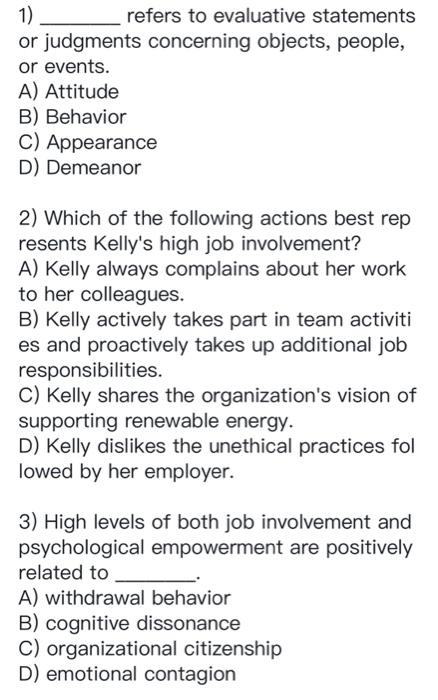
Question: 1) refers to evaluative statements or judgments concerning objects, people, or events. A) Attitude B) Behavior C) Appearance D) Demeanor 2) Which of the following
1) refers to evaluative statements or judgments
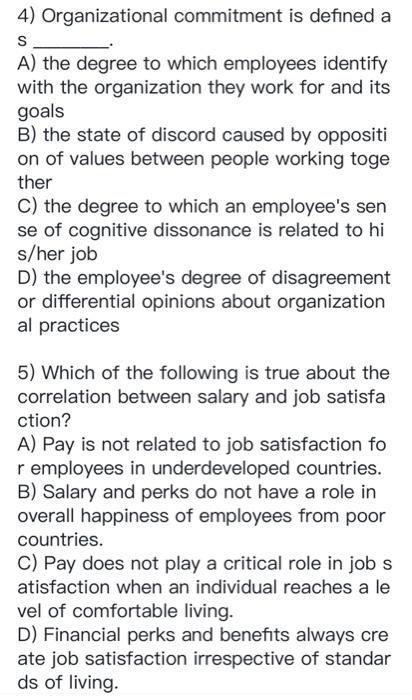
1) refers to evaluative statements or judgments concerning objects, people, or events. A) Attitude B) Behavior C) Appearance D) Demeanor 2) Which of the following actions best rep resents Kelly's high job involvement? A) Kelly always complains about her work to her colleagues. B) Kelly actively takes part in team activiti es and proactively takes up additional job responsibilities. C) Kelly shares the organization's vision of supporting renewable energy. D) Kelly dislikes the unethical practices fol lowed by her employer. 3) High levels of both job involvement and psychological empowerment are positively related to A) withdrawal behavior B) cognitive dissonance C) organizational citizenship D) emotional contagion 4) Organizational commitment is defined a A) the degree to which employees identify with the organization they work for and its goals B) the state of discord caused by oppositi on of values between people working toge ther C) the degree to which an employee's sen se of cognitive dissonance is related to hi s/her job D) the employee's degree of disagreement or differential opinions about organization al practices 5) Which of the following is true about the correlation between salary and job satisfa ction? A) Pay is not related to job satisfaction fo r employees in underdeveloped countries. B) Salary and perks do not have a role in overall happiness of employees from poor countries. C) Pay does not play a critical role in job s atisfaction when an individual reaches a le vel of comfortable living. D) Financial perks and benefits always cre ate job satisfaction irrespective of standar ds of living

Step by Step Solution

There are 3 Steps involved in it

1 Expert Approved Answer
Step: 1 Unlock blur-text-image

Question Has Been Solved by an Expert!

Get step-by-step solutions from verified subject matter experts

Step: 2 Unlock
Step: 3 Unlock

Students Have Also Explored These Related General Management Questions!