







Question: 1. Relative Clause (Defining & Non-defining) Activity 1. Read the rules below. Then underline the relative clauses in the sentences from the listening below. Write
1. Relative Clause (Defining & Non-defining)
Activity 1. Read the rules below. Then underline the relative clauses in the sentences from the listening below. Write the sentences as examples in the correct place in the rules.
Their job is to wash out foreign objects that come into contact with the eye.
In addition, cold air or wind which dry out the eyes, cause the tear glands to produce reflex tears.
Your tear ducts are also connected to your nose, which is why tears sometimes run down into it. Emotional tears help people to establish a bond with people they care for.
defining relative clauses identify a thing, person or place; without this information, the sentence isnt complete or doesnt make sense.
Example: Their job is to wash out foreign objects that come into contact with the eye.
in defining relative clauses where the relative pronoun is the object, the pronoun can be left out
Example: ________________________________________________
non-defining clauses add extra information about a person, place or thing; without this information, the sentence still make sense; the clause is separated from the rest of the sentence by commas; the relative pronoun cannot be left out
Example: ________________________________________________
non-defining clauses can also give a comment on the whole sentence.
Example: ________________________________________________
non-defining clauses are mostly used in formal, written speech
2. Relative Clause (Defining & Non-defining)
Activity 2. Complete the text with relative pronouns where necessary.
Professor Randolph Cornelius, (1) ________ is an expert crying studied tears using an experiment (2) ________ he carried out a Vassar College in the US. He showed participants pictures with people (3) ________ had tears rolling down their face and other pictures in (4) ________ the peoples tears had been deleted. The people with tears were clearly identified as being sad, (5) ________ in itself isnt surprising. But when participants looked at the people (6) ________ tears had been deleted, they often couldnt identify their emotions. The experiment, (7) ________ Cornelius repeated several times with the same results, clearly shows what a powerful signal tears give.
Activity 3. Complete the sentences with your own ideas.
- I often get frustrated by things that ______.
- I get angry with people who _______.
- I love doing activities which _______.
- _______, which makes me feel really sad.
- _______, which usually really cheers me up.
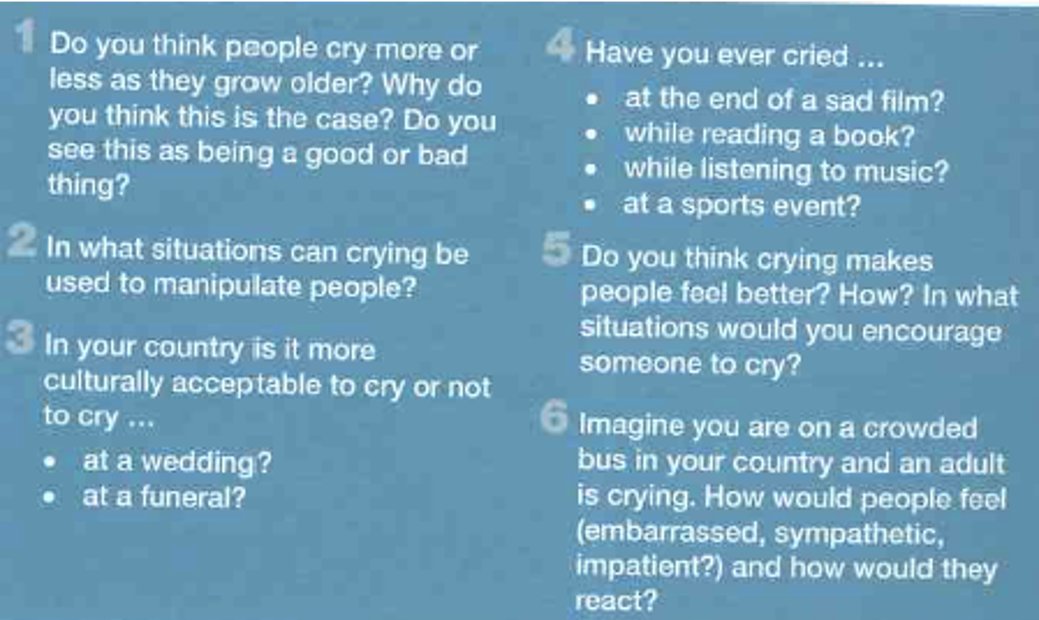
Activity 4. Work in pairs. Ask and answer the questions in the questionnaire. Give your partner examples or further information.
Sense and Sensibility (2)
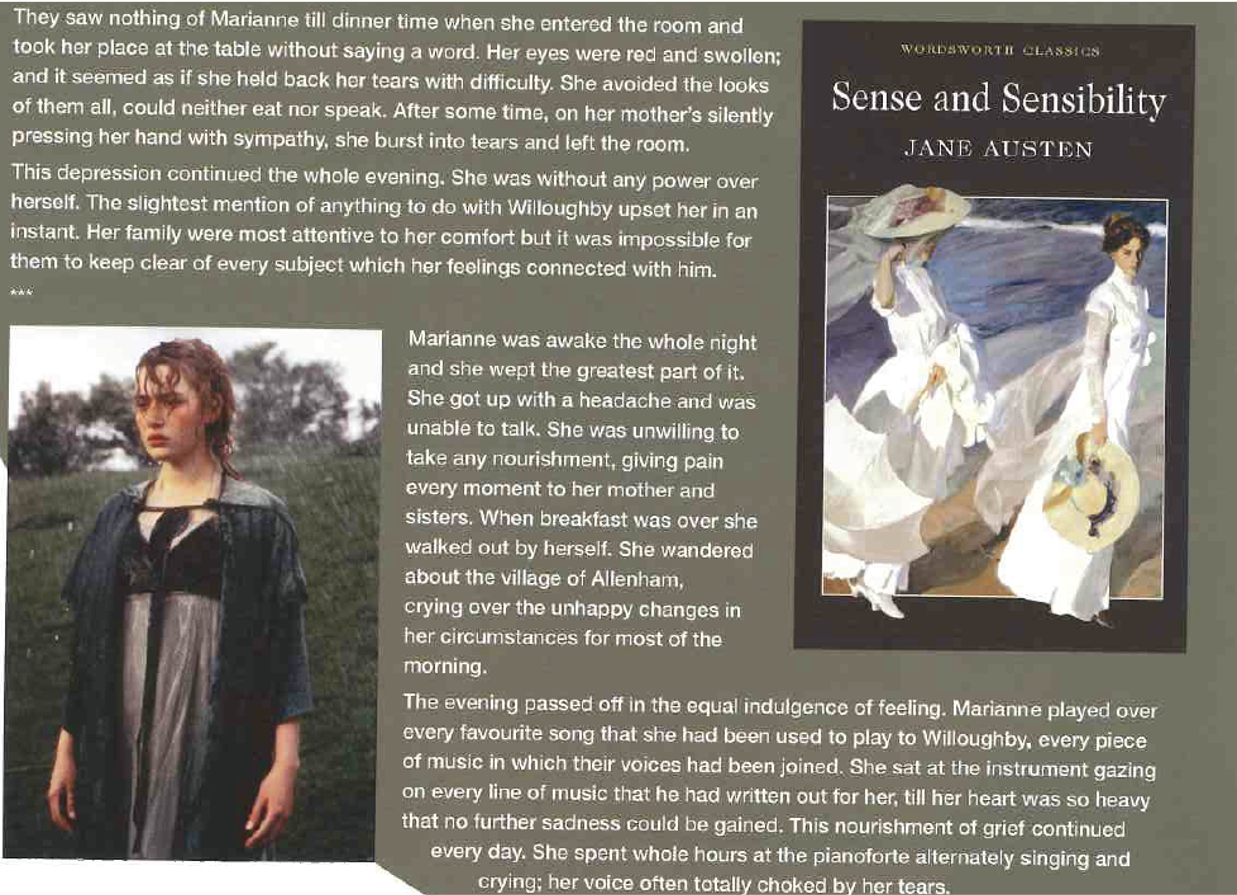
Activity 6. Answer the following questions.
- Why do you think Marianne is sad?
- Who do you think Willoughby might be?
- What activities remind her of him?
Activity 7. Read again. Tick () the ways in which Marianne shows her grief.
___ she doesnt eat
___ she sleeps late
___ she cries
___ she gets angry with her family
___ she doesnt speak
___ she goes riding alone
___ she walks around the village by herself
___ she plays music she played for Willoughby
1 Do you think people cry more or less as they grow older? Why do you think this is the case? Do you see this as being a good or bad thing? In what situations can crying be used to manipulate people? 3 In your country is it more culturally acceptable to cry or not to cry... at a wedding? at a funeral? Have you ever cried ... at the end of a sad film? while reading a book? while listening to music? at a sports event? 5 Do you think crying makes people feel better? How? In what situations would you encourage someone to cry? 6 Imagine you are on a crowded bus in your country and an adult is crying. How would people feel (embarrassed, sympathetic, impatient?) and how would they react? WORDSWORTI CLASSICS Sense and Sensibility They saw nothing of Marianne till dinner time when she entered the room and took her place at the table without saying a word. Her eyes were red and swollen; and it seemed as if she held back her tears with difficulty. She avoided the looks of them all, could neither eat nor speak. After some time, on her mother's silently pressing her hand with sympathy, she burst into tears and left the room. This depression continued the whole evening. She was without any power over herself. The slightest mention of anything to do with Willoughby upset her in an instant. Her family were most attentive to her comfort but it was impossible for them to keep clear of every subject which her feelings connected with him. JANE AUSTEN Marianne was awake the whole night and she wept the greatest part of it. She got up with a headache and was unable to talk. She was unwilling to take any nourishment, giving pain every moment to her mother and sisters. When breakfast was over she walked out by herself. She wandered about the village of Allenham, crying over the unhappy changes in her circumstances for most of the morning. The evening passed off in the equal indulgence of feeling. Marianne played over every favourite song that she had been used to play to Willoughby, every piece of music in which their voices had been joined. She sat at the instrument gazing on every line of music that he had written out for her, till her heart was so heavy that no further sadness could be gained. This nourishment of grief continued every day. She spent whole hours at the pianoforte alternately singing and crying; her voice often totally choked by her tearsStep by Step Solution
There are 3 Steps involved in it

Get step-by-step solutions from verified subject matter experts
 Study Help