







Question: 1. Set-up the social planner's constrained maximization problem. 2. Find the first-order necessary conditions of the social planner's problem. 3. Find the social planner's trade-off
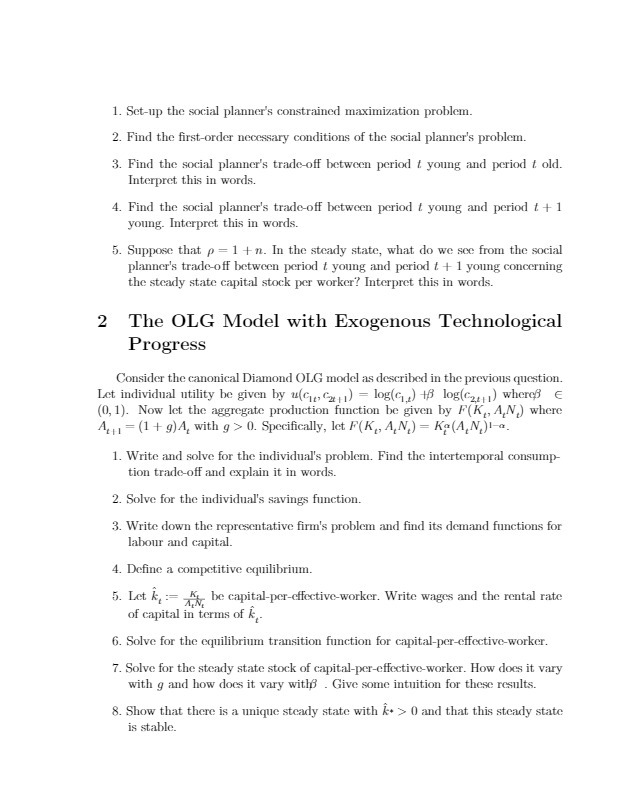
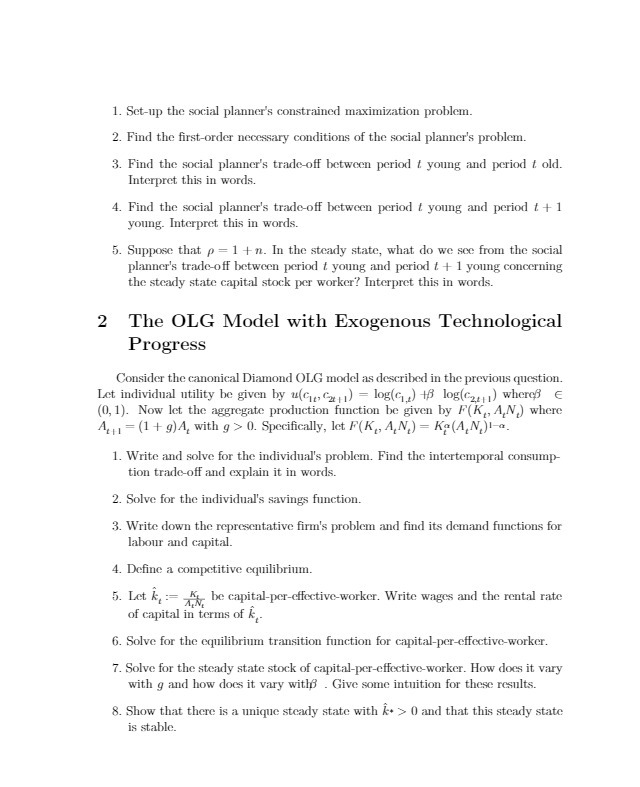
1. Set-up the social planner's constrained maximization problem. 2. Find the first-order necessary conditions of the social planner's problem. 3. Find the social planner's trade-off between period & young and period { old. Interpret this in words. 4. Find the social planner's trade-off between period { young and period { + 1 young. Interpret this in words. 5. Suppose that p = 1 + n. In the steady state, what do we see from the social planner's trade-off between period { young and period { + 1 young concerning the steady state capital stock per worker? Interpret this in words. 2 The OLG Model with Exogenous Technological Progress Consider the canonical Diamond OLG model as described in the previous question. Let individual utility be given by "( ) = log(G) +/ log(cz, ) whereBe (0, 1). Now let the aggregate production function be given by F(K,, AN) where At = (1 + 9)A, with g > 0. Specifically, let F(K,, AN,) = Ka(A, N.)I-a. 1. Write and solve for the individual's problem. Find the intertemporal consump- tion trade-off and explain it in words. 2. Solve for the individual's savings function. 3. Write down the representative firm's problem and find its demand functions for labour and capital. 4. Define a competitive equilibrium. 5. Let k, : - be capital-per-effective-worker. Write wages and the rental rate of capital in terms of k, 6. Solve for the equilibrium transition function for capital-per-effective-worker. 7. Solve for the steady state stock of capital-per-effective-worker. How does it vary with g and how does it vary with . Give some intuition for these results. 8. Show that there is a unique steady state with &. > 0 and that this steady state is stable
Step by Step Solution
There are 3 Steps involved in it

Get step-by-step solutions from verified subject matter experts
 Study Help