



Question: 1 . Suppose there are 1 0 0 0 users, and an attacker has a dictionary of 5 0 0 0 common passwords. An attacker
Suppose there are users, and an attacker has a dictionary of common passwords. An attacker has stolen the database of hashed passwords.
a If the users password in the database were hashed without salt, how many Hash computation does the attacker need to find all users that have the passwords in the dictionary?
b Calculate the number of Hash computations again, now assuming salt is used for the hash.
Show you computation steps and give necessary explanations to get full credit.
In class authentication we explained storing Hashpassword as one way to make the guessing work expensive While doing this indeed slows down the attackers offline password guessing attempt, it also significantly increases the servers effort. Suppose the server still stores Hashpassword but when Alice logs in her client machine first computes Hashpassword and sends that to the server.
a Will there still be the advantage gained by storing Hashpassword
b Will this save the server computation?
To answer both questions, first clearly give a YesNo and then use a few sentences to explain why you make this conclusion.
Consider the following authentication protocol. R is the challenge sent by Bob to Alice, and KAB is the secret Alice and Bob share. Which of the following are secure for a session key? When answering this question, for each option, think about the three aspects:
a Can Trudy impersonate Alice to Bob?
b Can this session key be securely used to encrypt messages exchanged between Alice and Bob?
c If this session key happened to be known by Trudy, can Trudy find KAB?
To get full credit, for the options that are not secure briefly explain why it is not secure you can explain by giving a case where an attacker can compromise the communication.
d KAB XOR R
e KAB R KAB
fRR KAB
g KAB KAB
hR KAB
i KAB R
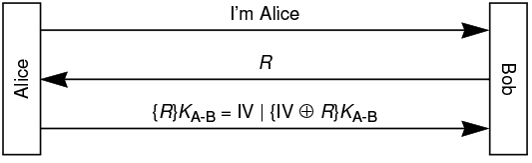
Alice and Bob use the mechanism shown in the following figure for authentication. In specific, after Alice informs Bob she wants to communicate, Bob generates a random number R and sends it back to Alice.
Assume R fits into a single block and Alice encrypts R in CBC mode, so RKAB is computed as IV xor RKAB where IV is Alice created for CBC operation. Alice then sends IV and IV xor RKAB to Bob, as shown in the rd message in the figure.
Suppose Eve sees an exchange between Alice and Bob, where the challenge is R How can Eve then impersonate Alice, during a different conversation where Bob sends a different challenge R
To get full credit, completely describe the content of messages Eve sends to Bob, and at what time. That is you need to describe the message exchange in a timeline.
Step by Step Solution
There are 3 Steps involved in it
1 Expert Approved Answer
Step: 1 Unlock

Question Has Been Solved by an Expert!
Get step-by-step solutions from verified subject matter experts
Step: 2 Unlock
Step: 3 Unlock