


Question: 1. Suppose there are two tellers taking customers in a bank. Service times at a teller are independent, exponentially distributed random variables, but the first
1. Suppose there are two tellers taking customers
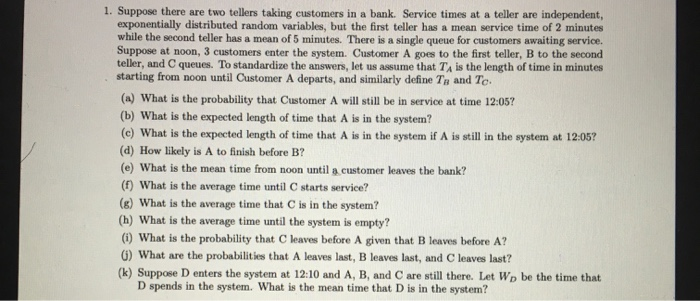
1. Suppose there are two tellers taking customers in a bank. Service times at a teller are independent, exponentially distributed random variables, but the first teller has a mean service time of 2 minutes while the second teller has a mean of 5 minutes. There is a single queue for customers awaiting service. Suppose at noon, 3 customers enter the system. Customer A goes to the first teller, B to the second teller, and C queues. To standardize the answers, let us assume that TA is the length of time in minutes starting from noon until Customer A departs, and similarly define Ta and Tc. (a) What is the probability that Customer A will still be in service at time 12:05? (b) What is the expected length of time that A is in the system? (c) What is the expected length of time that A is in the system if A is still in the system at 12:05? (d) How likely is A to finish before B? (e) What is the mean time from noon until a customer leaves the bank? (1) What is the average time until C starts service? (8) What is the average time that is in the system? (h) What is the average time until the system is empty? (i) What is the probability that leaves before A given that B leaves before A? 6) What are the probabilities that A leaves last, B leaves last, and leaves last? (k) Suppose D enters the system at 12:10 and A, B, and are still there. Let Wo be the time that D spends in the system. What is the mean time that D is in the system

Step by Step Solution

There are 3 Steps involved in it

1 Expert Approved Answer
Step: 1 Unlock blur-text-image

Question Has Been Solved by an Expert!

Get step-by-step solutions from verified subject matter experts

Step: 2 Unlock
Step: 3 Unlock

Students Have Also Explored These Related General Management Questions!