



Question: 1. The one-way independent groups design has one independent variable with 1 level. two independent variables with 1 level each. two independent variables with 3
1.
The one-way independent groups design has
one independent variable with 1 level.
two independent variables with 1 level each.
two independent variables with 3 or more levels each.
one independent variable with 3 or more levels.
2.
Although a two-sample experiment may be appealing, it is often desirable to conduct one-way experiments with more samples. Why?
to determine whether there is a complex relationship between the IV and the DV
to involve the same participants across all conditions
to test the effects of more than one DV in the same study
to save resources by confirming only one hypothesis
3.
One problem with extended research designs is that
they can only be conducted between-subjects, never within-subjects.
they are different enough from two-group studies that the results can't be analyzed with CIs.
they make many comparisons possible and thereby raise the chance that the researcher may "chase noise."
only the NHST approach to analysis can be used.
4.
The analysis of results from the one-way independent groups design involves the calculation ofsp, which is
the MoE with the largest likely error.
the pooled standard deviation, which is the variation across all the groups, balanced by sample size.
the sample-size component, which is based on the total sample size.
the s multiplier, which is necessary because of the use of multiple groups that may have different Ns.
5.
Calculating CIs for the one-way independent groups design requires which of the following assumptions?
The MoEs be greater than 1.0.
At least two of the groups have similar variation.
Each sample is drawn from a normally distributed population.
The data from at least one group comes from a random sample.
6.
For a study with four groups, how manyindependentresearch questions can be asked? (Hint: This is the same as the maximum number of planned research questions recommended in your book.)
two, because there are only two possible independent pairs of groups
sixteen, which is 42
five?one for each group plus another for all groups
three, which is the df (a fourth research would not be independent)
7.
The NHST approach to the one-way independent groups design is the
chi-square.
Ho.
ANOVA, the analysis of variance.
ttest.
8.
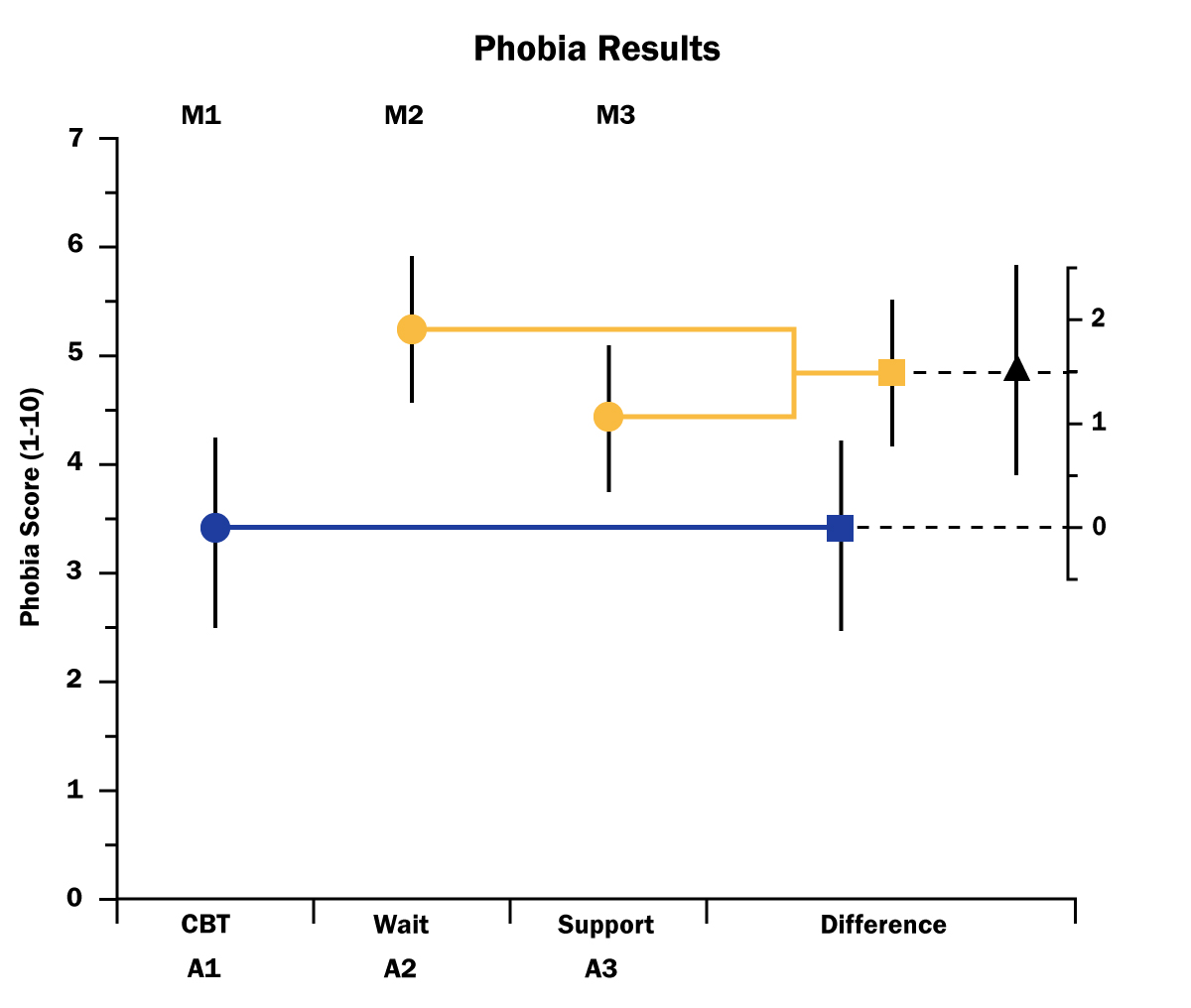
To what extent does cognitive behavioral therapy help reduce phobic behavior? To find out, researchers assigned participants to either cognitive-behavioral therapy (CBT), a wait-list control (Wait), or a support-group control (Support). After therapy, participants completed a phobia scale (1-10, the higher the score, more intense the symptoms). This figure shows the results.
\f
Step by Step Solution
There are 3 Steps involved in it

Get step-by-step solutions from verified subject matter experts