







Question: 1. This problem uses the HeckscherOhlin model to predict the direction of trade. Consider the production of handmade rugs and assembly line robots in Canada
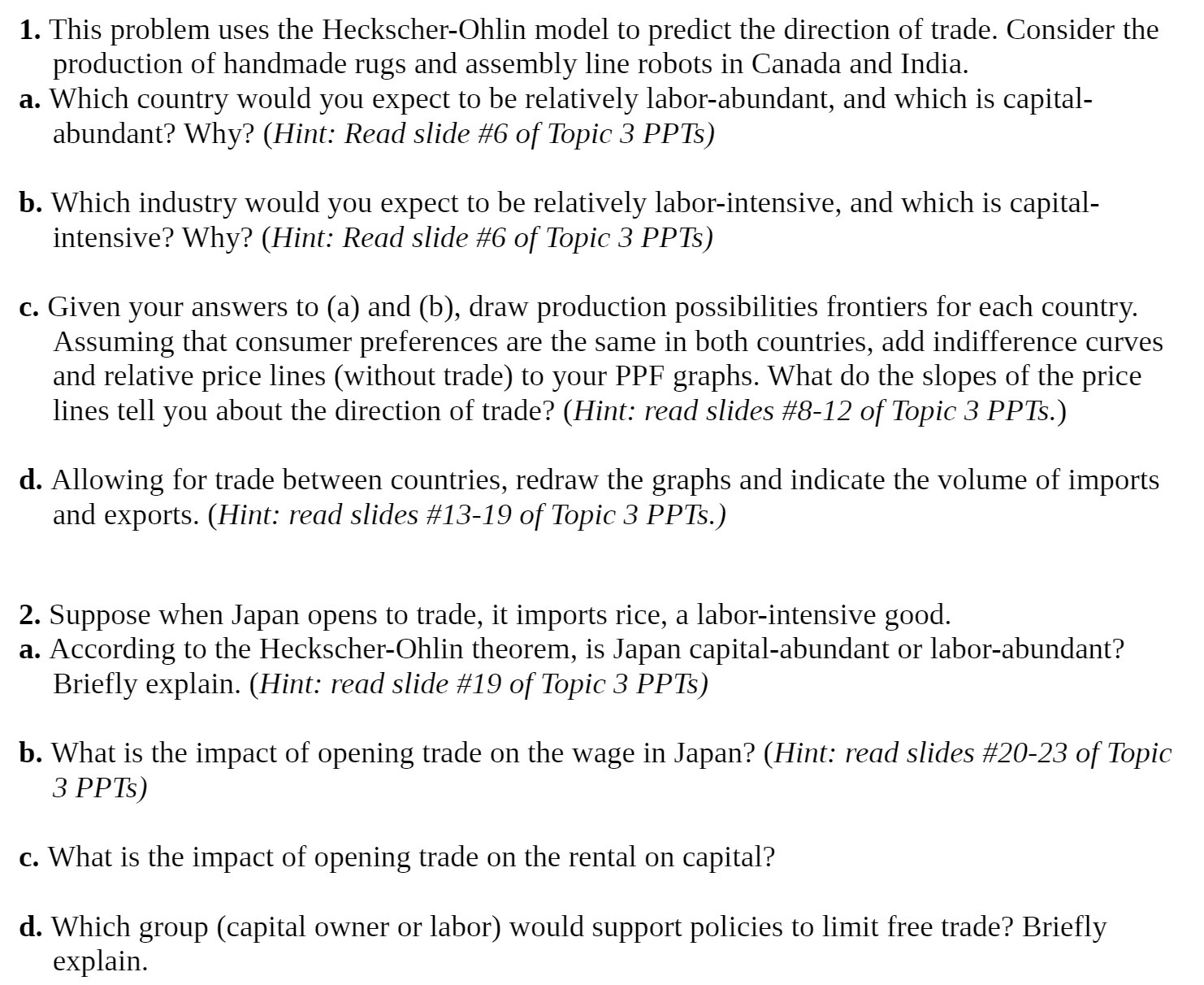
1. This problem uses the HeckscherOhlin model to predict the direction of trade. Consider the production of handmade rugs and assembly line robots in Canada and India. a. Which country would you expect to be relatively labor-abundant, and which is capital- abundant? Why? (Hint: Read slide #6 of Topic 3 PPTs) b. Which industry would you expect to be relatively labor-intensive, and which is capital- intensive? Why? (Hint: Read slide #6 of Topic 3 PPTS) c. Given your answers to (a) and (b), draw production possibilities frontiers for each country. Assuming that consumer preferences are the same in both countries, add indifference curves and relative price lines (without trade) to your PPF graphs. What do the slopes of the price lines tell you about the direction of trade? (Hint: read slides #812 of Topic 3 PPTs.) d. Allowing for trade between countries, redraw the graphs and indicate the volume of imports and exports. (Hint: read slides #1319 of Topic 3 PPTs.) 2. Suppose when Japan opens to trade, it imports rice, a labor-intensive good. a. According to the HeckscherOhlin theorem, is Japan capital-abundant or laborabundant? Briefly explain. (Hint: read slide #19 of Topic 3 PPTs) b. What is the impact of opening trade on the wage in Japan? (Hint: read slides #2023 of Topic 3 PPTS) c. What is the impact of opening trade on the rental on capital? (1. Which group (capital owner or labor) would support policies to limit free trade? Briefly explain
Step by Step Solution
There are 3 Steps involved in it

Get step-by-step solutions from verified subject matter experts
 Study Help