







Question: 1. Using Public Finance, I Textbook. Answer, Chapter 5: Q.3, Q.6 3. In the gure here. the number of parties that Cassandra gives per month
1. Using Public Finance, I Textbook. Answer, Chapter 5: Q.3, Q.6
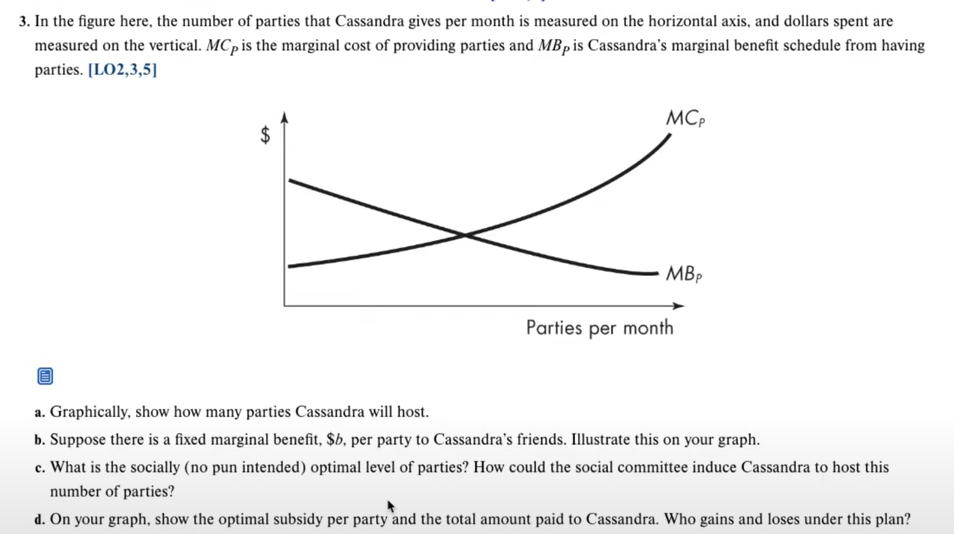

3. In the gure here. the number of parties that Cassandra gives per month is measured on the horizontal axis. and dollars spent are measured on the vertical. MG, is the marginal cost of providing parties and M3,; is Cassandra's marginal benet schedule from having parties. [L02,3.5| MCP M3,: Porties per month a. Graphically. show how many parties Cassandra will host. It. Suppose there is a xed marginal benet. $6. per party to Cassandra's friends. Illustrate this on your graph. c. What is the socially (no pun intended) optimal level of parties? How could the social committee induce Cassandra to host this numb-er of parties? It it. On your graph. show the optimal subsidy per party and the total amount paid to Cassandra. Who gains and loses under this plan? 6. The private marginal benefit for commodity X is given by 10 - X, where X is the number of units consumed. The private marginal cost of producing X is constant at $5. For each unit of X produced, an external cost of $2 is imposed on members of society. In the absence of any government intervention, how much X is produced? What is the efficient level of production of X? What is the gain to society involved in moving from the inefficient to the efficient level of production? Suggest a Pigouvian tax that would lead to the efficient level. How much revenue would the tax raise? [LO2,4]
Step by Step Solution
There are 3 Steps involved in it

Get step-by-step solutions from verified subject matter experts
 Study Help