


Question: 1. When a fixed-price contract or a cost-plus-fee arrangement with a guaranteed maximum is adopted, the assumes most of the financial risk associated with the
1. When a fixed-price contract or a cost-plus-fee

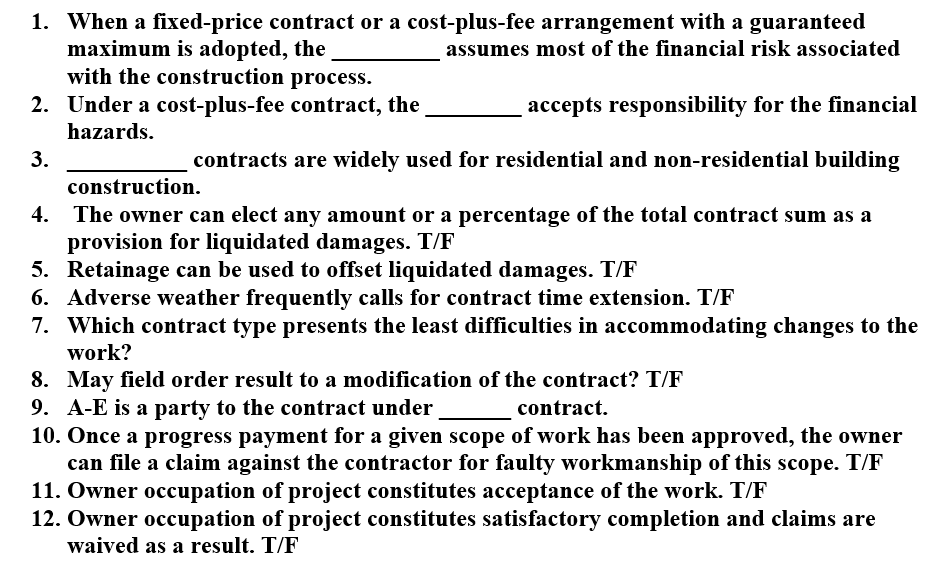
1. When a fixed-price contract or a cost-plus-fee arrangement with a guaranteed maximum is adopted, the assumes most of the financial risk associated with the construction process. 2. Under a cost-plus-fee contract, the accepts responsibility for the financial hazards. 3. contracts are widely used for residential and non-residential building construction. 4. The owner can elect any amount or a percentage of the total contract sum as a provision for liquidated damages. T/F 5. Retainage can be used to offset liquidated damages. T/F 6. Adverse weather frequently calls for contract time extension. T/F 7. Which contract type presents the least difficulties in accommodating changes to the work? 8. May field order result to a modification of the contract? T/F 9. A-E is a party to the contract under contract. 10. Once a progress payment for a given scope of work has been approved, the owner can file a claim against the contractor for faulty workmanship of this scope. T/F 11. Owner occupation of project constitutes acceptance of the work. T/F 12. Owner occupation of project constitutes satisfactory completion and claims are waived as a result. T/F

Step by Step Solution

There are 3 Steps involved in it

1 Expert Approved Answer
Step: 1 Unlock blur-text-image

Question Has Been Solved by an Expert!

Get step-by-step solutions from verified subject matter experts

Step: 2 Unlock
Step: 3 Unlock

Students Have Also Explored These Related General Management Questions!