



Question: 1. When doing business around the world, is it generally better to emphasise normativism or relativism? Justify your answer. CLOSING CASE Bribery and Corruption at
1. When doing business around the world, is it generally better to emphasise normativism or relativism? Justify your answer.
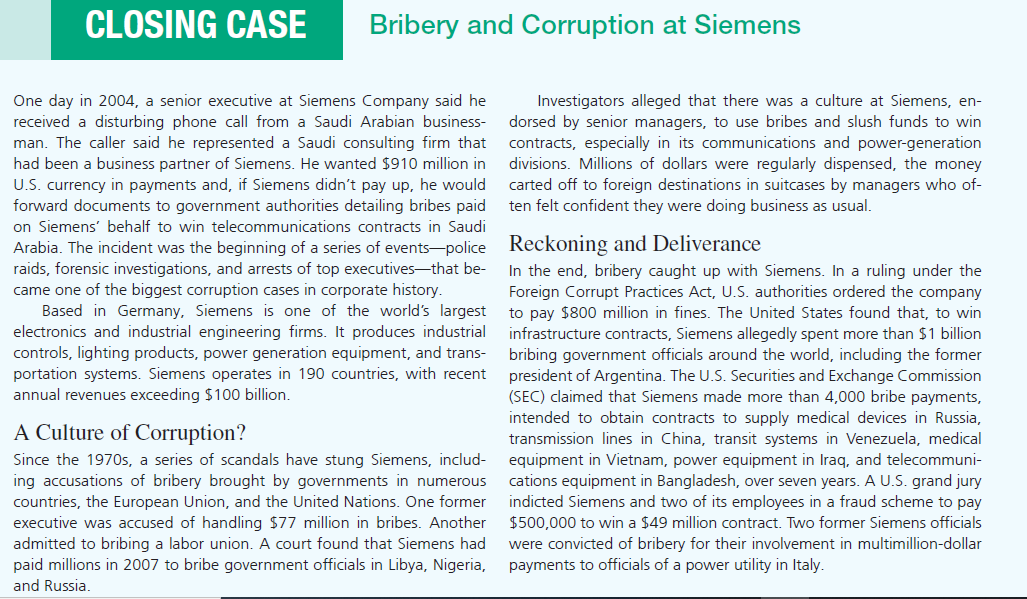
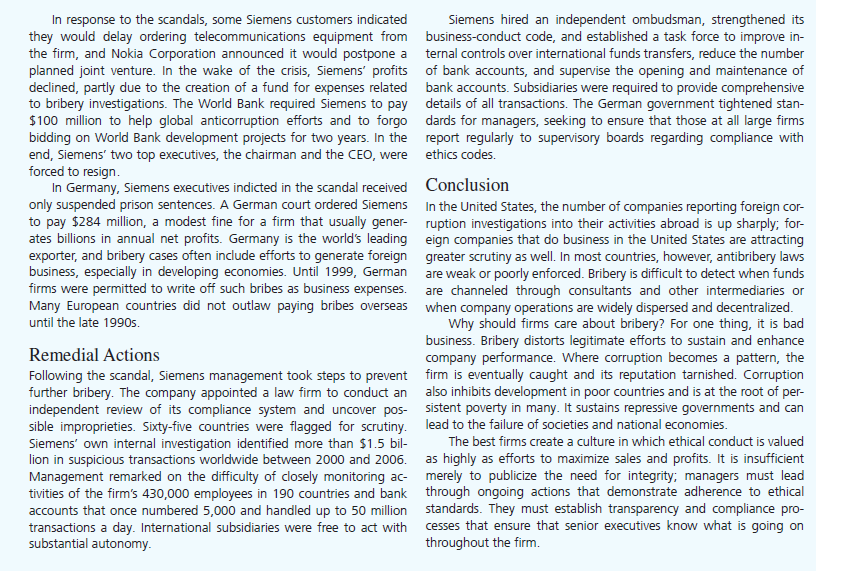
CLOSING CASE Bribery and Corruption at Siemens One day in 2004, a senior executive at Siemens Company said he Investigators alleged that there was a culture at Siemens, en- received a disturbing phone call from a Saudi Arabian business dorsed by senior managers, to use bribes and slush funds to win man. The caller said he represented a Saudi consulting firm that contracts, especially in its communications and power-generation had been a business partner of Siemens. He wanted $910 million in divisions. Millions of dollars were regularly dispensed, the money U.S. currency in payments and, if Siemens didn't pay up, he would carted off to foreign destinations in suitcases by managers who of- forward documents to government authorities detailing bribes paid ten felt confident they were doing business as usual. on Siemens' behalf to win telecommunications contracts in Saudi Arabia. The incident was the beginning of a series of events-police Reckoning and Deliverance raids, forensic investigations, and arrests of top executivesthat be In the end, bribery caught up with Siemens. In a ruling under the came one of the biggest corruption cases in corporate history. Foreign Corrupt Practices Act, U.S. authorities ordered the company Based in Germany, Siemens is one of the world's largest to pay $800 million in fines. The United States found that, to win electronics and industrial engineering firms. It produces industrial infrastructure contracts, Siemens allegedly spent more than $1 billion controls, lighting products, power generation equipment, and trans bribing government officials around the world, including the former portation systems. Siemens operates in 190 countries, with recent president of Argentina. The U.S. Securities and Exchange Commission annual revenues exceeding $100 billion. (SEC) claimed that Siemens made more than 4,000 bribe payments, intended to obtain contracts to supply medical devices in Russia, A Culture of Corruption? transmission lines in China, transit systems in Venezuela, medical Since the 1970s, a series of scandals have stung Siemens, includ equipment in Vietnam, power equipment in Iraq, and telecommuni- ing accusations of bribery brought by governments in numerous cations equipment in Bangladesh, over seven years. A U.S. grand jury countries, the European Union, and the United Nations. One former indicted Siemens and two of its employees in a fraud scheme to pay executive was accused of handling $77 million in bribes. Another $500,000 to win a $49 million contract. Two former Siemens officials admitted to bribing a labor union. A court found that Siemens had were convicted of bribery for their involvement in multimillion-dollar paid millions in 2007 to bribe government officials in Libya, Nigeria, payments to officials of a power utility in Italy. and Russia. In response to the scandals, some Siemens customers indicated Siemens hired an independent ombudsman, strengthened its they would delay ordering telecommunications equipment from business-conduct code, and established a task force to improve in- the firm, and Nokia Corporation announced it would postpone a ternal controls over international funds transfers, reduce the number planned joint venture. In the wake of the crisis, Siemens' profits of bank accounts, and supervise the opening and maintenance of declined, partly due to the creation of a fund for expenses related bank accounts. Subsidiaries were required to provide comprehensive to bribery investigations. The World Bank required Siemens to pay details of all transactions. The German government tightened stan- $100 million to help global anticorruption efforts and to forgo dards for managers, seeking to ensure that those at all large firms bidding on World Bank development projects for two years. In the report regularly to supervisory boards regarding compliance with end, Siemens' two top executives, the chairman and the CEO, were ethics codes. forced to resign. In Germany, Siemens executives indicted in the scandal received Conclusion only suspended prison sentences. A German court ordered Siemens in the United States, the number of companies reporting foreign cor- to pay $284 million, a modest fine for a firm that usually gener- ruption investigations into their activities abroad is up sharply, for- ates billions in annual net profits. Germany is the world's leading eign companies that do business in the United States are attracting exporter, and bribery cases often include efforts to generate foreign greater scrutiny as well. In most countries, however, antibribery laws business, especially in developing economies. Until 1999, German are weak or poorly enforced. Bribery is difficult to detect when funds firms were permitted to write off such bribes as business expenses. are channeled through consultants and other intermediaries or Many European countries did not outlaw paying bribes overseas when company operations are widely dispersed and decentralized. until the late 1990s. Why should firms care about bribery? For one thing, it is bad business. Bribery distorts legitimate efforts to sustain and enhance Remedial Actions company performance. Where corruption becomes a pattern, the Following the scandal, Siemens management took steps to prevent firm is eventually caught and its reputation tarnished. Corruption further bribery. The company appointed a law firm to conduct an also inhibits development in poor countries and is at the root of per- independent review of its compliance system and uncover pos- sistent poverty in many. It sustains repressive governments and can sible improprieties. Sixty-five countries were flagged for scrutiny lead to the failure of societies and national economies. Siemens' own internal investigation identified more than $1.5 bil The best firms create a culture in which ethical conduct is valued lion in suspicious transactions worldwide between 2000 and 2006. as highly as efforts to maximize sales and profits. It is insufficient Management remarked on the difficulty of closely monitoring ac merely to publicize the need for integrity; managers must lead tivities of the firm's 430,000 employees in 190 countries and bank through ongoing actions that demonstrate adherence to ethical accounts that once numbered 5,000 and handled up to 50 million standards. They must establish transparency and compliance pro- transactions a day. International subsidiaries were free to act with cesses that ensure that senior executives know what is going on substantial autonomy throughout the firm
Step by Step Solution
There are 3 Steps involved in it
1 Expert Approved Answer
Step: 1 Unlock

Question Has Been Solved by an Expert!
Get step-by-step solutions from verified subject matter experts
Step: 2 Unlock
Step: 3 Unlock