







Question: 1. Which type of variation occurs when a process is in control? (a) random (b) attribute (c) normal (d) sampling (e) assignable 2. Which term
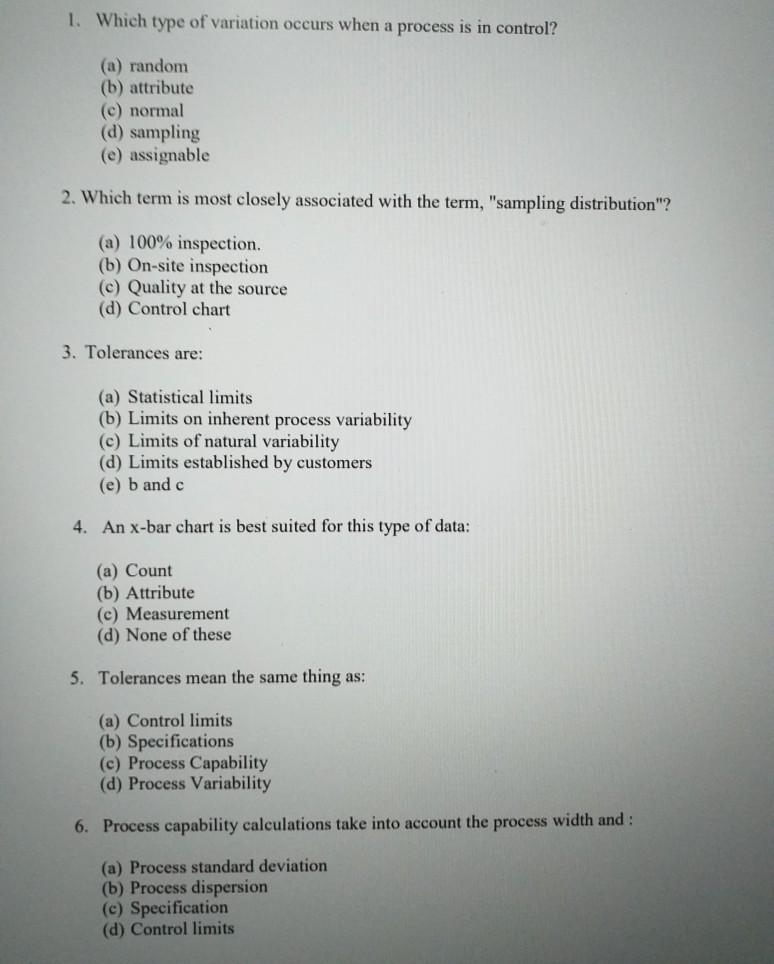
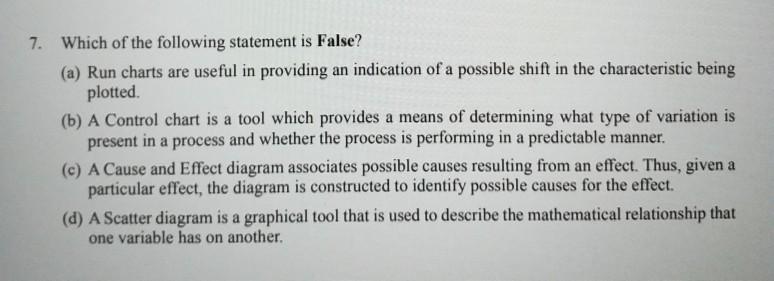
1. Which type of variation occurs when a process is in control? (a) random (b) attribute (c) normal (d) sampling (e) assignable 2. Which term is most closely associated with the term, "sampling distribution"? (a) 100% inspection. (b) On-site inspection (c) Quality at the source (d) Control chart 3. Tolerances are: (a) Statistical limits (b) Limits on inherent process variability (c) Limits of natural variability (d) Limits established by customers (e) b and c 4. An x-bar chart is best suited for this type of data: (a) Count (b) Attribute (c) Measurement (d) None of these 5. Tolerances mean the same thing as: (a) Control limits (b) Specifications (c) Process Capability (d) Process Variability 6. Process capability calculations take into account the process width and : (a) Process standard deviation (b) Process dispersion (c) Specification (d) Control limits 7. Which of the following statement is False? (a) Run charts are useful in providing an indication of a possible shift in the characteristic being plotted. (b) A Control chart is a tool which provides a means of determining what type of variation is present in a process and whether the process is performing in a predictable manner. (c) A Cause and Effect diagram associates possible causes resulting from an effect. Thus, given a particular effect, the diagram is constructed to identify possible causes for the effect. (d) A Scatter diagram is a graphical tool that is used to describe the mathematical relationship that one variable has on another
Step by Step Solution
There are 3 Steps involved in it
1 Expert Approved Answer
Step: 1 Unlock

Question Has Been Solved by an Expert!
Get step-by-step solutions from verified subject matter experts
Step: 2 Unlock
Step: 3 Unlock
 Study Help