







Question: 1- Would you evaluate the training program? What levels should be in focus? CASE STUDY 9 High E Heating & Air Systems Ron Johnson is

1- Would you evaluate the training program? What levels should be in focus?
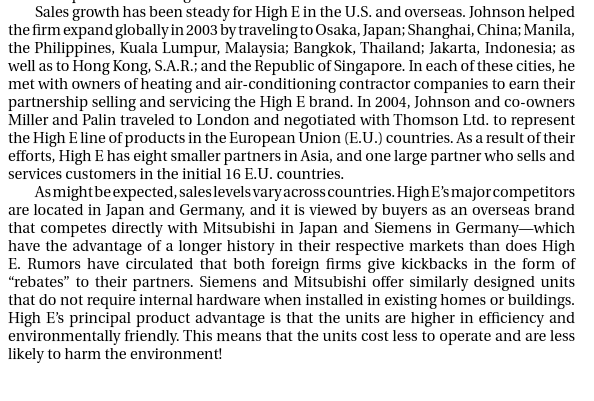
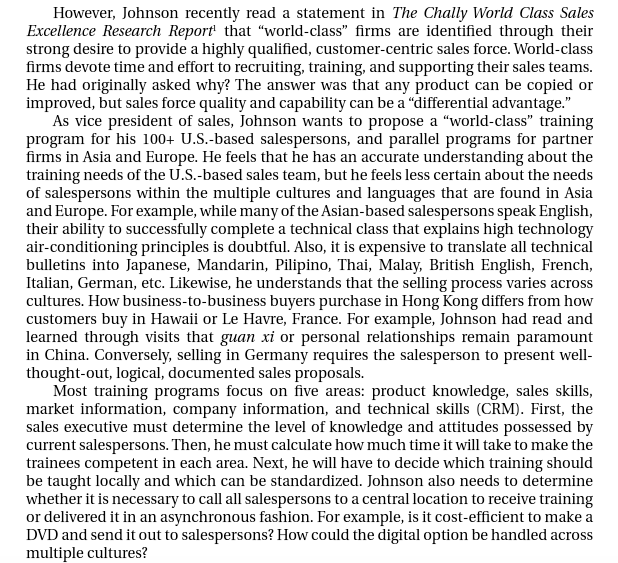
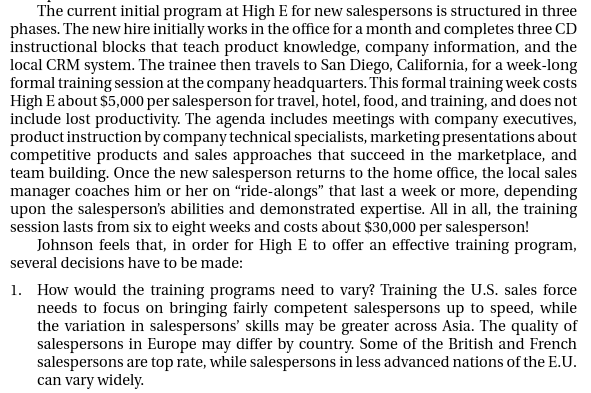
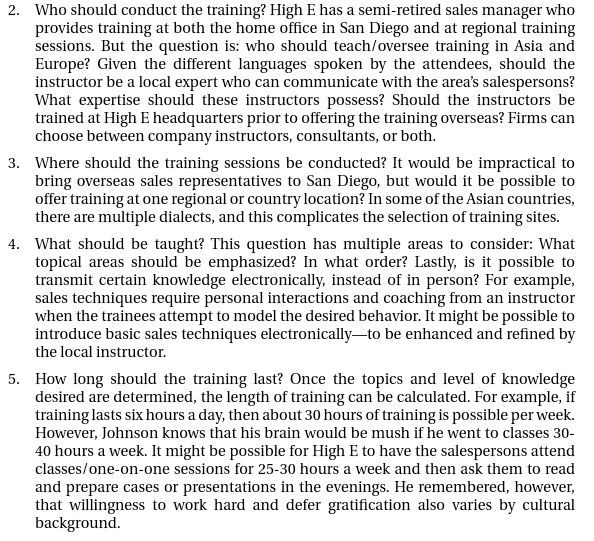
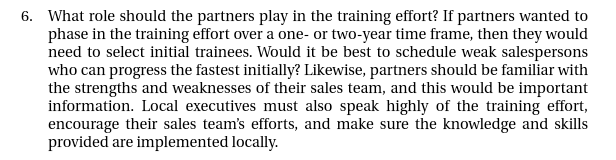
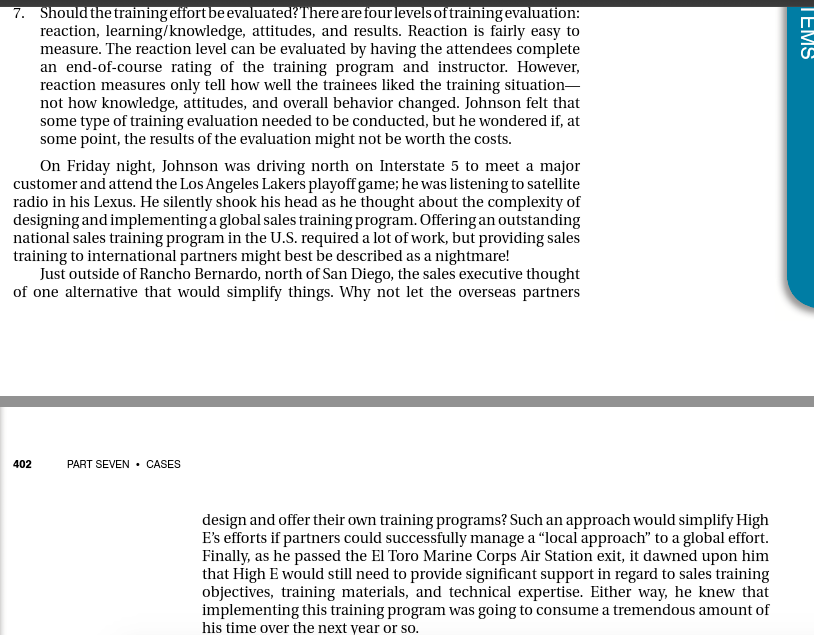
CASE STUDY 9 High E Heating & Air Systems Ron Johnson is vice president of sales For High E Heating & Air Systems, headquartered in San Diego, California. When Johnson joined High E as a territory salesperson in 1995, he was one of only 10 salespersons. As of January 1 this year, High E employed more than 105 salespersons in the United States, and had partnered with firms that employed more than 200 heating, ventilation, and air conditioning salespersons in Europe and Asia. He had earned a Bachelor's degree in marketing from San Diego State University, and then spent six years as a U.S. Naval officer who managed the installation and maintenance of heating and air conditioning systemson ships and ashore. The myriad experiences he gained at sea and on bases in California, Hawaii, and the Philippines provided a solid technical knowledge of heating and air conditioning systems. Between 1998 and 2001, Johnson earned an M.B.A. in international marketing from Chapman University in Orange, California. He even completed an independent study course on cross-cultural marketing taught by a professor who specialized in this area. High E specializes in high-efficiency heating and air conditioning systems that are easy to install and do not employ chemicals or substances that are harmful to the environment. This innovative marketing strategy was conceived by the engineer- owners, Jim Miller and Gary Palin, when they founded the company in 1986. High E's focus on environmentally friendly refrigerants was years ahead of the requirements set by the Environmental Protection Agency (EPA); the company gained a slow, but steady customer base in Southern California, and then expanded nation-wide. High E designs and builds heating and air conditioning units that can be added to existing buildings by running small tubes from an outside condenser through the walls to a blower unit mounted high on a wall. The High E air conditioning unit's temperature and fan speeds are controllable by a handheld device. These units have become extremely popular for updating older homes and condominium units in Hawaii, Arizona, Texas, and Florida, since there is no need for internal ductwork that would require demolishing walls and floors. Sales growth has been steady for High E in the U.S. and overseas. Johnson helped the firm expand globally in 2003 by traveling to Osaka, Japan; Shanghai, China; Manila, the Philippines, Kuala Lumpur, Malaysia; Bangkok, Thailand; Jakarta, Indonesia; as well as to Hong Kong, S.A.R.; and the Republic of Singapore. In each of these cities, he met with owners of heating and air-conditioning contractor companies to earn their partnership selling and servicing the High E brand. In 2004, Johnson and co-owners Miller and Palin traveled to London and negotiated with Thomson Ltd. to represent the High E line of products in the European Union (E.U.) countries. As a result of their efforts, High E has eight smaller partners in Asia, and one large partner who sells and services customers in the initial 16 E.U. countries. As might be expected, sales levels vary across countries. High E's major competitors are located in Japan and Germany, and it is viewed by buyers as an overseas brand that competes directly with Mitsubishi in Japan and Siemens in Germanywhich have the advantage of a longer history in their respective markets than does High E. Rumors have circulated that both foreign firms give kickbacks in the form of "rebates" to their partners. Siemens and Mitsubishi Offer similarly designed units that do not require internal hardware when installed in existing homes or buildings. High E's principal product advantage is that the units are higher in efficiency and environmentally friendly. This means that the units cost less to operate and are less likely to harm the environment! However, Johnson recently read a statement in The Chally World Class Sales Excellence Research Report that "world-class firms are identified through their strong desire to provide a highly qualified, customer-centric sales force. World-class firms devote time and effort to recruiting, training, and supporting their sales teams. He had originally asked why? The answer was that any product can be copied or improved, but sales force quality and capability can be a "differential advantage." As vice president of sales, Johnson wants to propose a "world-class" training program for his 100+ U.S.-based salespersons, and parallel programs for partner firms in Asia and Europe. He feels that he has an accurate understanding about the training needs of the U.S.-based sales team, but he feels less certain about the needs of salespersons within the multiple cultures and languages that are found in Asia and Europe. For example, while many of the Asian-based salespersons speak English, their ability to successfully complete a technical class that explains high technology air-conditioning principles is doubtful. Also, it is expensive to translate all technical bulletins into Japanese, Mandarin, Pilipino, Thai, Malay, British English, French, Italian, German, etc. Likewise, he understands that the selling process varies across cultures. How business-to-business buyers purchase in Hong Kong differs from how customers buy in Hawaii or Le Havre, France. For example, Johnson had read and learned through visits that guan xi or personal relationships remain paramount in China. Conversely, selling in Germany requires the salesperson to present well- thought-out, logical, documented sales proposals. Most training programs focus on five areas: product knowledge, sales skills, market information, company information, and technical skills (CRM). First, the sales executive must determine the level of knowledge and attitudes possessed by current salespersons. Then, he must calculate how much time it will take to make the trainees competent in each area. Next, he will have to decide which training should be taught locally and which can be standardized. Johnson also needs to determine whether it is necessary to call all salespersons to a central location to receive training or delivered it in an asynchronous fashion. For example, is it cost-efficient to make a DVD and send it out to salespersons? How could the digital option be handled across multiple cultures? The current initial program at High E for new salespersons is structured in three phases. The new hire initially works in the office for a month and completes three CD instructional blocks that teach product knowledge, company information, and the local CRM system. The trainee then travels to San Diego, California, for a week-long formal training session at the company headquarters. This formal training week costs High E about $5,000 per salesperson for travel, hotel, food, and training, and does not include lost productivity. The agenda includes meetings with company executives, product instruction by company technical specialists, marketing presentations about competitive products and sales approaches that succeed in the marketplace, and team building. Once the new salesperson returns to the home office, the local sales manager coaches him or her on ride-alongs" that last a week or more, depending upon the salesperson's abilities and demonstrated expertise. All in all, the training session lasts from six to eight weeks and costs about $30,000 per salesperson! Johnson feels that, in order for High E to offer an effective training program, several decisions have to be made: 1. How would the training programs need to vary? Training the U.S. sales force needs to focus on bringing fairly competent salespersons up to speed, while the variation in salespersons' skills may be greater across Asia. The quality of salespersons in Europe may differ by country. Some of the British and French salespersons are top rate, while salespersons in less advanced nations of the E.U. can vary widely. 2. Who should conduct the training? High E has a semi-retired sales manager who provides training at both the home office in San Diego and at regional training sessions. But the question is: who should teach/oversee training in Asia and Europe? Given the different languages spoken by the attendees, should the instructor be a local expert who can communicate with the area's salespersons? What expertise should these instructors possess? Should the instructors be trained at High E headquarters prior to offering the training overseas? Firms can choose between company instructors, consultants, or both. 3. Where should the training sessions be conducted? It would be impractical to bring overseas sales representatives to San Diego, but would it be possible to offer training at one regional or country location? In some of the Asian countries, there are multiple dialects, and this complicates the selection of training sites. 4. What should be taught? This question has multiple areas to consider: What topical areas should be emphasized? In what order? Lastly, is it possible to transmit certain knowledge electronically, instead of in person? For example, sales techniques require personal interactions and coaching from an instructor when the trainees attempt to model the desired behavior. It might be possible to introduce basic sales techniques electronicallyto be enhanced and refined by the local instructor. 5. How long should the training last? Once the topics and level of knowledge desired are determined, the length of training can be calculated. For example, if training lasts six hours a day, then about 30 hours of training is possible per week. However, Johnson knows that his brain would be mush if he went to classes 30- 40 hours a week. It might be possible for High E to have the salespersons attend classes/one-on-one sessions for 25-30 hours a week and then ask them to read and prepare cases or presentations in the evenings. He remembered, however, that willingness to work hard and defer gratification also varies by cultural background. 6. What role should the partners play in the training effort? If partners wanted to phase in the training effort over a one-or two-year time frame, then they would need to select initial trainees. Would it be best to schedule weak salespersons who can progress the fastest initially? Likewise, partners should be familiar with the strengths and weaknesses of their sales team, and this would be important information. Local executives must also speak highly of the training effort, encourage their sales team's efforts, and make sure the knowledge and skills provided are implemented locally. TEMS 7. Should the training effort be evaluated? There are four levels of training evaluation: reaction, learning/knowledge, attitudes, and results. Reaction is fairly easy to measure. The reaction level can be evaluated by having the attendees complete an end-of-course rating of the training program and instructor. However, reaction measures only tell how well the trainees liked the training situation, not how knowledge, attitudes, and overall behavior changed. Johnson felt that some type of training evaluation needed to be conducted, but he wondered if, at some point, the results of the evaluation might not be worth the costs. On Friday night, Johnson was driving north on Interstate 5 to meet a major customer and attend the Los Angeles Lakers playoff game; he was listening to satellite radio in his Lexus. He silently shook his head as he thought about the complexity of designing and implementing a global sales training program. Offering an outstanding national sales training program in the U.S. required a lot of work, but providing sales training to international partners might best be described as a nightmare! Just outside of Rancho Bernardo, north of San Diego, the sales executive thought of one alternative that would simplify things. Why not let the overseas partners 402 PART SEVEN CASES design and offer their own training programs? Such an approach would simplify High E's efforts if partners could successfully manage a "local approach" to a global effort. Finally, as he passed the El Toro Marine Corps Air Station exit, it dawned upon him that High E would still need to provide significant support in regard to sales training objectives, training materials, and technical expertise. Either way, he knew that implementing this training program was going to consume a tremendous amount of his time over the next year or so
Step by Step Solution
There are 3 Steps involved in it
1 Expert Approved Answer
Step: 1 Unlock

Question Has Been Solved by an Expert!
Get step-by-step solutions from verified subject matter experts
Step: 2 Unlock
Step: 3 Unlock
 Study Help