







Question: 1. Write a Newton-Raphson root solver 2. Write a bi-section root solver 3. Write a secant method root-solver 4. Demonstrate their effectiveness on the
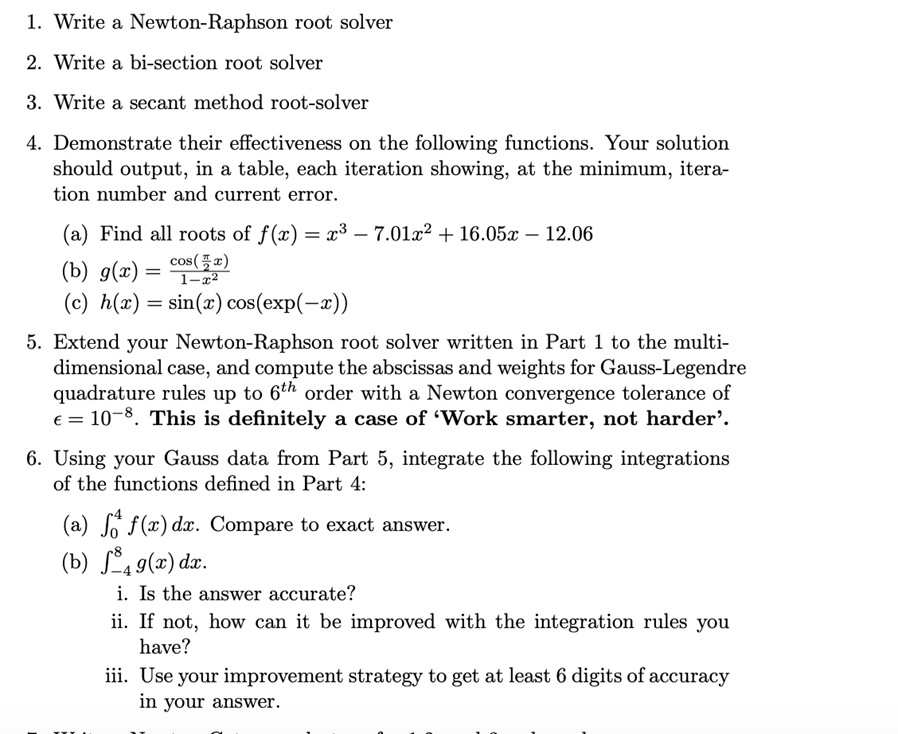
1. Write a Newton-Raphson root solver 2. Write a bi-section root solver 3. Write a secant method root-solver 4. Demonstrate their effectiveness on the following functions. Your solution should output, in a table, each iteration showing, at the minimum, itera- tion number and current error. (a) Find all roots of f(x) = x - 7.01x + 16.05x - 12.06 cos(x) 1-x (c) h(x) = sin(x) cos(exp(-x)) (b) g(x) = = 5. Extend your Newton-Raphson root solver written in Part 1 to the multi- dimensional case, and compute the abscissas and weights for Gauss-Legendre quadrature rules up to 6th order with a Newton convergence tolerance of = 10-8. This is definitely a case of 'Work smarter, not harder'. 6. Using your Gauss data from Part 5, integrate the following integrations of the functions defined in Part 4: (a) (b) f(x) dx. Compare to exact answer. g(x) dx. i. Is the answer accurate? ii. If not, how can it be improved with the integration rules you have? iii. Use your improvement strategy to get at least 6 digits of accuracy in your answer.
Step by Step Solution
3.43 Rating (153 Votes )
There are 3 Steps involved in it
Part 1 NewtonRaphson Root Solver python def newtonraphsonf fprime x0 tolerance maxiterations x x0 iteration 0 error absfx while error tolerance and it... View full answer

Get step-by-step solutions from verified subject matter experts
 Study Help