







Question: 1 X - bar Theory - For English, syntax will be the iteration of the following X - bar structure. - We need to distinguish
Xbar Theory
For English, syntax will be the iteration of the following Xbar structure.
We need to distinguish types of elements
Heads: Every phrase contains one and only one head, which is of the same category of the phrase;
Complements: Sister to X;
Specifiers: Sister to mathrmXprime daughter of XP;
Adjuncts: Sister to XP daughter of XP
How to draw an Xbar tree:
For every head there should be three layers;
If there is no specifier, you can omit the Xbar level;
Both the specifier and the complement are phrases.
Complements are sisters of the head that selects them.
Phrase types:
Phrases in parentheses are optional
Subjects and VPISH
Heads syntactically select for constituents that represent their semantic arguments eg Agent, Theme, Patient, etc. and the selection follows the principle of locality:
If an atom selects an element, it acts as a head. The head must have the selected element as its complement or its specifier. Selection is local in the sense that there is a maximal distance between a selector and what it selects: a head's argument are realized within its maximal projection.
An apparent counterexample: the subject of a sentence is an argument of the verb eg its Agent but it is the specifier of TP
UT VPinternal Subject Hy pothesis VPISH:
The subject of a sentence is selected for by the verb and merges internally moves to the VP as its specifier.
In addition to TPs and DPs VPs now have specifiers too; the verb selects for all its arguments, including the subject
We can see VPinternal subjects active in another type of construction:
VPsmall clauses show directly that the subject merges in the VP
Other small clauses include AP small clauses and PP small clauses, which all have contain subjects
uT Small clauses show that in addition to TP DP and VP APs and PPs can have subjects specifiers too!
VP small clause:
eg Peter heard Mary leave
Tree:
AP small clause:
eg Fred saw Sue drunk
Tree:
PP small clause:
eg Bill prefers his soup in a mug
Tree:
Practice: Draw a surface tree for the sentence below. Make sure to include VPISH.
Martin prefers his soup in a cup.
The skinny squirrel's nuts mysteriously disappeared.
Sue believed that the director was proud of her latest film.
It is likely that that the squirrels ate the berries surprised Ada.
Structural ambiguity
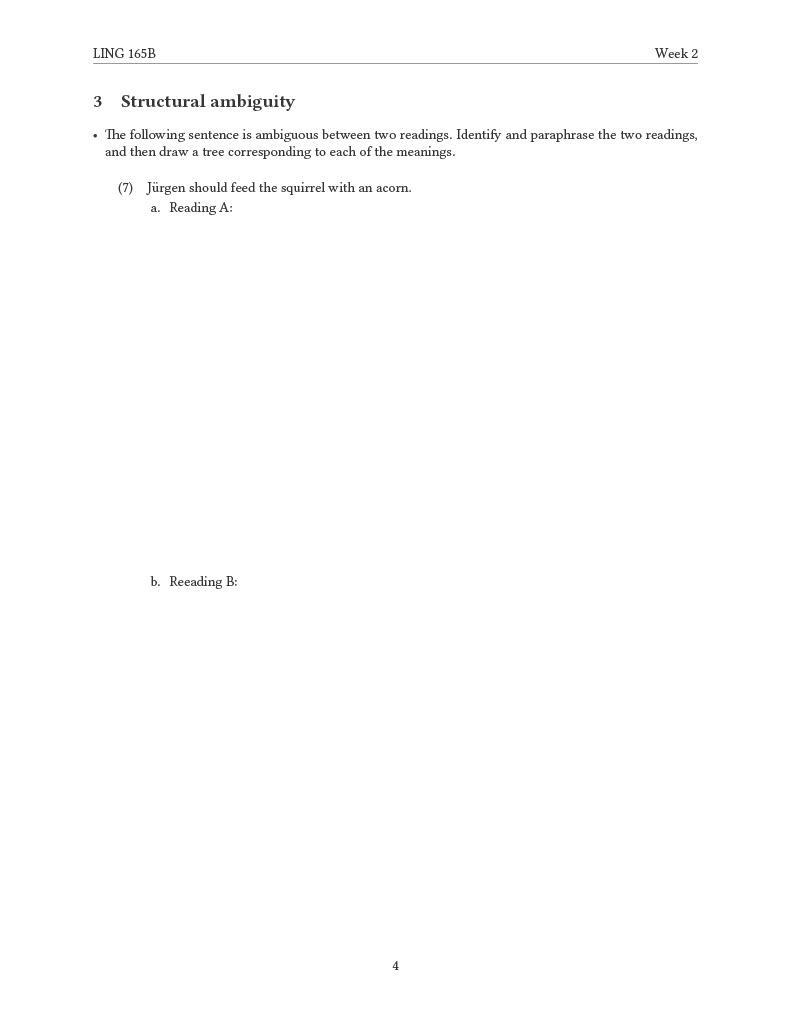
The following sentence is ambiguous between two readings. Identify and paraphrase the two readings, and then draw a tree corresponding to each of the meanings.
Jrgen should feed the squirrel with an acorn.
a Reading A:
b Reeading B:
Step by Step Solution
There are 3 Steps involved in it
1 Expert Approved Answer
Step: 1 Unlock

Question Has Been Solved by an Expert!
Get step-by-step solutions from verified subject matter experts
Step: 2 Unlock
Step: 3 Unlock
 Study Help