







Question: 1. You are provided the following parameter values: (i) sigma (stock return annual standard deviation) = 40% maturity = 1 year (annual) risk-free rate
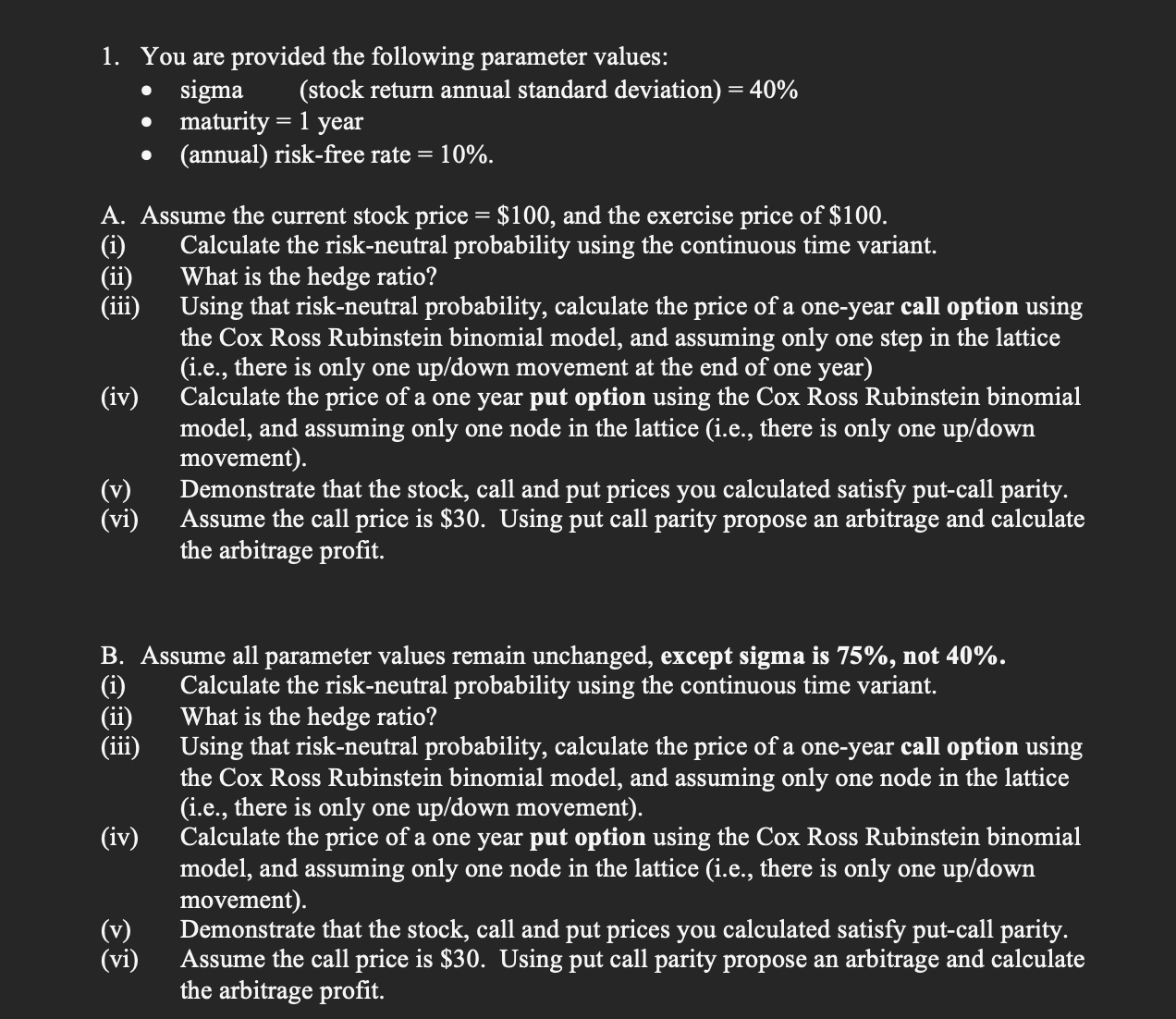
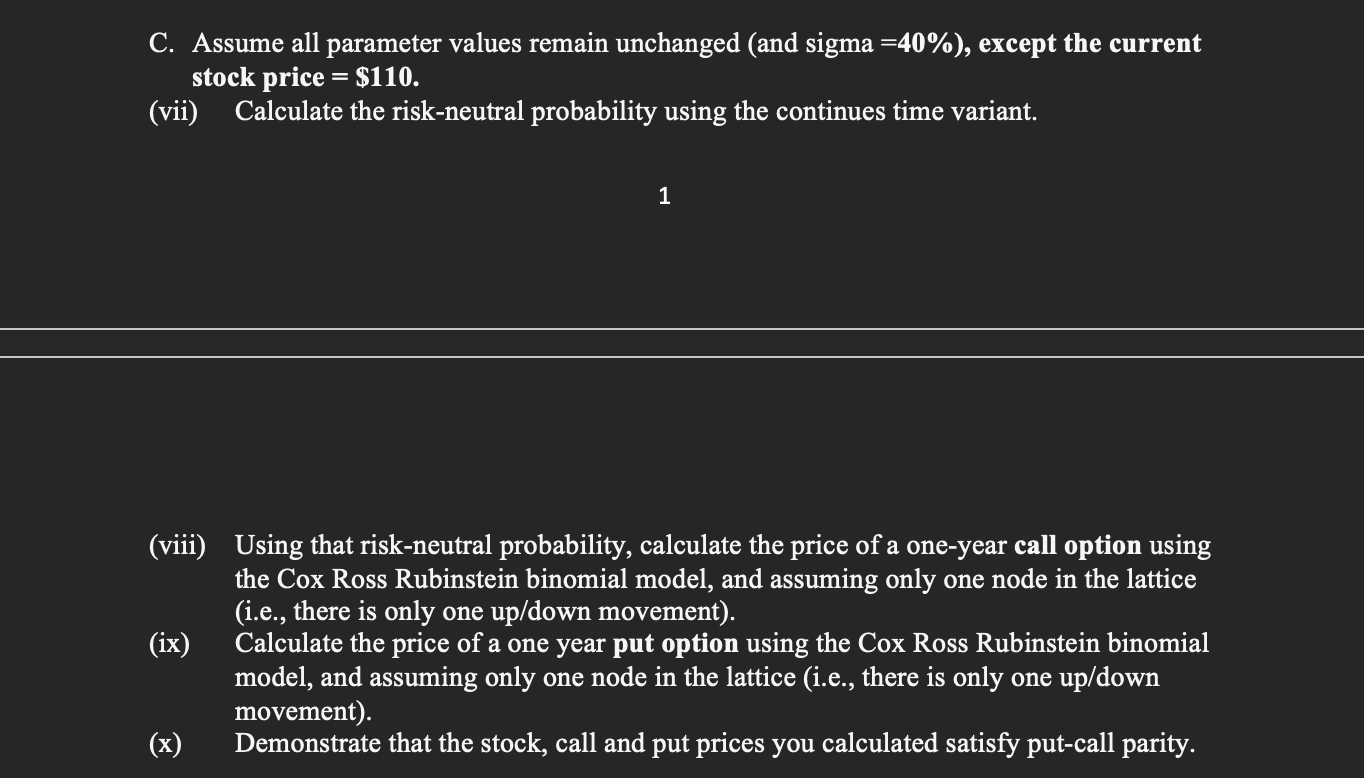
1. You are provided the following parameter values: (i) sigma (stock return annual standard deviation) = 40% maturity = 1 year (annual) risk-free rate = 10%. A. Assume the current stock price = $100, and the exercise price of $100. Calculate the risk-neutral probability using the continuous time variant. What is the hedge ratio? (ii) (iii) (iv) (v) (vi) 33 Using that risk-neutral probability, calculate the price of a one-year call option using the Cox Ross Rubinstein binomial model, and assuming only one step in the lattice (i.e., there is only one up/down movement at the end of one year) Calculate the price of a one year put option using the Cox Ross Rubinstein binomial model, and assuming only one node in the lattice (i.e., there is only one up/down movement). Demonstrate that the stock, call and put prices you calculated satisfy put-call parity. Assume the call price is $30. Using put call parity propose an arbitrage and calculate the arbitrage profit. B. Assume all parameter values remain unchanged, except sigma is 75%, not 40%. Calculate the risk-neutral probability using the continuous time variant. What is the hedge ratio? (i) (ii) (iii) (iv) (v) 33 (vi) Using that risk-neutral probability, calculate the price of a one-year call option using the Cox Ross Rubinstein binomial model, and assuming only one node in the lattice (i.e., there is only one up/down movement). Calculate the price of a one year put option using the Cox Ross Rubinstein binomial model, and assuming only one node in the lattice (i.e., there is only one up/down movement). Demonstrate that the stock, call and put prices you calculated satisfy put-call parity. Assume the call price is $30. Using put call parity propose an arbitrage and calculate the arbitrage profit. C. Assume all parameter values remain unchanged (and sigma =40%), except the current stock price = $110. (vii) Calculate the risk-neutral probability using the continues time variant. 1 (viii) Using that risk-neutral probability, calculate the price of a one-year call option using the Cox Ross Rubinstein binomial model, and assuming only one node in the lattice (i.e., there is only one up/down movement). (ix) (x) Calculate the price of a one year put option using the Cox Ross Rubinstein binomial model, and assuming only one node in the lattice (i.e., there is only one up/down movement). Demonstrate that the stock, call and put prices you calculated satisfy put-call parity.
Step by Step Solution
There are 3 Steps involved in it

Get step-by-step solutions from verified subject matter experts
 Study Help