







Question: 10. Consider the following distribution plan. Single product. Two plants: p1 and p2. Plant p2 has an annual capacity of 60,000 units. The two
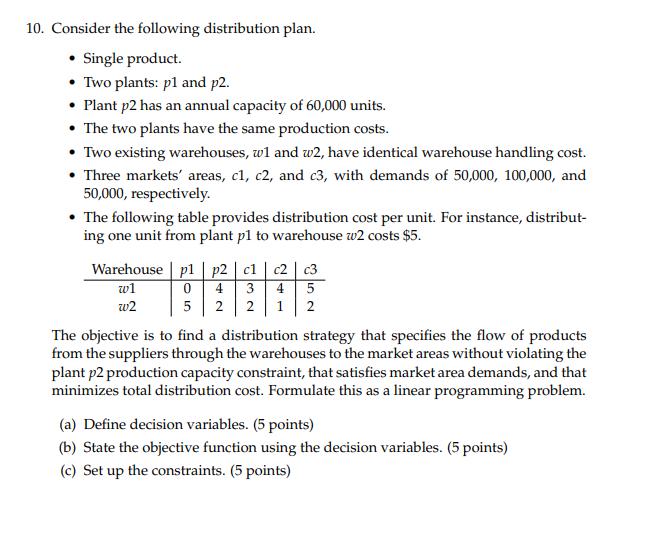
10. Consider the following distribution plan. Single product. Two plants: p1 and p2. Plant p2 has an annual capacity of 60,000 units. The two plants have the same production costs. Two existing warehouses, w1 and w2, have identical warehouse handling cost. Three markets' areas, c1, c2, and c3, with demands of 50,000, 100,000, and 50,000, respectively. The following table provides distribution cost per unit. For instance, distribut- ing one unit from plant pl to warehouse w2 costs $5. Warehouse p1 p2 | c1 | c2 | c3 22 w1 0 4 w2 5 32 3 4 5 2 1 2 The objective is to find a distribution strategy that specifies the flow of products from the suppliers through the warehouses to the market areas without violating the plant p2 production capacity constraint, that satisfies market area demands, and that minimizes total distribution cost. Formulate this as a linear programming problem. (a) Define decision variables. (5 points) (b) State the objective function using the decision variables. (5 points) (c) Set up the constraints. (5 points)
Step by Step Solution
There are 3 Steps involved in it
Sure I can help you analyze the distribution plan and formulate it as a linear programming problem Decision Variables Part a Let xij denote the number of units shipped from plant i to warehouse j wher... View full answer

Get step-by-step solutions from verified subject matter experts
 Study Help