







Question: (10 points) Should one prepared for old age? John values consumption the same way every period, where u(c)=1c1 and =2. He is impatient with =0.95.
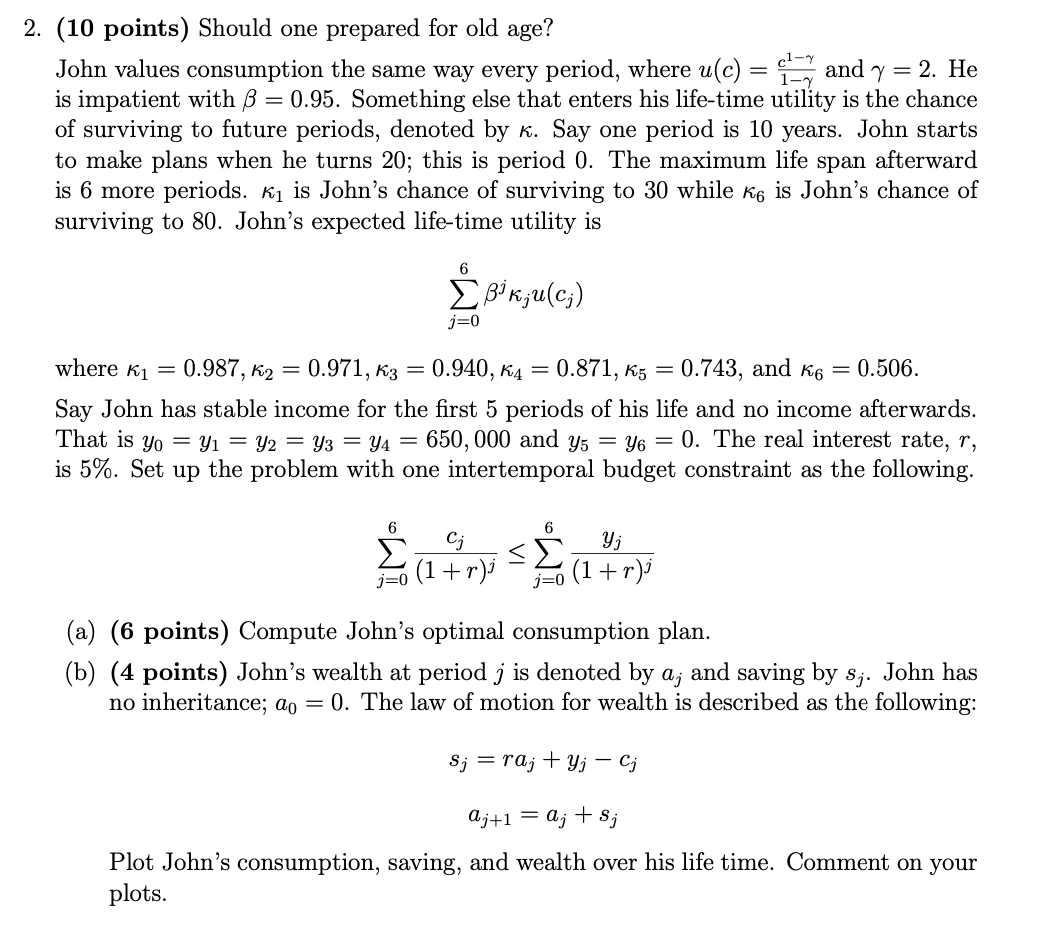
(10 points) Should one prepared for old age? John values consumption the same way every period, where u(c)=1c1 and =2. He is impatient with =0.95. Something else that enters his life-time utility is the chance of surviving to future periods, denoted by . Say one period is 10 years. John starts to make plans when he turns 20; this is period 0 . The maximum life span afterward is 6 more periods. 1 is John's chance of surviving to 30 while 6 is John's chance of surviving to 80. John's expected life-time utility is j=06jju(cj) where 1=0.987,2=0.971,3=0.940,4=0.871,5=0.743, and 6=0.506. Say John has stable income for the first 5 periods of his life and no income afterwards. That is y0=y1=y2=y3=y4=650,000 and y5=y6=0. The real interest rate, r, is 5%. Set up the problem with one intertemporal budget constraint as the following. j=06(1+r)jcjj=06(1+r)jyj (a) (6 points) Compute John's optimal consumption plan. (b) (4 points) John's wealth at period j is denoted by aj and saving by sj. John has no inheritance; a0=0. The law of motion for wealth is described as the following: sj=raj+yjcjaj+1=aj+sj Plot John's consumption, saving, and wealth over his life time. Comment on your plots. (10 points) Should one prepared for old age? John values consumption the same way every period, where u(c)=1c1 and =2. He is impatient with =0.95. Something else that enters his life-time utility is the chance of surviving to future periods, denoted by . Say one period is 10 years. John starts to make plans when he turns 20; this is period 0 . The maximum life span afterward is 6 more periods. 1 is John's chance of surviving to 30 while 6 is John's chance of surviving to 80. John's expected life-time utility is j=06jju(cj) where 1=0.987,2=0.971,3=0.940,4=0.871,5=0.743, and 6=0.506. Say John has stable income for the first 5 periods of his life and no income afterwards. That is y0=y1=y2=y3=y4=650,000 and y5=y6=0. The real interest rate, r, is 5%. Set up the problem with one intertemporal budget constraint as the following. j=06(1+r)jcjj=06(1+r)jyj (a) (6 points) Compute John's optimal consumption plan. (b) (4 points) John's wealth at period j is denoted by aj and saving by sj. John has no inheritance; a0=0. The law of motion for wealth is described as the following: sj=raj+yjcjaj+1=aj+sj Plot John's consumption, saving, and wealth over his life time. Comment on your plots
Step by Step Solution
There are 3 Steps involved in it

Get step-by-step solutions from verified subject matter experts
 Study Help