



Question: 10.8 The real PD controller: kc1Ds E(s) U(s) 1Ds 1Ds kc E(s) U(s) in the limit as 0. (a) Calculate the responses of the real
10.8 The real PD controller: kc1Ds E(s) U(s) 1Ds 1Ds kc E(s) U(s) in the limit as 0. (a) Calculate the responses of the real PD and the ideal PD controller to a unit step change in the error. Plot the response of the real PD for various small values of (e.g. = 0.1, 0.02, 0.01, 0.005, ) in a u(t)/kc versus t/D diagram. Does it approximate the response of the ideal PD as 0? (b) Calculate and compare the frequency response of the real PD and the ideal PD controller. Use MATLAB to plot the Bode diagrams AR/kc and versus D for both the ideal PD and the real PD for various small values of (e.g. = 0.1, 0.05, 0.02, 0.01, 0.005, ). In what sense does the real PD approximate the ideal PD?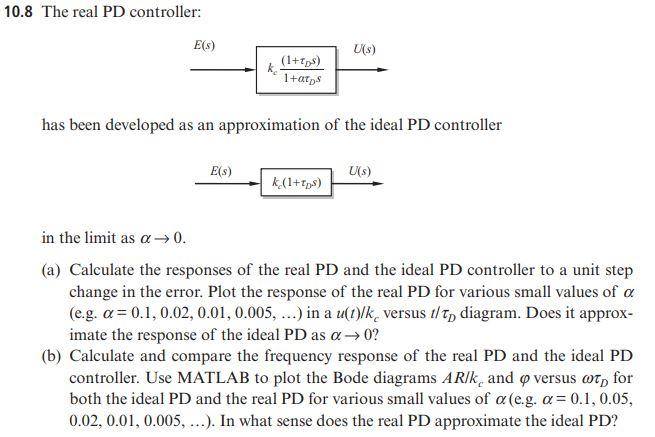
10.8 The real PD controller: has been developed as an approximation of the ideal PD controller in the limit as 0. (a) Calculate the responses of the real PD and the ideal PD controller to a unit step change in the error. Plot the response of the real PD for various small values of (e.g. =0.1,0.02,0.01,0.005, ) in a u(t)/kc versus t/D diagram. Does it approximate the response of the ideal PD as 0 ? (b) Calculate and compare the frequency response of the real PD and the ideal PD controller. Use MATLAB to plot the Bode diagrams AR/kc and versus D for both the ideal PD and the real PD for various small values of (e.g. =0.1,0.05, 0.02,0.01,0.005,). In what sense does the real PD approximate the ideal PD
Step by Step Solution
There are 3 Steps involved in it

Get step-by-step solutions from verified subject matter experts