







Question: 1.1 To develop a mission statement, you should first define the business of the company. What business is Cathay Pacific in? (Make use of Abells


1.1 To develop a mission statement, you should first define the business of the company. What business is Cathay Pacific in? (Make use of Abells Framework: Who, What and How?)
1.2 Next, think of the vision for the business. In your opinion, what should be the Strategic Vision of Cathay Pacific?
1.3 Now, develop a complete Mission Statement for the Cathay Pacific by combining Q1 & Q2. The statement should be concise and to the point
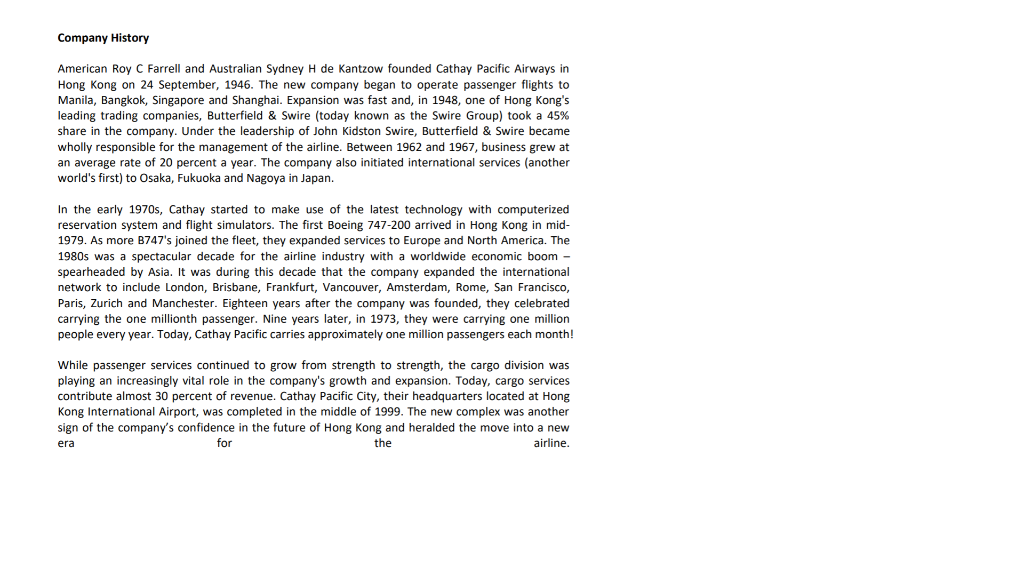
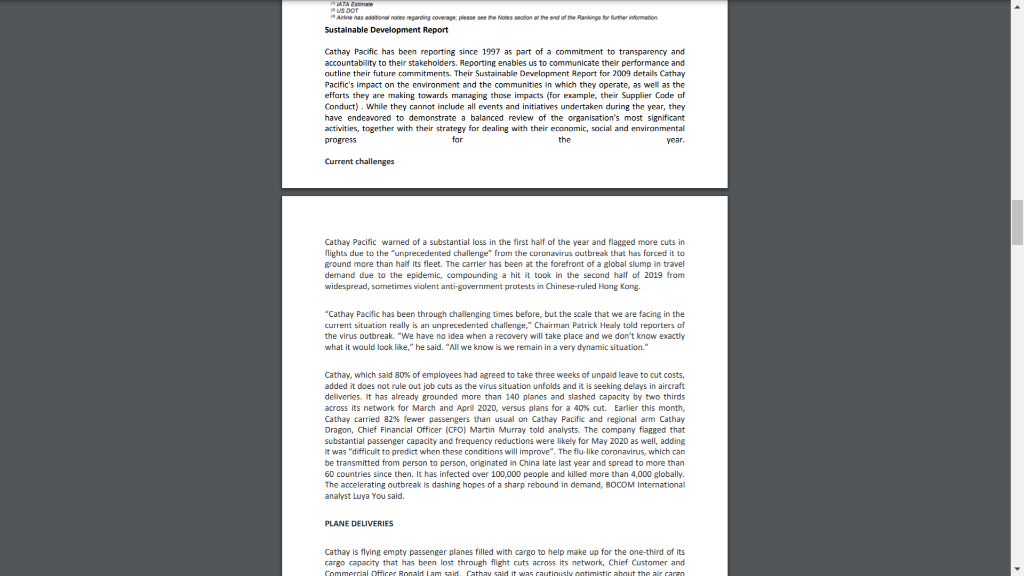
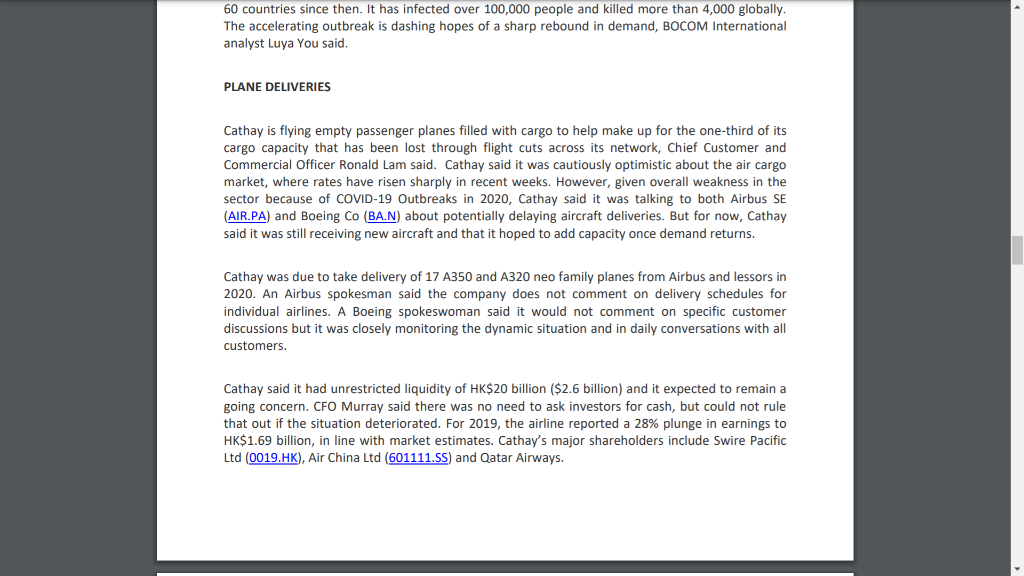
Company History American Roy C Farrell and Australian Sydney H de Kantzow founded Cathay Pacific Airways in Hong Kong 24 September, 1946. The new company began to operate passenger flights to Manila, Bangkok, Singapore and Shanghai. Expansion was fast and, in 1948, one of Hong Kong's leading trading companies, Butterfield & Swire (today known as the Swire Group) took a 45% share in the company. Under the leadership of John Kidston Swire, Butterfield & Swire became wholly responsible for the management of the airline. Between 1962 and 1967, business grew at an average rate of 20 percent a year. The company also initiated international services (another world's first) to Osaka, Fukuoka and Nagoya in Japan. In the early 1970s, Cathay started to make use of the latest technology with computerized reservation system and flight simulators. The first Boeing 747-200 arrived in Hong Kong in mid- 1979. As more B747's joined the fleet, they expanded services to Europe and North America. The 1980s was spectacular decade for the airline industry with a worldwide economic boom - spearheaded by Asia. It was during this decade that the company expanded the international network to include London, Brisbane, Frankfurt, Vancouver, Amsterdam, Rome, San Francisco, Paris, Zurich and Manchester. Eighteen years after the company was founded, they celebrated carrying the one millionth passenger. Nine years later, in 1973, they were carrying one million people every year. Today, Cathay Pacific carries approximately one million passengers each month! While passenger services continued to grow from strength to strength, the cargo division was playing an increasingly vital role in the company's growth and expansion. Today, cargo services contribute almost 30 percent of revenue. Cathay Pacific City, their headquarters located at Hong Kong International Airport, was completed in the middle of 1999. The new complex was another sign of the company's confidence in the future of Hong Kong and heralded the move into a new era for the airline. The Cathay Pacific Group, including Dragonair and Air Hong Kong, now operates more than 150 aircraft to some 130 destinations across the globe. They are committed to growing their operation to help strengthen Hong Kong's role as one of the premier international aviation hubs. The Cathay Pacific fleet is being significantly modernised with a total of 30 Boeing 777-300ER aircraft set to arrive by 2012. These will form the backbone of the airline's ultra-long-haul passenger fleet, bringing significant benefits in terms of fuel efficiency - a top priority in this era of high fuel prices. They also continue to modernize the in-flight product, with new cabin designs being introduced on the entire medium- and long-haul fleet. The new cabins are, uniquely, being fitted in First, Business and Economy Class at the same time, and are taking the travel experience to new highs. They are also committed to strengthening Hong Kong's role as an airfreight hub, and are now in the process of building the new Cathay Pacific Cargo Terminal which will open in mid-2011. This HK$4.8 billion facility will add an additional air cargo throughput of 2.6 million tonnes a year and will be open to all carriers using the airport. cargo In addition, they are enhancing their own freighter fleet with six new Boeing 747-400 "Extended Range Freighters" in the process of being delivered and 10 new-generation Boeing 747-8F freighters arriving between 2009 and 2012. These newer, more fuel-efficient aircraft will enable us to offer an even higher level of service to its cargo customers. In early 2008 they considerably strengthened their services to India, adding 20 more flights each week and a new destination, Chennai. With their own strong international network and Dragonair's superb connections in the Mainland they have opened up new travel possibilities and reinforced Hong Kong's position as a gateway to China and a hub for the world to envy. Cathay Pacific and Hong Kong Cathay Pacific has been serving and growing with Hong Kong for 60 years. They started with one aircraft, and two founders who each put up HK$1 to register the company here on 24 September, 1946. Today they employ over 23,000 people and have thousands of Hong Kong shareholders with a stake in the airline. They launched the Cadet Pilot Programme in 1988 to recruit and train local pilots. More than 300 cadets have joined the airline and some have risen to the rank of Captain. About 30 Hong Kong cadets earn their wings each year. More than half of all their flight attendants are from Hong Kong. With more than 1,000 courses and 42,000 days of instruction each year, their engineering works, HAECO, has trained more than 8,500 staff and almost 2,500 more work for joint-venture companies. They extend to TAECO, an aircraft engineering works in Xiamen, and HAESL, the Hong Kong aero engine services company. Cathay Pacific World Rankings Cathay Pacific was ranked the world's 3rd most profitable airline (net profit) and the 4th largest airline in the world by operating revenue. They are ranked 12th-largest in the world in terms of revenue passenger kilometres and 5th-largest in freight tonne kilometres. With the challenges it has been facing, Cathay Pacific has been recently ranked the world's 15th most scheduled passengers carried and 4th largest in-freight tonne kilometres. All based on data of World Air Transport Statistics 2019 The Cathay Pacific Group, including Dragonair and Air Hong Kong, now operates more than 150 aircraft to some 130 destinations across the globe. They are committed to growing their operation to help strengthen Hong Kong's role as one of the premier international aviation hubs. The Cathay Pacific fleet is being significantly modernised with a total of 30 Boeing 777-300ER aircraft set to arrive by 2012. These will form the backbone of the airline's ultra-long-haul passenger fleet, bringing significant benefits in terms of fuel efficiency - a top priority in this era of high fuel prices. They also continue to modernize the in flight product, with new cabin designs being introduced on the entire medium- and long-haul fleet. The new cabins are, uniquely, being fitted in First, Business and Economy Class at the same time, and are taking the travel experience to new highs. They are also committed to strengthening Hong Kong's role as an airfreight hub, and are now in the process of building the new Cathay Pacific Cargo Terminal which will open in mid-2011. This HK$4.8 billion facility will add an additional air cargo throughput of 2.6 million tonnes a year and will be open to all cargo carriers using the airport. In addition, they are enhancing their own freighter fleet with six new Boeing 747-400 "Extended Range Freighters" in the process of being delivered and 10 new-generation Boeing 747-8F freighters arriving between 2009 and 2012. These newer, more fuel-efficient aircraft will enable us to offer an even higher level of service to its cargo customers. In early 2008 they considerably strengthened their services to India, adding 20 more flights each week and a new destination, Chennai. With their own strong international network and Dragonair's superb connections in the Mainland they have opened up new travel possibilities and reinforced Hong Kong's position as a gateway to China and a hub for the world to envy. Cathay Pacific and Hong Kong Cathay Pacific has been serving and growing with Hong Kong for 60 years. They started with one aircraft, and two founders who each put up HK$1 to register the company here on 24 September, 1946. Today they employ over 23,000 people and have thousands of Hong Kong shareholders with a stake in the airline They launched the Cadet Pilot Programme in 1988 to recruit and train local pilots. More than 300 cadets have joined the airline and some have risen to the rank of Captain. About 30 Hong Kong cadets earn their wings each year. More than half of all their flight attendants are from Hong Kong. With more than 1,000 courses and 42,000 days of instruction each year, their engineering works, HAECO, has trained more than 8,500 staff and almost 2,500 more work for joint venture companies. They extend to TAECO, an aircraft engineering works in Xiamen, and HAESL, the Hong Kong aero engine services company. Cathay Pacific World Rankings Cathay Pacific was ranked the world's 3rd most profitable airline (net profit)* and the 4th largest airline in the world by operating revenue. They are ranked 12th-largest in the world in terms of revenue passenger kilometres and 5th-largest in freight tonne kilometres. With the challenges it has been facing, Cathay Pacific has been recently ranked the world's 15th most scheduled passengers carried and 4th largest in-freight tonne kilometres*. * All based on data of World Air Transport Statistics 2019 ATA E AUS DOT Arise as actiones ready covers section at the end of the Rankings for the information Sustainable Development Report Cathay Pacific has been reporting since 1997 as part of a commitment to transparency and accountability to their stakeholders. Reporting enables us to communicate their performance and outline their future commitments. Their Sustainable Development Report for 2009 details Cathay Pacific's impact on the environment and the communities in which they operate, as well as the efforts they are making towards managing those impacts (for example, their Supplier Code of Conduct). While they cannot include all events and initiatives undertaken during the year, they have endeavored to demonstrate a balanced review of the organisation's most significant activities, together with their strategy for dealing with their economic, social and environmental progress for the year. Current challenges Cathay Pacific warned of a substantial loss in the first half of the year and flagged more cuts in flights due to the unprecedented challenge from the coronavirus outbreak that has forced it to ground more than half its fleet. The carrier has been at the forefront of a global slump in travel demand due to the epidemic, compounding a hit it took in the second half of 2019 from widespread, sometimes violent anti-government protests in Chinese-ruled Hong Kong. "Cathay Pacific has been through challenging times before, but the scale that we are facing in the current situation really is an unprecedented challenge Chairman Patrick Healy told reporters of the virus outbreak. "We have no idea when a recovery will take place and we don't know exactly what it would look like," he said. "All we know is we remain in a very dynamic situation." Cathay, which said 80% of employees had agreed to take three weeks of unpaid leave to cut costs, added it does not rule out job cuts as the virus situation unfolds and it is seeking delays in aircraft deliveries. It has already grounded more than 140 planes and slashed capacity by two thirds across its network for March and April 2020, versus plans for a 40% cut. Earlier this month, Cathay carried 82% fewer passengers than usual on Cathay Pacific and regional arm Cathay Dragon, Chief Financial Officer (CFO) Martin Murray told analysts. The company flagged that substantial passenger capacity and frequency reductions were likely for May 2020 as well, adding it was "difficult to predict when these conditions will improve". The flu-like coronavirus, which can be transmitted from person to person, originated in China late last year and spread to more than 60 countries since then. It has infected over 100,000 people and killed more than 4,000 globally. The accelerating outbreak is dashing hopes of a sharp rebound in demand, BOCOM International analyst Luya You said. PLANE DELIVERIES Cathay is flying empty passenger planes filled with cargo to help make up for the one-third of its cargo capacity that has been lost through flight cuts across its network, Chief Customer and Commercial Officer Ronald Lam said Cathay said it was cautiously ontimistic about the air cars 60 countries since then. It has infected over 100,000 people and killed more than 4,000 globally. The accelerating outbreak is dashing hopes of a sharp rebound in demand, BOCOM International analyst Luya You said. PLANE DELIVERIES Cathay is flying empty passenger planes filled with cargo to help make up for the one-third of its cargo capacity that has been lost through flight cuts across its network, Chief Customer and Commercial Officer Ronald Lam said. Cathay said it was cautiously optimistic about the air cargo market, where rates have risen sharply in recent weeks. However, given overall weakness in the sector because of COVID-19 Outbreaks in 2020, Cathay said it was talking to both Airbus SE (AIR.PA) and Boeing Co (BA.N) about potentially delaying aircraft deliveries. But for now, Cathay said it was still receiving new aircraft and that it hoped to add capacity once demand returns. Cathay was due to take delivery of 17 A350 and A320 neo family planes from Airbus and lessors in 2020. An Airbus spokesman said the company does not comment on delivery schedules for individual airlines. A Boeing spokeswoman said it would not comment on specific customer discussions but it was closely monitoring the dynamic situation and in daily conversations with all customers. Cathay said it had unrestricted liquidity of HK$20 billion ($2.6 billion) and it expected to remain a going concern. CFO Murray said there was no need to ask investors for cash, but could not rule that out if the situation deteriorated. For 2019, the airline reported a 28% plunge in earnings to HK$1.69 billion, in line with market estimates. Cathay's major shareholders include Swire Pacific Ltd (0019.HK), Air China Ltd (601111.Ss) and Qatar AirwaysStep by Step Solution
There are 3 Steps involved in it
1 Expert Approved Answer
Step: 1 Unlock

Question Has Been Solved by an Expert!
Get step-by-step solutions from verified subject matter experts
Step: 2 Unlock
Step: 3 Unlock
 Study Help