







Question: 116 CHAPTER 3 The Project Manager 2. Considering the attributes power plant and backup disaster response centers where cars were floating in the parking lot.Wi,
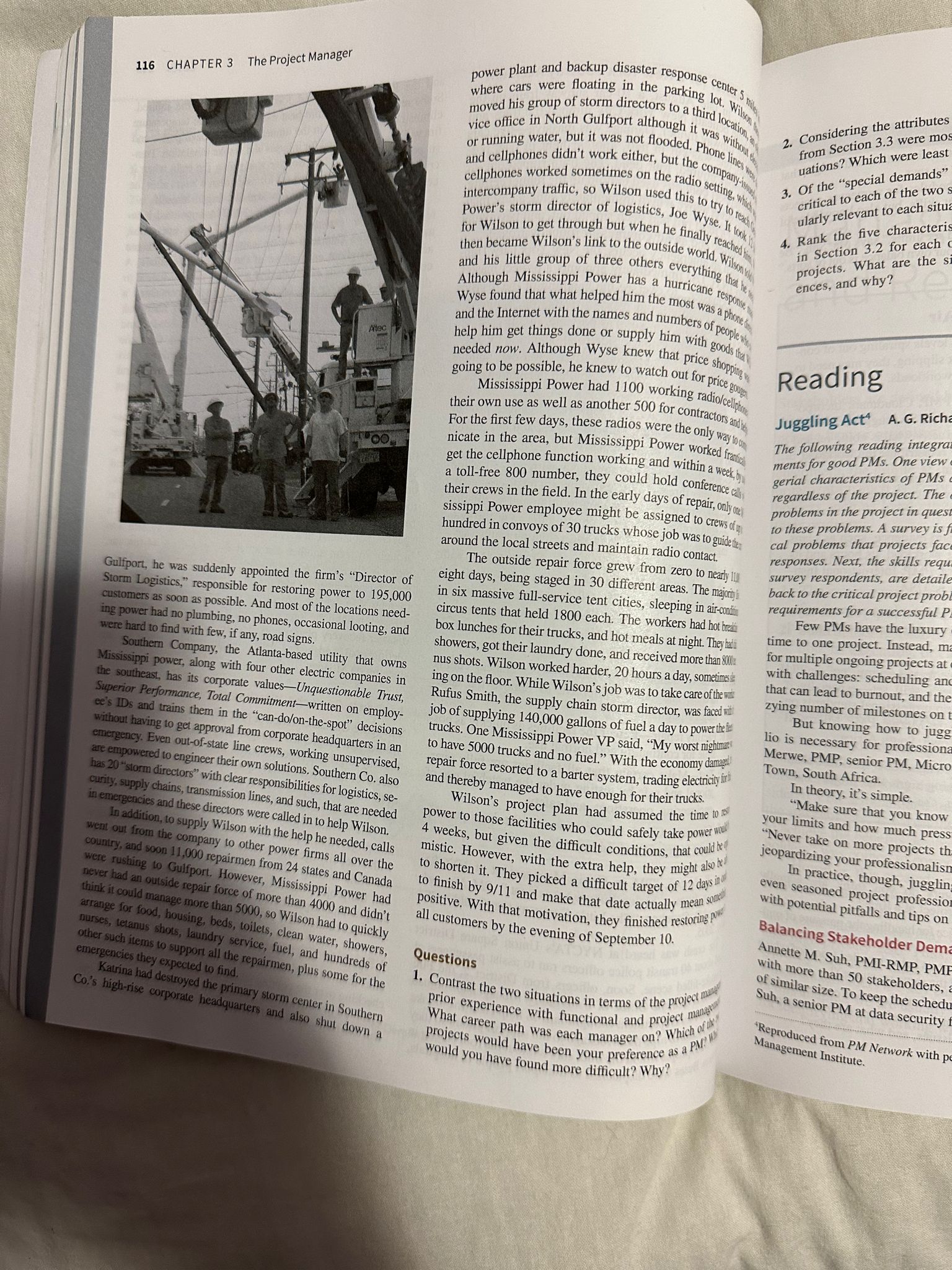
116 CHAPTER 3 The Project Manager 2. Considering the attributes power plant and backup disaster response centers where cars were floating in the parking lot.Wi, moved his group of storm directors to a third 10cattion, or running water, but it was not flooded. Phone lithouly, and cellphones didn't work either, but the company cellphones worked sometimes on the radio setting, wh intercompany traffic, so Wilson used this to try to Power's storm director of logistics, Joe Wyse. It took for Wilson to get through but when he finally reached then became Wilson's link to the outside world. Wilson and his little group of three others everything that Although Mississippi Power has a hurric and the Internet with the names and numbers of people ex. help him get things done or supply him with goods the needed now. Although Wyse knew that price shopping going to be possible, he knew to watch out for price gou Mississippi Power had 1100 working radio/cell their own use as well as another 500 for controf cor the first few to on For the first few days, these radios were the nicate in the area, but Mississippi Power worked frantion get the cellphone function working and within a week, by a toll-free 800 number, they could hold conference all their crews in the field. In the early days of repair, only octe sissippi Power employee might be assigned to crews of hundred in convoys of 30 trucks whose job was to guideth around the local streets and maintain radio contact. Gulfport, he was suddenly appointed the firm's "Director of Storm Logistics," responsible for restoring power to 195,000 customers as soon as possible. And most of the locations needing power had no plumbing, no phones, occasional looting, and were hard to find with few, if any, road signs. Southern Company, the Atlanta-based utility that owns Mississippi power, along with four other electric companies in the southeast, has its corporate values-Unquestionable Trust, Superior Performance, Total Commitment-written on employee's IDs and trains them in the "can-do/on-the-spot" decisions without having to get approval from corporate headquarters in an emergency. Even out-of-state line crews, working unsupervised, are empowered to engineer their own solutions. Southern Co. also has 20 "storm directors" with clear responsibilities for logistics, security, supply chains, transmission lines, and such, that are needed in emergencies and these directors were called in to help Wilson. In addition, to supply Wilson with the help he needed, calls went out from the company to other power firms all over the country, and soon 11,000 repairmen from 24 states and Canada never has an to Gulfport. However, Mississippi Power had picked a difficult target of 12 days in arm ir could manage more the of more than 4000 and pod date actually mean solve arrange for food. howine than 5000, so Wilson 4000 and didn't nurses, tetanus shousing, beds, toilets, clean had to quickly other such items tots, laundry service, clean water, showers, emergencies they to support all the repe fuel, and hundreds of Katrin they expected to find repairmen, plus some of 1. Contrast the two situations in terms of the projec prior experience with functional and project What career path was each manager on? Which of th 2 eight days, being staged in 30 rew from to nearly in six massive full circus tents that held 1800 each box lunches for their trucks, and. The workers had hot breit showers, got their laundry and hot meals at night. They hati nus shots. Wilson worked harder, than 8002 ing on the floor. While Wilsor, 20 hours a day, sometimss Rufus Smith, the supply con's job was to take care of the ric job of supplying 140 , chain storm director, was faced in: trucks. One Mississippi follons of fuel a day to power thete to have 5000 trucks and Power VP said, "My worst nighmer! repair force resorted to a fuel." With the economy damaged and thereby man to a barter system, trading electricity fir Wilson's project to have enough for their trucks. power to those fime to to 4 weeks, but facilities who could safely take power wor mistic. How given the difficult conditions, that could bet to shorten wer, with the extra help, they might also l2 ? to finish by The metivation, they finished restoring polt all customers by the evening of September 10 . critical to each of the two 4. Rank the five characteris in Section 3.2 for each projects. What are the s ences, and why? Reading Juggling ACt 4 A. G. Rich The following reading integra ments for good PMs. One view gerial characteristics of PMS regardless of the project. The problems in the project in quest to these problems. A survey is f cal problems that projects fac responses. Next, the skills requ survey respondents, are detaile back to the critical project probi requirements for a successful P1 Few PMs have the luxury time to one project. Instead, ma for multiple ongoing projects at with challenges: scheduling and that can lead to burnout, and the zying number of milestones on t But knowing how to jugg lio is necessary for professiona Merwe, PMP, senior PM, Micro Town, South Africa. In theory, it's simple. "Make sure that you know your limits and how much press "Never take on more projects th jeopardizing your professionalisn In practice, though, jugglin even seasoned project profession with potential pitfalls and tips on Balancing Stakeholder Dema Annette M. Suh, PMI-RMP, PMF with more than 50 stakeholders, of similar size. To keep the sched Suh, a senior PM at data Reproduced from PM Reproduced from Management Institute. wo jects would have been your preference as a Pl? Would you have found more difficult? Why? 2. Considering the attributes of the two PMs, which attributes from Section 3.3 were most important to each of the two situations? Which were least important? 3. Of the "special demands" listed in Section 3.2, which were critical to each of the two situations? Which were not particularly relevant to each situation? 4. Rank the five characteristics desired for team members in Section 3.2 for each of the project teams in the two projects. What are the similarities, what are the differences, and why? 5. Considering the iron triangle of goal trade-off's, what would take priority at the beginning of each project? What towards the end of each project? Explain your thinking. 6. Describe how these two projects would have been handled in a culture that was slower paced, such as Latin America. Or one that was more top-down, respect for elders, oriented, like Japan. Or one that was more relationship based and less litigious than the United States. Reading Juggling Act 4 A. G. Richardson The following reading integrates two views about the requirements for good PMs. One view concerns the personal and managerial characteristics of PMs and their ability to lead a team, regardless of the project. The other view considers the critical problems in the project in question and the PM's talents relative to these problems. A survey is first described, and then the critical problems that projects face are identified from the survey responses. Next, the skills required of PMs, as indicated by the survey respondents, are detailed. Finally, the skills are related back to the critical project problems for an integrated view of the reguirements for a successful PM. Few PMs have the luxury of devoting 100 percent of their time to one project. Instead, many find themselves responsible for multiple ongoing projects at once. This balancing act is laden with challenges: scheduling and resource conflicts, long hours that can lead to burnout, and the constant struggle to keep a dizzying number of milestones on track. San Francisco, California, USA, didn't even consider trying to store all the information in her head. "What gets you through this successfully is that you write it down," she says. "Block off time on your calendar to check in on every project you have. I like to color-code projects, so I can see at a glance what relates to each project. I also keep meeting minutes with attendance, so I know who was present when decisions or commitments were made. With a large group, it's impossible to keep track any other way." When reviewing project notes, pay special attention to the most powerful and influential stakeholders, says Ms. van der Merwe. Using key stakeholders' management and communication plans can make it easier to track specific demands and prioritize between projects. Checking in, even briefly, with all stakeholders creates the opportunity to evaluate the project's alignment with organizational goals before prioritizing, according to Arindam Das, PMP, principal, business services at Bangalore, India-based In
Step by Step Solution
There are 3 Steps involved in it

Get step-by-step solutions from verified subject matter experts
 Study Help