







Question: 118. (Instructor Problem - no solutions will be provided) You are employed by CGT, a Fortune 500 firm that is a major producer of chemicals
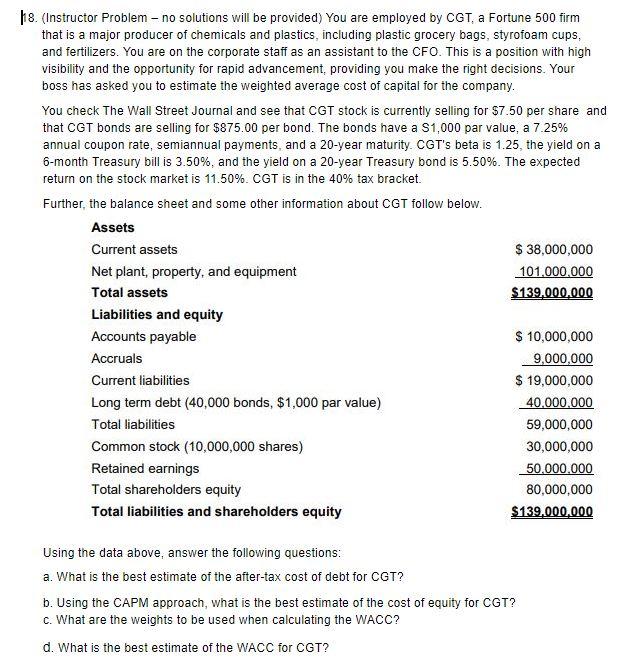
118. (Instructor Problem - no solutions will be provided) You are employed by CGT, a Fortune 500 firm that is a major producer of chemicals and plastics, including plastic grocery bags, styrofoam cups, and fertilizers. You are on the corporate staff as an assistant to the CFO. This is a position with high visibility and the opportunity for rapid advancement, providing you make the right decisions. Your boss has asked you to estimate the weighted average cost of capital for the company. You check The Wall Street Journal and see that CGT stock is currently selling for $7.50 per share and that CGT bonds are selling for $875.00 per bond. The bonds have a S1,000 par value, a 7.25% annual coupon rate, semiannual payments, and a 20-year maturity. CGT's beta is 1.25, the yield on a 6-month Treasury bill is 3.50%, and the yield on a 20-year Treasury bond is 5.50%. The expected return on the stock market is 11.50%. CGT is in the 40% tax bracket. Further, the balance sheet and some other information about CGT follow below. Assets Current assets $ 38,000,000 Net plant, property, and equipment 101.000.000 Total assets $139,000,000 Liabilities and equity Accounts payable $ 10,000,000 Accruals 9,000,000 Current liabilities $ 19,000,000 Long term debt (40,000 bonds, $1,000 par value) 40.000.000 Total liabilities 59,000,000 Common stock (10,000,000 shares) 30,000,000 Retained earnings 50.000.000 Total shareholders equity 80,000,000 Total liabilities and shareholders equity $139,000,000 Using the data above, answer the following questions: a. What is the best estimate of the after-tax cost of debt for CGT? b. Using the CAPM approach, what is the best estimate of the cost of equity for CGT? c. What are the weights to be used when calculating the WACC? d. What is the best estimate of the WACC for CGT? 118. (Instructor Problem - no solutions will be provided) You are employed by CGT, a Fortune 500 firm that is a major producer of chemicals and plastics, including plastic grocery bags, styrofoam cups, and fertilizers. You are on the corporate staff as an assistant to the CFO. This is a position with high visibility and the opportunity for rapid advancement, providing you make the right decisions. Your boss has asked you to estimate the weighted average cost of capital for the company. You check The Wall Street Journal and see that CGT stock is currently selling for $7.50 per share and that CGT bonds are selling for $875.00 per bond. The bonds have a S1,000 par value, a 7.25% annual coupon rate, semiannual payments, and a 20-year maturity. CGT's beta is 1.25, the yield on a 6-month Treasury bill is 3.50%, and the yield on a 20-year Treasury bond is 5.50%. The expected return on the stock market is 11.50%. CGT is in the 40% tax bracket. Further, the balance sheet and some other information about CGT follow below. Assets Current assets $ 38,000,000 Net plant, property, and equipment 101.000.000 Total assets $139,000,000 Liabilities and equity Accounts payable $ 10,000,000 Accruals 9,000,000 Current liabilities $ 19,000,000 Long term debt (40,000 bonds, $1,000 par value) 40.000.000 Total liabilities 59,000,000 Common stock (10,000,000 shares) 30,000,000 Retained earnings 50.000.000 Total shareholders equity 80,000,000 Total liabilities and shareholders equity $139,000,000 Using the data above, answer the following questions: a. What is the best estimate of the after-tax cost of debt for CGT? b. Using the CAPM approach, what is the best estimate of the cost of equity for CGT? c. What are the weights to be used when calculating the WACC? d. What is the best estimate of the WACC for CGT
Step by Step Solution
There are 3 Steps involved in it

Get step-by-step solutions from verified subject matter experts
 Study Help