







Question: 12 Memory pointers allow us to access variable or array data from multiple places not just through the variable or array index. We can return
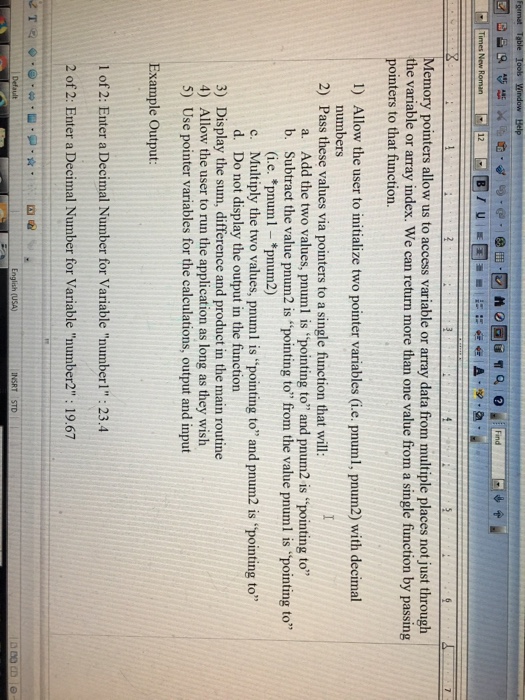
12 Memory pointers allow us to access variable or array data from multiple places not just through the variable or array index. We can return more than one value from a single function by passing ointers to that function. numbers 2) Pass these values via pointers to a single function that will: Add the two values, pnuml is "pointing to" and pnum2 is "pointing to" a. b. Subtract the value pnum2 is "pointing to" from the value pnuml is pointing to" (i.e. *pnuml - *pnum2) c. Multiply the two values, pnuml is "pointing to" and pnum2 is "pointing to" Do not display the output in the function 3) 4) 5) d. Display the sum, difference and product in the main routine Allow the user to run the application as long as they wish Use pointer variables for the calculations, output and input Example Output 1 of 2: Enter a Decimal Number for Variable "number" 23.4 2 of 2: Enter a Decimal Number for Variable "number2" 19.67 Default Engl
Step by Step Solution
There are 3 Steps involved in it

Get step-by-step solutions from verified subject matter experts
 Study Help