



Question: 12. This is all one question with multiple parts The function s = f(t) gives the position of an object moving along the s-axis as
12. This is all one question with multiple parts
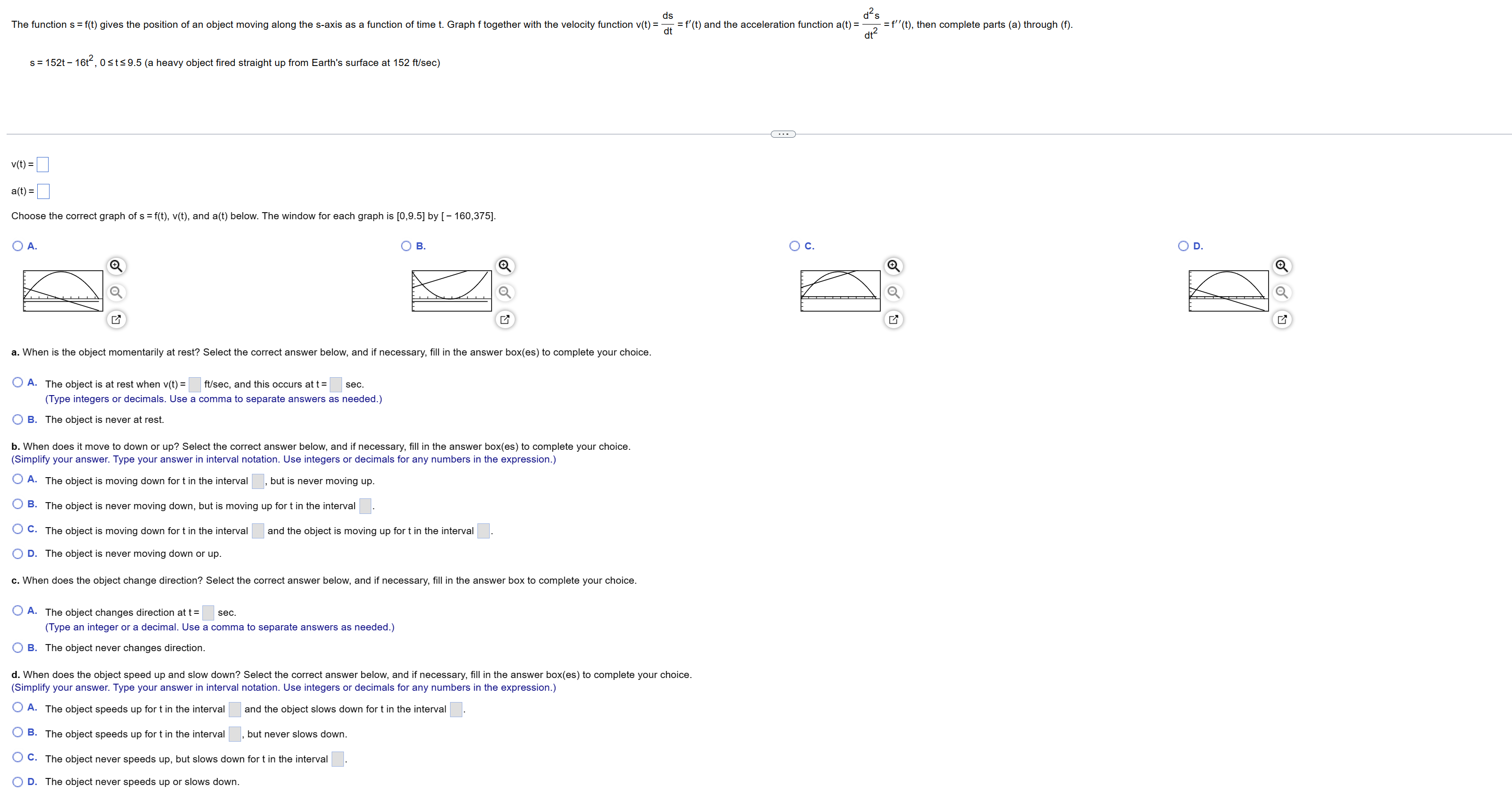
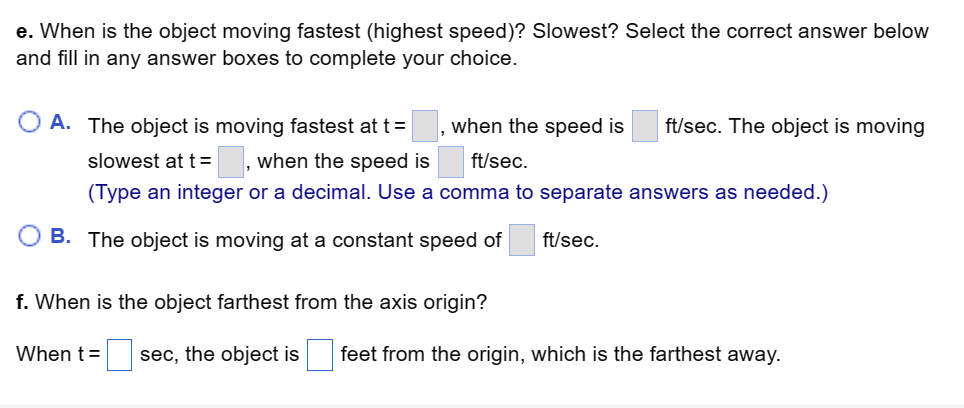
The function s = f(t) gives the position of an object moving along the s-axis as a function of time t. Graph f together with the velocity function v(t) = - = f'(t) and the acceleration function a(t) = ds d's d+2 = f"(t), then complete parts (a) through (f). s = 152t - 16t", 0 sts 9.5 (a heavy object fired straight up from Earth's surface at 152 fu/sec) v(t ) = a(t) = Choose the correct graph of s = f(t), v(t), and a(t) below. The window for each graph is [0,9.5] by [ - 160,375]. A. O B. O c. OD O a. When is the object momentarily at rest? Select the correct answer below, and if necessary, fill in the answer box(es) to complete your choice. O A. The object is at rest when v(t) = ft/sec, and this occurs at t= sec. Type integers or decimals. Use a comma to separate answers as needed.) O B. The object is never at rest. b. When does it move to down or up? Select the correct answer below, and if necessary, fill in the answer box(es) to complete your choice. (Simplify your answer. Type your answer in interval notation. Use integers or decimals for any numbers in the expression.) O A. The object is moving down for t in the interval , but is never moving up. O B. The object is never moving down, but is moving up for t in the interval O C. The object is moving down for t in the interval and the object is moving up for t in the interval O D. The object is never moving down or up. c. When does the object change direction? Select the correct answer below, and if necessary, fill in the answer box to complete your choice. O A. The object changes direction at t= sec. (Type an integer or a decimal. Use a comma to separate answers as needed.) O B. The object never changes direction. d. When does the object speed up and slow down? Select the correct answer below, and if necessary, fill in the answer box(es) to complete your choice. (Simplify your answer. Type your answer in interval notation. Use integers or decimals for any numbers in the expression.) O A. The object speeds up for t in the interval and the object slows down for t in the interval O B. The object speeds up for t in the interval , but never slows down. O C. The object never speeds up, but slows down for t in the interval D. The object never speeds up or slows down.e. When is the object moving fastest (highest speed)? Slowest? Select the correct answer below and fill in any answer boxes to complete your choice. O A. The object is moving fastest at t = when the speed is ft/sec. The object is moving slowest at t = , when the speed is ft/sec. (Type an integer or a decimal. Use a comma to separate answers as needed.) O B. The object is moving at a constant speed of ft/sec. f. When is the object farthest from the axis origin? When t= sec, the object is feet from the origin, which is the farthest away
Step by Step Solution
There are 3 Steps involved in it

Get step-by-step solutions from verified subject matter experts