







Question: 13.2-2 is the main question (just solve this one) Please show all your work. Thank you. APPENDIX 2 The book is 10th edition of introduction
13.2-2 is the main question (just solve this one) Please show all your work. Thank you.

APPENDIX 2
The book is 10th edition of introduction to operations research
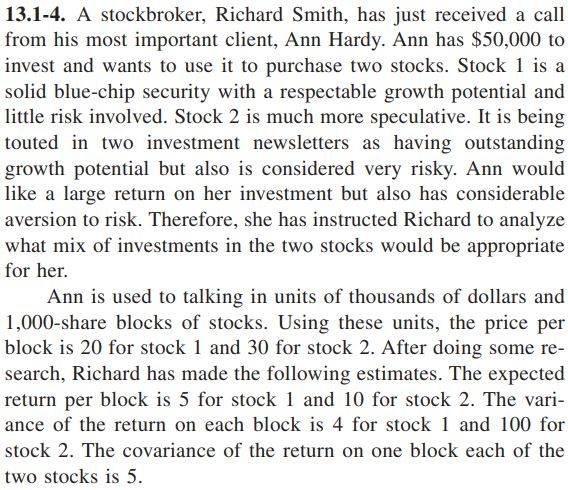
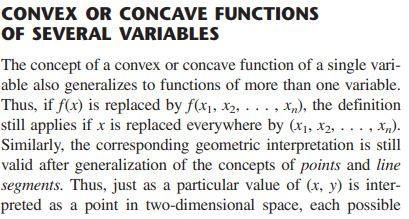
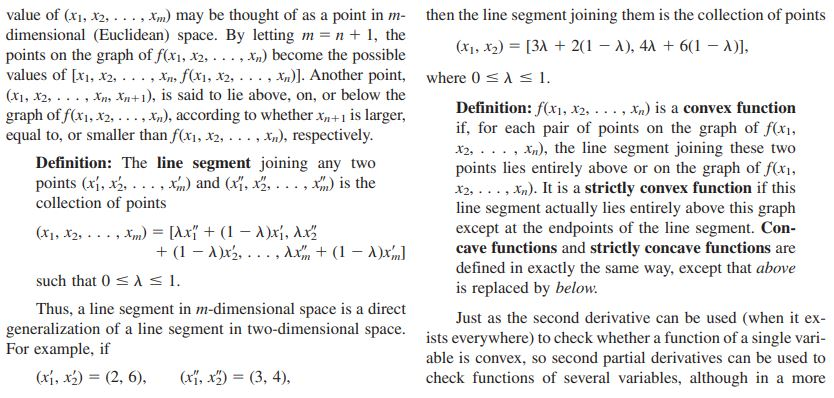
13.2-2. Reconsider Prob. 13.1-4. Show that the model formulated is a convex programming problem by using the test in Appendix 2 to show that the objective function being minimized is convex. 13.1-4. A stockbroker, Richard Smith, has just received a call from his most important client, Ann Hardy. Ann has $50,000 to invest and wants to use it to purchase two stocks. Stock 1 is a solid blue-chip security with a respectable growth potential and little risk involved. Stock 2 is much more speculative. It is being touted in two investment newsletters as having outstanding growth potential but also is considered very risky. Ann would like a large return on her investment but also has considerable aversion to risk. Therefore, she has instructed Richard to analyze what mix of investments in the two stocks would be appropriate for her. Ann is used to talking in units of thousands of dollars and 1,000-share blocks of stocks. Using these units, the price per block is 20 for stock 1 and 30 for stock 2. After doing some re- search, Richard has made the following estimates. The expected return per block is 5 for stock 1 and 10 for stock 2. The vari- ance of the return on each block is 4 for stock 1 and 100 for stock 2. The covariance of the return on one block each of the two stocks is 5. CONVEX OR CONCAVE FUNCTIONS OF SEVERAL VARIABLES The concept of a convex or concave function of a single vari- able also generalizes to functions of more than one variable, Thus, if f(x) is replaced by f(x1, x2,...,x), the definition still applies if x is replaced everywhere by (x1, x2, ..., X.). Similarly, the corresponding geometric interpretation is still valid after generalization of the concepts of points and line segments. Thus, just as a particular value of (x, y) is inter- preted as a point in two-dimensional space, each possible value of (x1, x2,...,xn) may be thought of as a point in m- then the line segment joining them is the collection of points dimensional (Euclidean) space. By letting m= n + 1, the points on the graph of f(x1, x2, . . . , Xn) become the possible (x1, x2) = [3 + 2(1 - 1), 4+ 6(1 - 1)], values of [X1, X2, ..., X., f(x1, X2, ..., X.)]. Another point, where 0 si sl. (x1, x2, ..., Xn Xx+1), is said to lie above, on, or below the graph of f(x1,x2,...,xn), according to whether Xn+1 is larger, Definition: f(x1,x2,...,xn) is a convex function equal to, or smaller than f(x1, x2, ..., X), respectively. if, for each pair of points on the graph of f(x1, X2,..,xn)the line segment joining these two Definition: The line segment joining any two points lies entirely above or on the graph of f(x1, points (x1, x2,...,x) and (x1,x2,...,m) is the X2, ..., X). It is a strictly convex function if this collection of points line segment actually lies entirely above this graph (x1, X2, ..., Xm) = (2x + (1 - 1)x1, A.x" except at the endpoints of the line segment. Con- + (1 - 1)x, ..., 4x + (1 - X)x] cave functions and strictly concave functions are defined in exactly the same way, except that above such that 0Step by Step Solution
There are 3 Steps involved in it
1 Expert Approved Answer
Step: 1 Unlock

Question Has Been Solved by an Expert!
Get step-by-step solutions from verified subject matter experts
Step: 2 Unlock
Step: 3 Unlock
 Study Help