



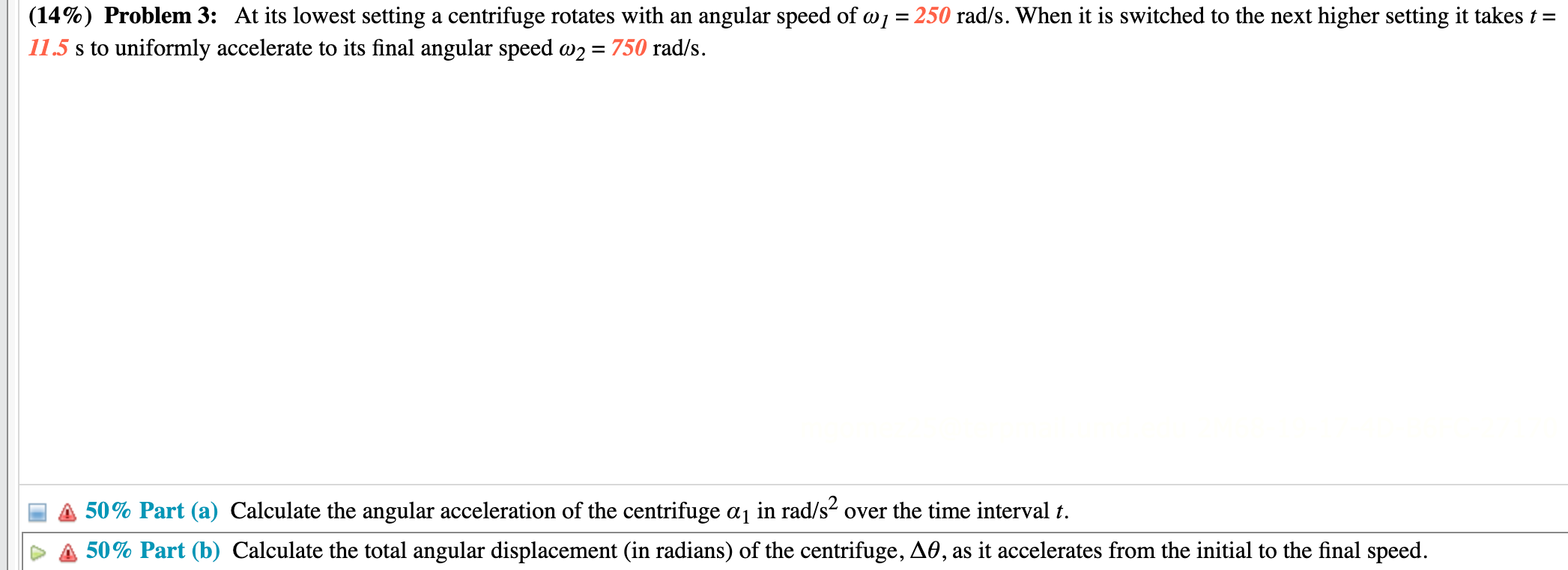
Question: (14%) Problem 3: At its lowest setting a centrifuge rotates with an angular speed of w] = 250 rad/s. When it is switched to the
![an angular speed of w] = 250 rad/s. When it is switched](https://dsd5zvtm8ll6.cloudfront.net/si.experts.images/questions/2024/09/66f6cf0da4d57_89366f6cf0d8344a.jpg)
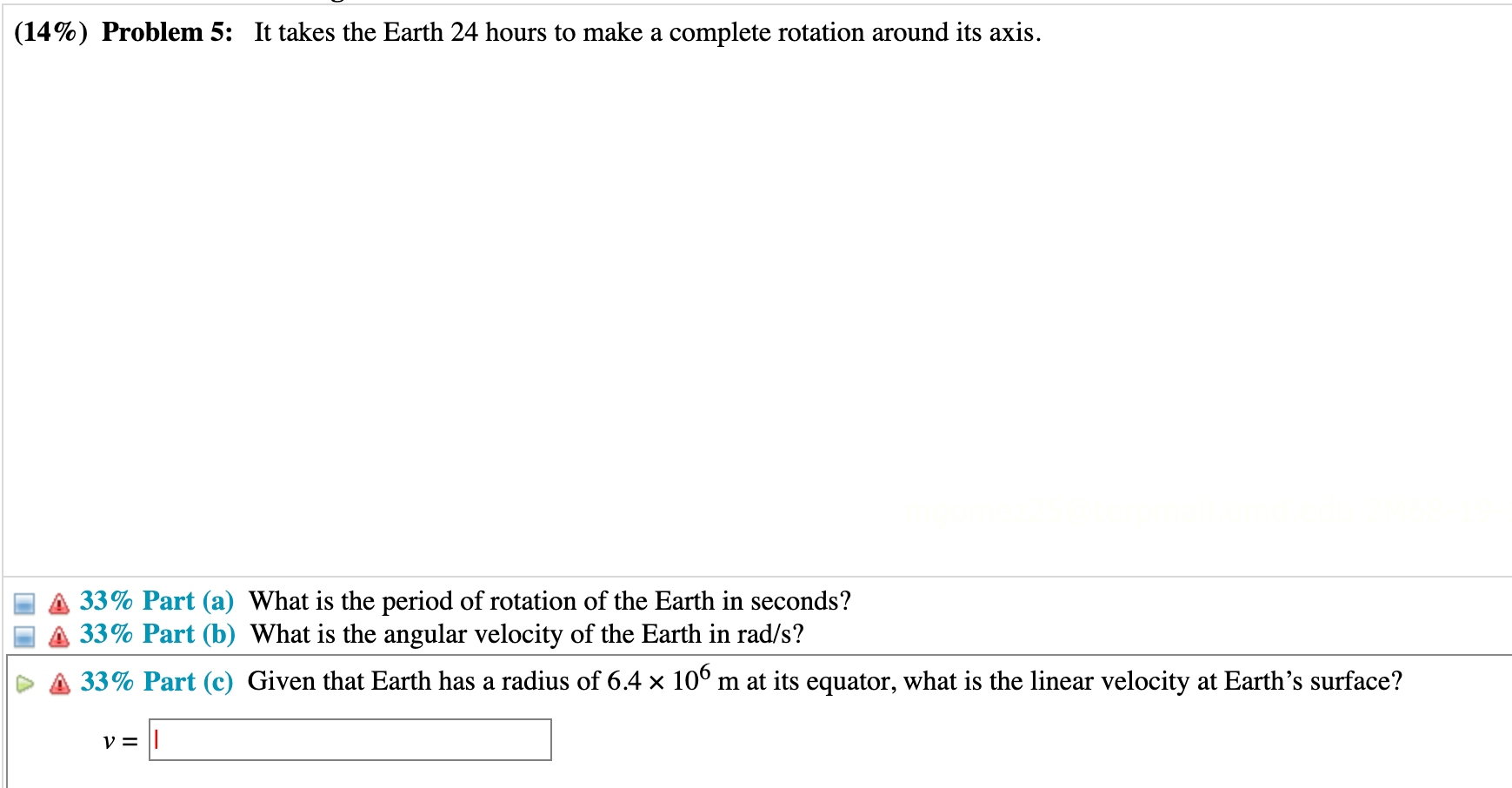
(14%) Problem 3: At its lowest setting a centrifuge rotates with an angular speed of w] = 250 rad/s. When it is switched to the next higher setting it takes I: 11.5 s to uniformly accelerate to its nal angular speed (02 = 750 rad/s. A 50% Part (a) Calculate the angular acceleration of the centrifuge al in rad/s2 over the time interval t. [> 3 50% Part (b) Calculate the total angular displacement (in radians) of the centrifuge, A6, as it accelerates from the initial to the nal speed. (14%) Problem 4: With the aid of a string, a gyroscope is accelerated from rest to 37 rad/s in 0.39 s. Randomized Variables (0 =37 radfs t = 0.39 s E 50% Part (a) What is its angular acceleration, in radians per square seconds? D a 50% Part (b) How many revolutions does it go through in the process? 6=| (14%) Problem 5: It takes the Earth 24 hours to make a complete rotation around its axis. E a 33% Part (a) What is the period of rotation of the Earth in seconds? 3 33% Part (b) What is the angular velocity of the Earth in rad/s? D it 33% Part (c) Given that Earth has a radius of 6.4 x 10⁶ m at its equator, what is the linear velocity at Earth's surface? v=ll|
Step by Step Solution
There are 3 Steps involved in it

Get step-by-step solutions from verified subject matter experts