Question: . 153 Knowing the Difference between Major and Minor Details EXERCISES Connecting Topic Sentences and Supporting Details DIRECTIONS Read each paragraph and write the number
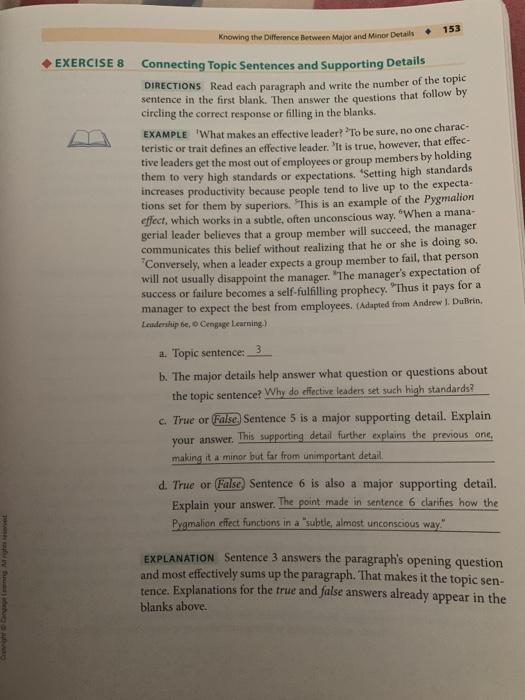
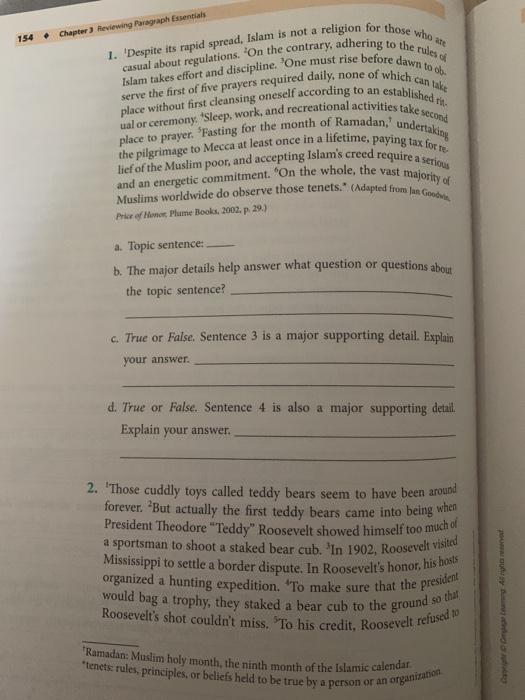
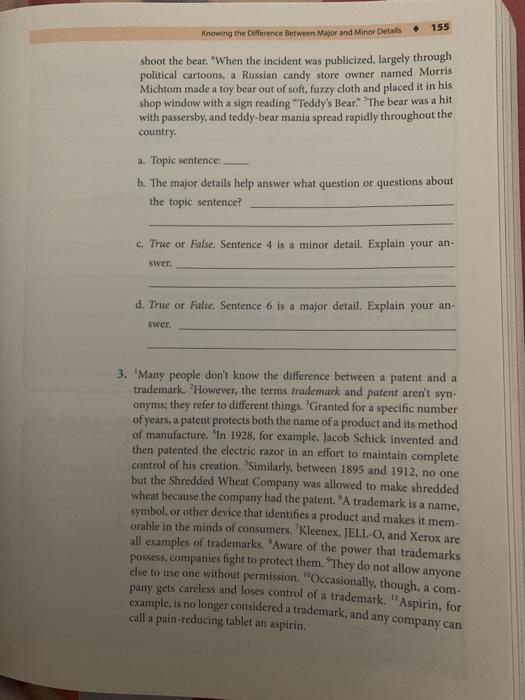
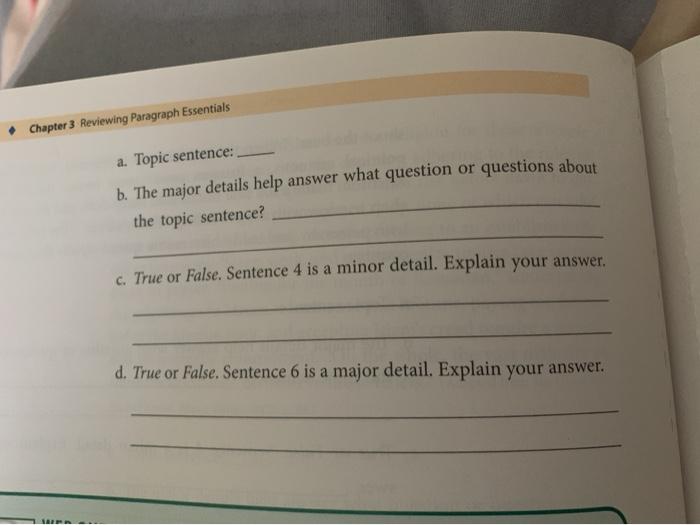
. 153 Knowing the Difference between Major and Minor Details EXERCISES Connecting Topic Sentences and Supporting Details DIRECTIONS Read each paragraph and write the number of the topic sentence in the first blank. Then answer the questions that follow by circling the correct response or filling in the blanks EXAMPLE 'What makes an effective leader? To be sure, no one charac- teristic or trait defines an effective leader. 'It is true, however, that effec- tive leaders get the most out of employees or group members by holding them to very high standards or expectations. "Setting high standards increases productivity because people tend to live up to the expecta- tions set for them by superiors. This is an example of the Pygmalion effect, which works in a subtle, often unconscious way, "When a mana- gerial leader believes that a group member will succeed, the manager communicates this belief without realizing that he or she is doing so. Conversely, when a leader expects a group member to fail, that person will not usually disappoint the manager. "The manager's expectation of success or failure becomes a self-fulfilling prophecy. Thus it pays for a manager to expect the best from employees. (Adapted from Andrew I. DuBrin, Leadership, o engage Learning) a. Topic sentence: 3 b. The major details help answer what question or questions about the topic sentence? Why do effective leaders set such high standards? c. True or False Sentence 5 is a major supporting detail. Explain your answer. This supporting detail further explains the previous one, making it a minor but far from unimportant detail d. True or False, Sentence 6 is also a major supporting detail. Explain your answer. The point made in sentence 6 clarifies how the Pygmalion effect functions in a subtle, almost unconscious way." EXPLANATION Sentence 3 answers the paragraph's opening question and most effectively sums up the paragraph. That makes it the topic sen- tence. Explanations for the true and false answers already appear in the blanks above Ramadan: Muslim holy month, the ninth month of the Islamic calendar 154 . Chapter Reviewing Paragraph Essentials which can al established in place without first cleansing oneself according to an 1. Despite its rapid spread, Islam is not a religion for those who att casual about regulations. On the contrary, adhering to the rules o Islam takes effort and discipline. One must rise before dawn to do ual or ceremony: Sleep, work, and recreational activities take second place to prayer. "Fasting for the month of Ramadan, undertaking the pilgrimage to Mecca at least once in a lifetime, paying tax for and an energetic commitment. On the whole, the vast majority of lief of the Muslim poor, and accepting Islam's creed require a serious Muslims worldwide do observe those tenets." (Adapted from an Good President Theodore "Teddy Roosevelt showed himself too much of a sportsman to shoot a staked bear cub. In 1902, Roosevelt visited Mississippi to settle a border dispute. In Roosevelt's honor, his hosts organized a hunting expedition. To make sure that the president would bag a trophy, they staked a bear cub to the ground so that Roosevelt's shot couldn't miss. To his credit, Roosevelt refused to Prior of Monet Plume Book, 2002, p. 29.) a. Topic sentence: b. The major details help answer what question or questions about the topic sentence? c. True or False. Sentence 3 is a major supporting detail. Explain your answer. d. True or False. Sentence 4 is also a major supporting detail. Explain your answer. 2. "Those cuddly toys called teddy bears seem to have been around forever. But actually the first teddy bears came into being when vo "tenets: rules, principles, or beliefs held to be true by a person or an organization 155 Knowing the Difference Between for and Minor Details shoot the bear. "When the incident was publicized, largely through political cartoons, a Russian candy store owner named Morris Michtom made a toy bear out of soft, fuzzy cloth and placed it in his shop window with a sign reading "Teddy's Bear." "The bear was a hit with passersby, and teddy bear mania spread rapidly throughout the country a. Topic sentence: b. The major details help answer what question or questions about the topic sentence? c. True or False. Sentence 4 is a minor detail. Explain your an- swer. d. True or False. Sentence 6 is a major detail. Explain your an- swer. 3. Many people don't know the difference between a patent and a trademark. However, the terms trademark and patent aren't syn- onyms, they refer to different things. Granted for a specific number of years, a patent protects both the name of a product and its method of manufacture. "In 1928, for example, Jacob Schick invented and then patented the electric razor in an effort to maintain complete control of his creation. Similarly, between 1895 and 1912, no one but the Shredded Wheat Company was allowed to make shredded wheat because the company had the patent. A trademark is a name, symbol, or other device that identifies a product and makes it mem- orable in the minds of consumers. Kleenex, JELL-O, and Xerox are all examples of trademarks. Aware of the power that trademarks possess companies fight to protect them. They do not allow anyone else to use one without permission. "Occasionally, though, a com- pany gets careless and loses control of a trademark. "Aspirin, for example, is no longer considered a trademark, and any company can call a pain-reducing tablet an aspirin. Chapter 3 Reviewing Paragraph Essentials questions about a. Topic sentence: b. The major details help answer what question or the topic sentence? c. True or False. Sentence 4 is a minor detail. Explain your answer. d. True or False. Sentence 6 is a major detail. Explain your









 Study Help