Question: 16. [-/2.64 Points] DETAILS DEVORESTAT9 9.1.007. MY NOTES ASK YOUR TEACHER PRACTICE ANOTHER Is there any systematic tendency for part-time college faculty to hold their

 16. [-/2.64 Points] DETAILS DEVORESTAT9 9.1.007. MY NOTES ASK YOUR TEACHER
PRACTICE ANOTHER Is there any systematic tendency for part-time college faculty to

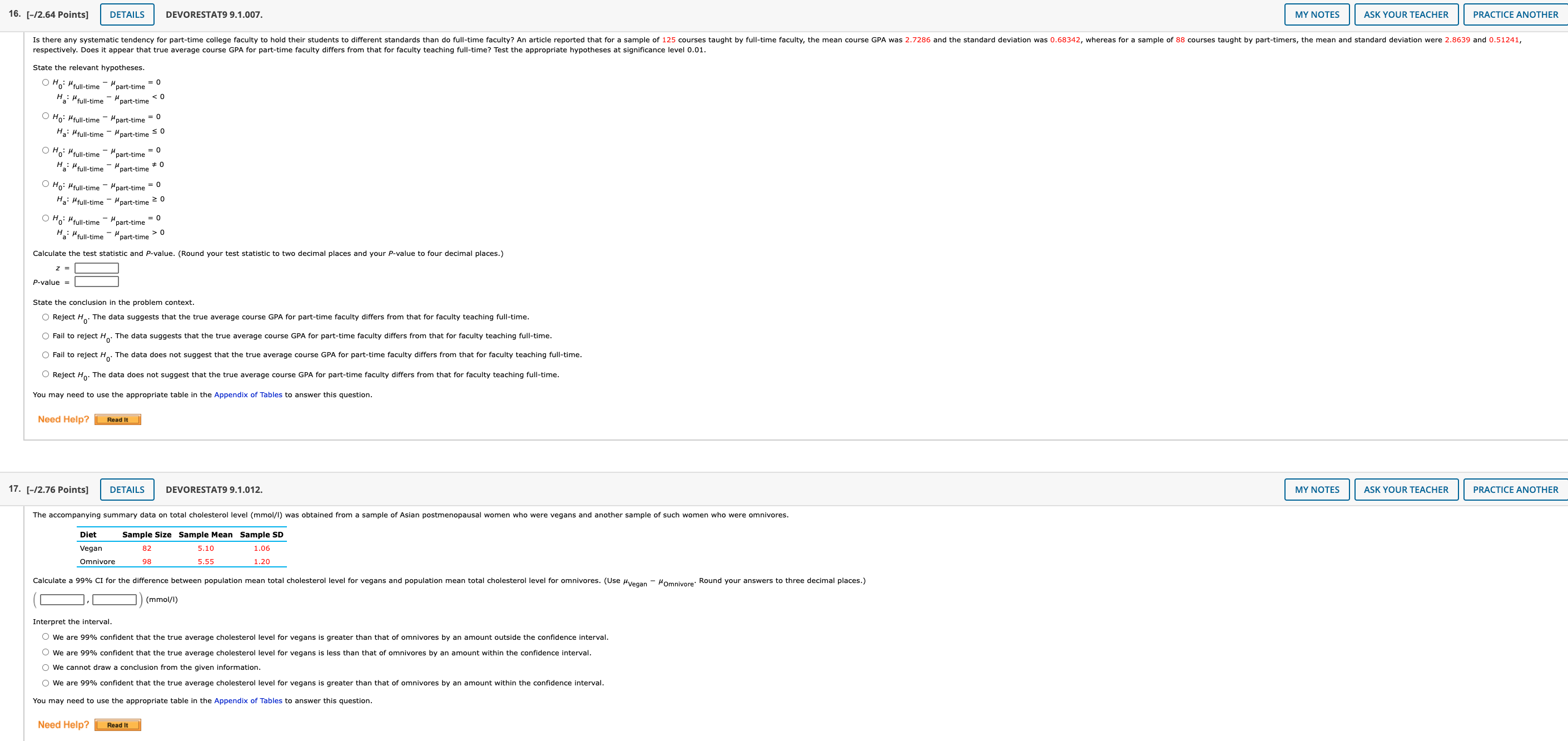
16. [-/2.64 Points] DETAILS DEVORESTAT9 9.1.007. MY NOTES ASK YOUR TEACHER PRACTICE ANOTHER Is there any systematic tendency for part-time college faculty to hold their students to different standards than do full-time faculty? An article reported that for a sample of 125 courses taught by full-time faculty, the mean course GPA was 2.7286 and the standard deviation was 0.68342, whereas for a sample of 88 courses taught by part-timers, the mean and standard deviation were 2.8639 and 0.51241, respectively. Does it appear that true average course GPA for part-time faculty differs from that for faculty teaching full-time? Test the appropriate hypotheses at significance level 0.01. State the relevant hypotheses. O Ho: "full-time part-time = 0 Ha: " full-time - "part-time o Calculate the test statistic and P-value. (Round your test statistic to two decimal places and your P-value to four decimal places.) P-value = State the conclusion in the problem context. O Reject H. The data suggests that the true average course GPA for part-time faculty differs from that for faculty teaching full-time. Fail to reject H. The data suggests that the true average course GPA for part-time faculty differs from that for faculty teaching full-time. O Fail to reject H. The data does not suggest that the true average course GPA for part-time faculty differs from that for faculty teaching full-time. O Reject Ho. The data does not suggest that the true average course GPA for part-time faculty differs from that for faculty teaching full-time. You may need to use the appropriate table in the Appendix of Tables to answer this question. Need Help? Read It 17. [-/2.76 Points] DETAILS DEVORESTAT9 9.1.012. MY NOTES ASK YOUR TEACHER PRACTICE ANOTHER The accompanying summary data on total cholesterol level (mmol/1) was obtained from a sample of Asian postmenopausal women who were vegans and another sample of such women who were omnivores. Diet Sample Size Sample Mean Sample SD Vegan 82 5.10 1.06 Omnivore 98 5.55 1.20 Calculate a 99% CI for the difference between population mean total cholesterol level for vegans and population mean total cholesterol level for omnivores. (Use /Vegan - Homnivore- Round your answers to three decimal places.) (mmol/1) Interpret the interval. We are 99% confident that the true average cholesterol level for vegans is greater than that of omnivores by an amount outside the confidence interval. We are 99% confident that the true average cholesterol level for vegans is less than that of omnivores by an amount within the confidence interval. O We cannot draw a conclusion from the given information. We are 99% confident that the true average cholesterol level for vegans is greater than that of omnivores by an amount within the confidence interval. You may need to use the appropriate table in the Appendix of Tables to answer this question. Need Help? Read It

Step by Step Solution

There are 3 Steps involved in it

1 Expert Approved Answer
Step: 1 Unlock blur-text-image
Question Has Been Solved by an Expert!

Get step-by-step solutions from verified subject matter experts

Step: 2 Unlock
Step: 3 Unlock

Students Have Also Explored These Related Mathematics Questions!