







Question: 160 Chapter 4: Ratio and Regression Estimation b It often does not work as well as (4.10) in practice, however: Ifs, and sy are large,
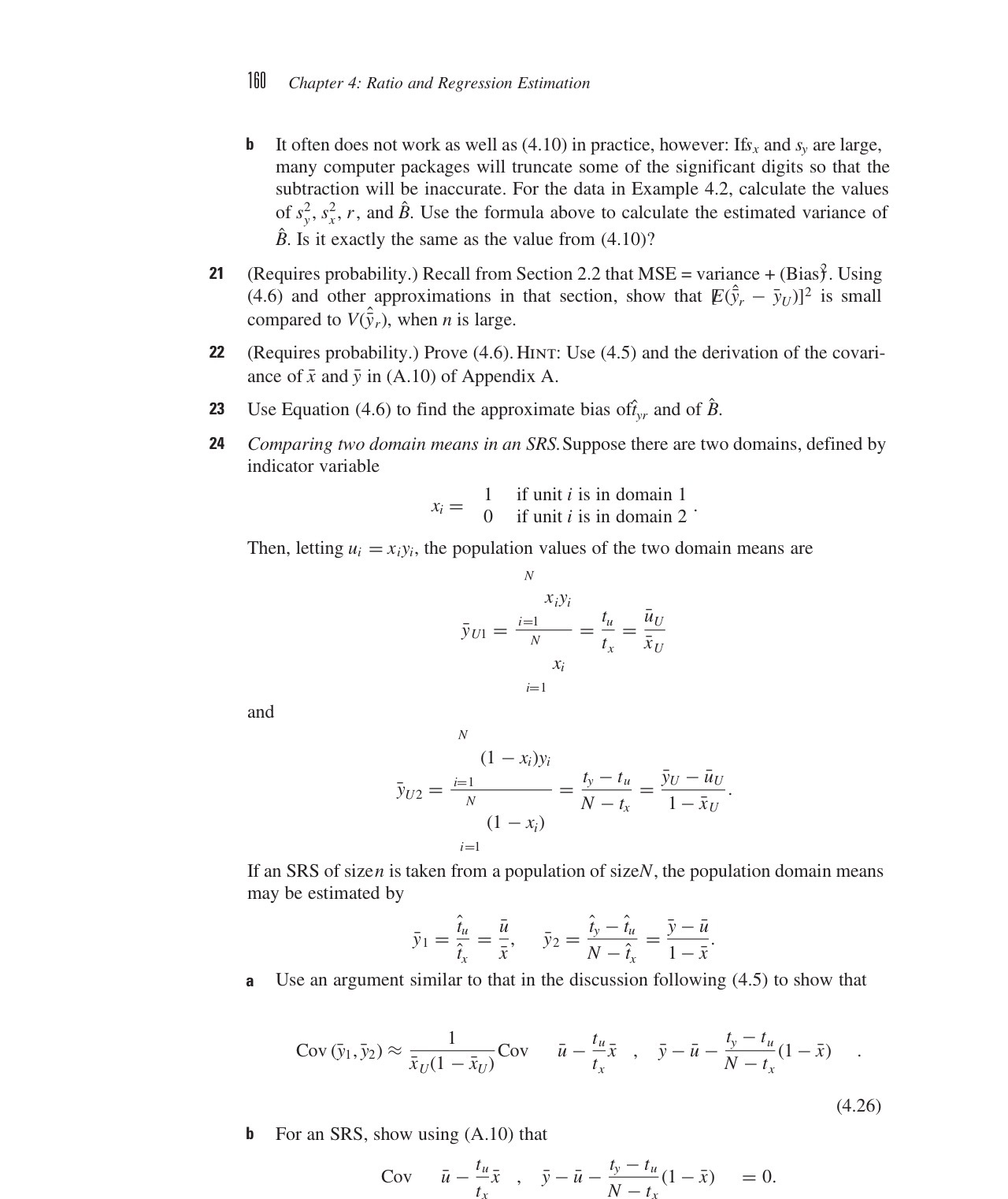
160 Chapter 4: Ratio and Regression Estimation b It often does not work as well as (4.10) in practice, however: Ifs, and sy are large, many computer packages will truncate some of the significant digits so that the subtraction will be inaccurate. For the data in Example 4.2, calculate the values of s , S,, r, and B. Use the formula above to calculate the estimated variance of B. Is it exactly the same as the value from (4.10)? 21 (Requires probability.) Recall from Section 2.2 that MSE = variance + (Bias). Using (4.6) and other approximations in that section, show that E(), - yu)] is small compared to V(yr), when n is large. 22 (Requires probability.) Prove (4.6). HINT: Use (4.5) and the derivation of the covari- ance of x and y in (A.10) of Appendix A. 23 Use Equation (4.6) to find the approximate bias off, and of B. 24 Comparing two domain means in an SRS. Suppose there are two domains, defined by indicator variable xi = if unit i is in domain 1 0 if unit i is in domain 2 Then, letting u; = x;yi, the population values of the two domain means are XiVi uU N t . xu i=1 and V (1 - xi)yi ty - tu yu - uu N N - tx 1 - xu (1 - x;) i=1 If an SRS of sizen is taken from a population of sizeN, the population domain means may be estimated by 31 = ty - tu _ y - u N - 1 1-x a Use an argument similar to that in the discussion following (4.5) to show that Cov (V1, )2) ~ 1 Cov u - "x , ju- ty u (1-x ) xu(1 - XU) tx N- tx (4.26) b For an SRS, show using (A.10) that Cov u - "x , ju-x ly " (1 - x) = 0. N
Step by Step Solution
There are 3 Steps involved in it

Get step-by-step solutions from verified subject matter experts
 Study Help