







Question: 192. modified) context (current and desired state), problem (gap between current and desired state) and solution (selection of one of the possible ways of achieving
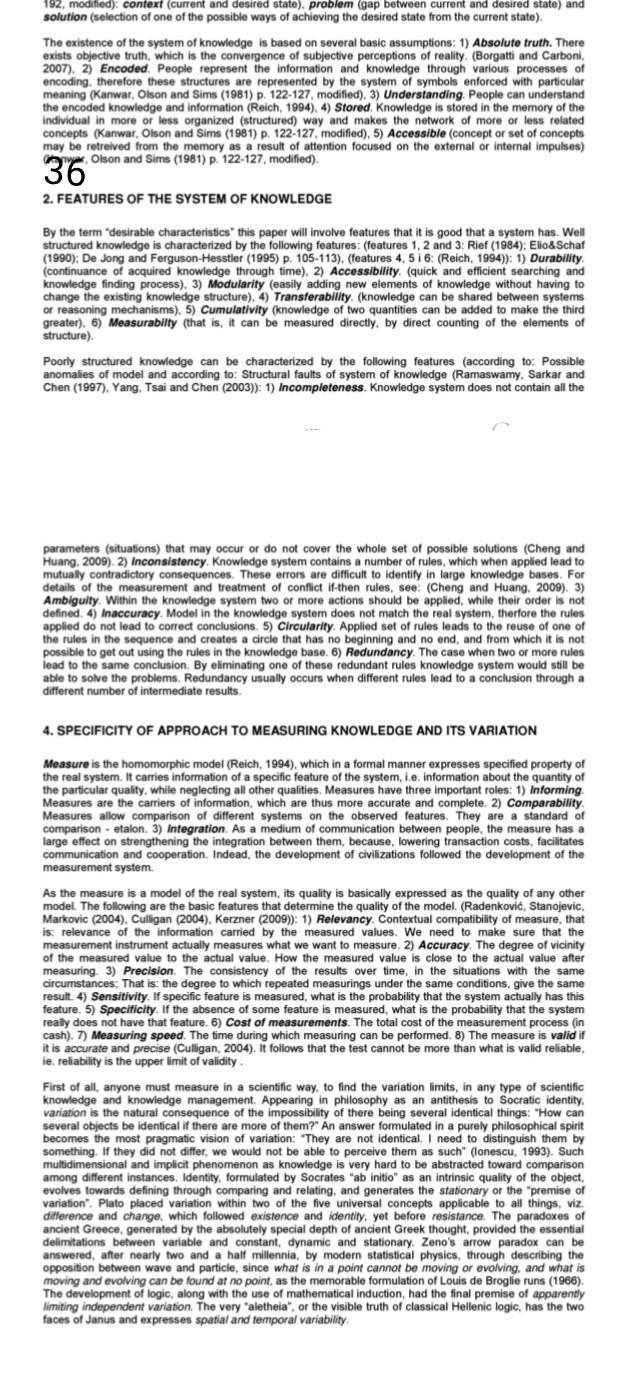

192. modified) context (current and desired state), problem (gap between current and desired state) and solution (selection of one of the possible ways of achieving the desired state from the current state). The existence of the system of knowledge is based on several basic assumptions: 1) Absolute truth. There exists objective truth, which is the convergence of subjective perceptions of reality (Borgatti and Carboni, 2007), 2) Encoded. People represent the information and knowledge through various processes of encoding, therefore these structures are represented by the system of symbols enforced with particular meaning (Kanwar, Olson and Sims (1981) p. 122-127 modified). 3) Understanding. People can understand the encoded knowledge and information (Reich, 1994). 4) Stored. Knowledge is stored in the memory of the individual in more or less organized (structured) way and makes the network of more or less related concepts (Kanwar, Olson and Sims (1981) p. 122-127 modified), 5) Accessible (concept or set of concepts may be retreived from the memory as a result of attention focused on the external or internal impulses) Olson and Sims (1981) p. 122-127, modified) 36 2. FEATURES OF THE SYSTEM OF KNOWLEDGE By the term "desirable characteristics this paper will involve features that it is good that a system has. Well structured knowledge is characterized by the following features: (features 1, 2 and 3: Rief (1984), Elio&Schaf (1990): De Jong and Ferguson-Hesstier (1995) p. 105-113), (features 4,516: (Reich, 1994)): 1) Durability (continuance of acquired knowledge through time). 2) Accessibility (quick and efficient searching and knowledge finding process), 3) Modularity (easily adding new elements of knowledge without having to change the existing knowledge structure), Transferability (knowledge can be shared between systems or reasoning mechanisms). 5) Cumulativity (knowledge of two quantities can be added to make the third greater). 6) Measurabilty (that is, it can be measured directly by direct counting of the elements of structure) Poorly structured knowledge can be characterized by the following features (according to: Possible anomalies of model and according to: Structural faults of system of knowledge (Ramaswamy. Sarkar and Chen (1997), Yang, Tsai and Chen (2003)): 1) Incompleteness. Knowledge system does not contain all the parameters (situations) that may occur or do not cover the whole set of possible solutions (Cheng and Huang, 2009). 2) Inconsistency Knowledge system contains a number of rules, which when applied lead to mutually contradictory consequences. These errors are difficult to identity in large knowledge bases. For details of the measurement and treatment of conflict if-then rules, see: (Cheng and Huang, 2009). 3) Ambiguity. Within the knowledge system two or more actions should be applied, while their order is not defined. 4) Inaccuracy. Model in the knowledge system does not match the real system, therfore the rules applied do not lead to correct conclusions. 5) Circularity. Applied set of rules leads to the reuse of one of the rules in the sequence and creates a circle that has no beginning and no end, and from which it is not possible to get out using the rules in the knowledge base. 6) Redundancy. The case when two or more rules lead to the same conclusion. By eliminating one of these redundant rules knowledge system would still be able to solve the problems. Redundancy usually occurs when different rules lead to a conclusion through a different number of intermediate results 4. SPECIFICITY OF APPROACH TO MEASURING KNOWLEDGE AND ITS VARIATION Measure is the homomorphic model (Reich, 1994), which in a formal manner expresses specified property of the real system. It carries information of a specific feature of the system, i.e. information about the quantity of the particular quality, while neglecting all other qualities. Measures have three important roles: 1) Informing Measures are the carriers of information, which are thus more accurate and complete. 2) Comparability Measures allow comparison of different systems on the observed features. They are a standard of comparison - etalon. 3) Integration. As a medium of communication between people, the measure has a large effect on strengthening the integration between them, because, lowering transaction costs, facilitates communication and cooperation. Indead, the development of civilizations followed the development of the measurement system. As the measure is a model of the real system, its quality is basically expressed as the quality of any other model. The following are the basic features that determine the quality of the model. (Radenkovi, Stanojevic, Markovic (2004). Culligan (2004), Kerzner (2009): 1) Relevancy. Contextual compatibility of measure, that is relevance of the information carried by the measured values. We need to make sure that the measurement instrument actually measures what we want measure. 2) Accuracy. The degree of vicinity of the measured value to the actual value. How the measured value is close to the actual value after measuring 3) Precision. The consistency of the results over time, in the situations with the same circumstances. That is the degree to which repeated measurings under the same conditions, give the same result. 4) Sensitivity. If specific feature is measured, what is the probability that the system actually has this feature. 5) Specificity. If the absence of some feature is measured, what is the probability that the system realy does not have that feature. 6) Cost of measurements. The total cost of the measurement process in cash). 7) Measuring speed. The time during which measuring can be performed. 8) The measure is valid if it is accurate and precise (Culligan, 2004). It follows that the test cannot be more than what is valid reliable, le reliability is the upper limit of validity First of all, anyone must measure in a scientific way to find the variation limits, in any type of scientific knowledge and knowledge management. Appearing in philosophy as an antithesis to Socratic identity variation is the natural consequence of the impossibility of there being several identical things: "How can several objects be identical if there are more of them?" An answer formulated in a purely philosophical spirit becomes the most pragmatic vision of variation: "They are not identical. I need to distinguish them by something. If they did not differ, we would not be able to perceive them as such" (lonescu, 1993). Such multidimensional and implicit phenomenon as knowledge is very hard to be abstracted toward comparison among different instances. Identity, formulated by Socrates "ab initio" as an intrinsic quality of the object, evolves towards defining through comparing and relating, and generates the stationary or the "premise of variation". Plato placed variation within two of the five universal concepts applicable to all things, viz. difference and change, which followed existence and identity, yet before resistance. The paradoxes of ancient Greece, generated by the absolutely special depth of ancient Greek thought, provided the essential delimitations between variable and constant, dynamic and stationary. Zeno's arrow paradox can be answered, after nearly two and a half millennia, by modern statistical physics, through describing the opposition between wave and particle, since what is in a point cannot be moving or evolving, and what is moving and evolving can be found at no point, as the memorable formulation of Louis de Broglie runs (1966), The development of logic, along with the use of mathematical induction, had the final premise of apparently limiting independent variation. The very "aletheia", or the visible truth of classical Hellenic logic, has the two faces of Janus and expresses spatial and temporal variability Q38 hassle 1: Carolyn Barrett, a advertising and marketing surveyor, takes a mean of 10 minutes to finish a selected questionnaire. Carolyns performance rating (pace) is a hundred and ten% and there's an allowance of 15%. what's the everyday time for finishing this questionnaire? what's the same old time for finishing this questionnaire? trouble 2: Tom Leonard, of Leonard, Spitz, and Wareham, takes three hours and 25 minutes to write an stop of month file. Tom is rated at 95% (work tempo is 95%) and the office has a personal time allowance of eight%. there is no put off time or fatigue time. what is the normal time for writing an give up of month record? what's the usual time for writing an end of month file
Step by Step Solution
There are 3 Steps involved in it
1 Expert Approved Answer
Step: 1 Unlock

Question Has Been Solved by an Expert!
Get step-by-step solutions from verified subject matter experts
Step: 2 Unlock
Step: 3 Unlock
 Study Help