







Question: 19-21 please Simulation Link: htt s: het.co|orado.edu sims html wave-interference latest wave-interference en.html [Part B: Interference Adding in Slits Select the 'Slits' option at the
19-21 please
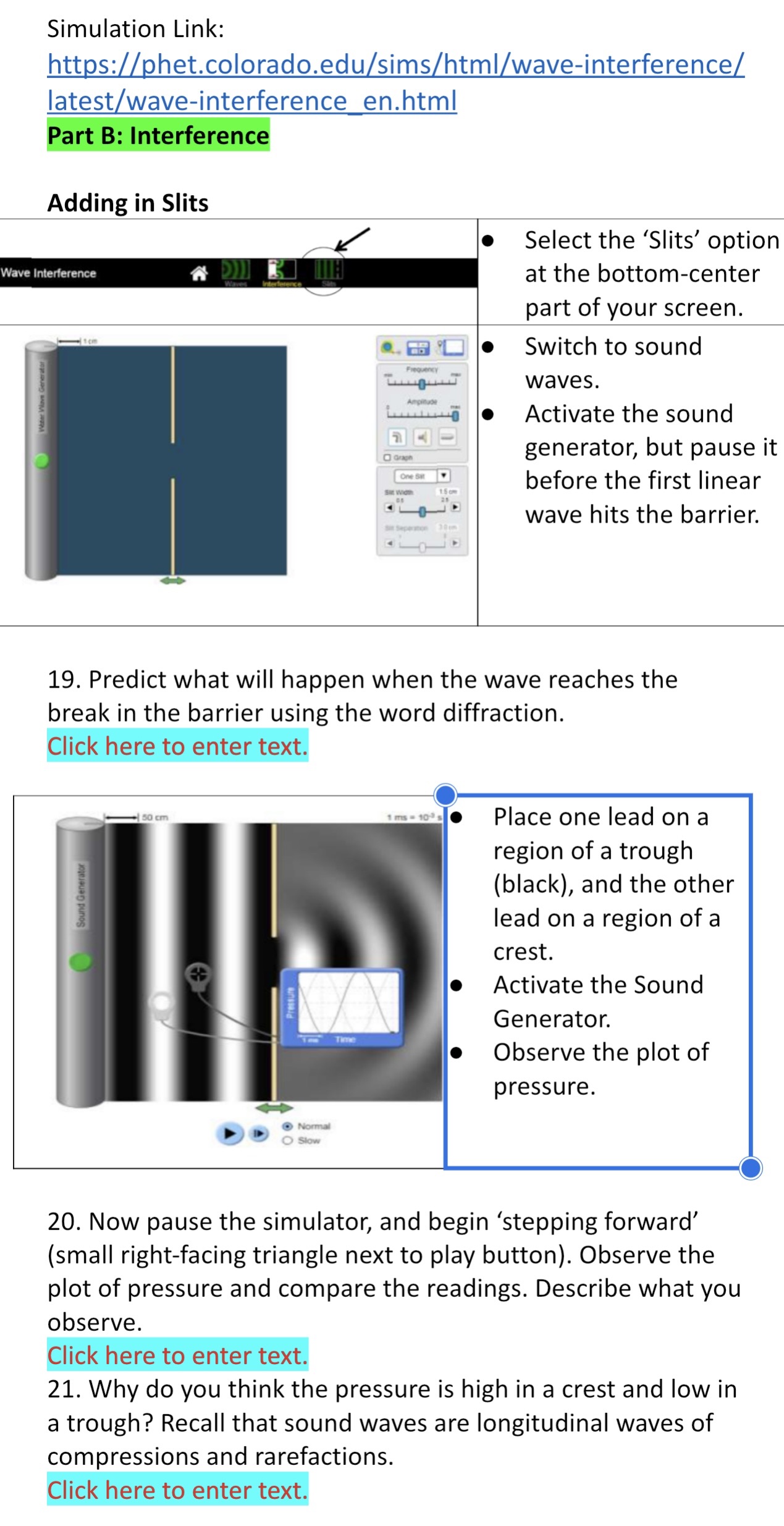
Simulation Link: htt s: het.co|orado.edu sims html wave-interference latest wave-interference en.html [Part B: Interference Adding in Slits Select the 'Slits' option at the bottom-center part of your screen. LE '13 0 Switch to sound 133-3 waves. m Activate the sound i It - 0;.7 7 generator, but pause It _-_ before the first linear 'T i\" wave hits the barrier. 19. Predict what will happen when the wave reaches the break in the barrier using the word diffraction. Click here to enter text. Place one lead on a region of a trough (black), and the other lead on a region of a crest. Activate the Sound Generator. Observe the plot of pressure. 20. Now pause the simulator, and begin 'stepping forward' (small right-facing triangle next to play button). Observe the plot of pressure and compare the readings. Describe what you observe. Click here to enter text. 21. Why do you think the pressure is high in a crest and low in a trough? Recall that sound waves are longitudinal waves of compressions and rarefactions. Click here to enter text
Step by Step Solution
There are 3 Steps involved in it

Get step-by-step solutions from verified subject matter experts
 Study Help