







Question: 1a) For the current system, determine the maximum outside arrival rate that the bottleneck station can handle and still keep up. 1b) For the proposed
1a) For the current system, determine the maximum outside arrival rate that the bottleneck station can handle and still keep up. 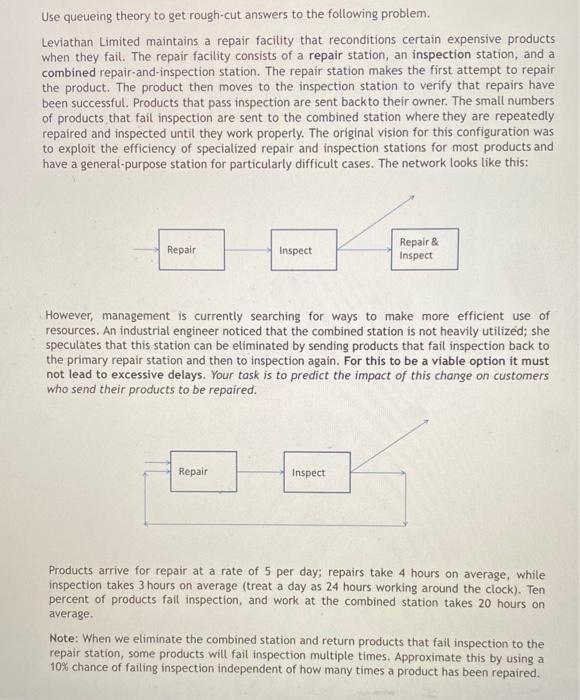
1b) For the proposed system determine the maximum outside arrival rate that the bottleneck station can handle and still keep up.
2a) For both the current and proposed systems set the outside arrival rate yo the minimum of the two maximum outside arrival rates you determined in question 1a and 1b.
2b) For both the current and proposed systems add a server to the bottleneck station (so now it is M/M/2).
how to calculate the arrival rates for each queue on the first model and the second model would be greatly appreciated.
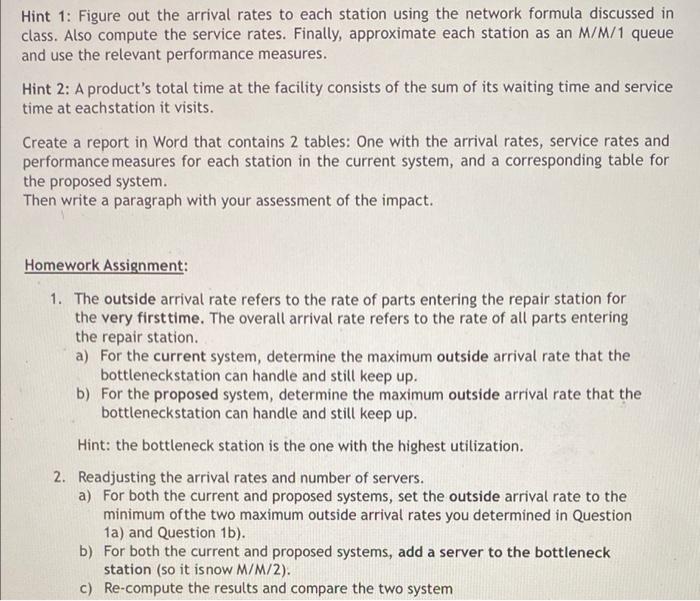
Use queueing theory to get rough-cut answers to the following problem. Leviathan Limited maintains a repair facility that reconditions certain expensive products when they fail. The repair facility consists of a repair station, an inspection station, and a combined repair-and-inspection station. The repair station makes the first attempt to repair the product. The product then moves to the inspection station to verify that repairs have been successful. Products that pass inspection are sent back to their owner. The small numbers of products that fail inspection are sent to the combined station where they are repeatedly repaired and inspected until they work properly. The original vision for this configuration was to exploit the efficiency of specialized repair and inspection stations for most products and have a general-purpose station for particularly difficult cases. The network looks like this: Repair Inspect Repair & Inspect However, management is currently searching for ways to make more efficient use of resources. An industrial engineer noticed that the combined station is not heavily utilized; she speculates that this station can be eliminated by sending products that fail inspection back to the primary repair station and then to inspection again. For this to be a viable option it must not lead to excessive delays. Your task is to predict the impact of this change on customers who send their products to be repaired. Repair Inspect Products arrive for repair at a rate of 5 per day; repairs take 4 hours on average, while inspection takes 3 hours on average (treat a day as 24 hours working around the clock). Ten percent of products fail inspection, and work at the combined station takes 20 hours on average. Note: When we eliminate the combined station and return products that fail inspection to the repair station, some products will fail inspection multiple times. Approximate this by using a 10% chance of failing inspection independent of how many times a product has been repaired. Hint 1: Figure out the arrival rates to each station using the network formula discussed in class. Also compute the service rates. Finally, approximate each station as an M/M/1 queue and use the relevant performance measures. Hint 2: A product's total time at the facility consists of the sum of its waiting time and service time at eachstation it visits. Create a report in Word that contains 2 tables: One with the arrival rates, service rates and performance measures for each station in the current system, and a corresponding table for the proposed system. Then write a paragraph with your assessment of the impact. Homework Assignment: 1. The outside arrival rate refers to the rate of parts entering the repair station for the very first time. The overall arrival rate refers to the rate of all parts entering the repair station. a) For the current system, determine the maximum outside arrival rate that the bottleneckstation can handle and still keep up. b) For the proposed system, determine the maximum outside arrival rate that the bottleneckstation can handle and still keep up. Hint: the bottleneck station is the one with the highest utilization. 2. Readjusting the arrival rates and number of servers. a) For both the current and proposed systems, set the outside arrival rate to the minimum of the two maximum outside arrival rates you determined in Question 1a) and Question 1b). b) For both the current and proposed systems, add a server to the bottleneck station (so it is now M/M/2). c) Re-compute the results and compare the two system Step by Step Solution
There are 3 Steps involved in it
1 Expert Approved Answer
Step: 1 Unlock

Question Has Been Solved by an Expert!
Get step-by-step solutions from verified subject matter experts
Step: 2 Unlock
Step: 3 Unlock
 Study Help