







Question: 2, (10 points) Consider the alphabet ? = {0,1). We'll use the same sets from this week's individual homework, generalized to arbitrary positive integers k2
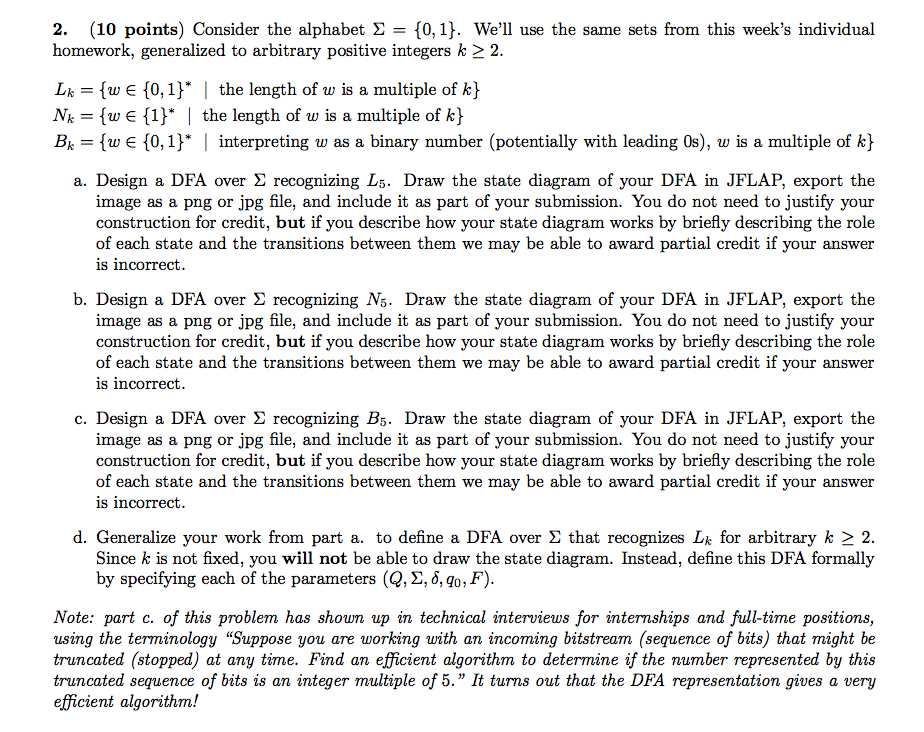
2, (10 points) Consider the alphabet ? = {0,1). We'll use the same sets from this week's individual homework, generalized to arbitrary positive integers k2 2 Lk-{wE 10,1}* the length of w is a multiple of k} Be = {w E {0, 1)" I interpreting w as a binary number (potentially with leading 0s), w is a multiple of k {w E {1)" | the length of w is a multiple of k a. Design a DFA over ? recognizing L5-Draw the state diagram of your DFA in JFLAP, export the image as a png or jpg file, and include it as part of your submission. You do not need to justify your construction for credit, but if you describe how your state diagram works by briefly describing the role of each state and the transitions between them we may be able to award partial credit if your answer is incorrect b. Design a DFA over ? recognizing MS. Draw the state diagram of your DFA in JFLAP, export the image as a png or jpg file, and include it as part of your submission. You do not need to justify your construction for credit, but if you describe how your state diagram works by briefly describing the role of each state and the transitions between them we may be able to award partial credit if your answer is incorrect c. Design a DFA over ? recognizing B5. Draw the state diagram of your DFA in JFLAP, export the image as a png or jpg file, and include it as part of your submission. You do not need to justify your construction for credit, but if you describe how your state diagram works by briefly describing the role of each state and the transitions between them we may be able to award partial credit if your answer is incorrect d. Generalize your work from part a. to define a DFA over ? that recognizes Lk for arbitrary k > 2 Since k is not fixed, you will not be able to draw the state diagram. Instead, define this DFA formally by specifying each of the parameters (Q, 2, 6, go, F) Note: part c. of this problem has shown up in technical interviews for internships and full-time positions, using the terminology "Suppose you are working with an incoming bitstream (sequence of bits) that might be truncated (stopped) at any time. Find an efficient algorithm to determine if the number represented by this truncated sequence of bits is an integer multiple of 5." It turns out that the DFA representation gives a very efficient algorithm
Step by Step Solution
There are 3 Steps involved in it

Get step-by-step solutions from verified subject matter experts
 Study Help