







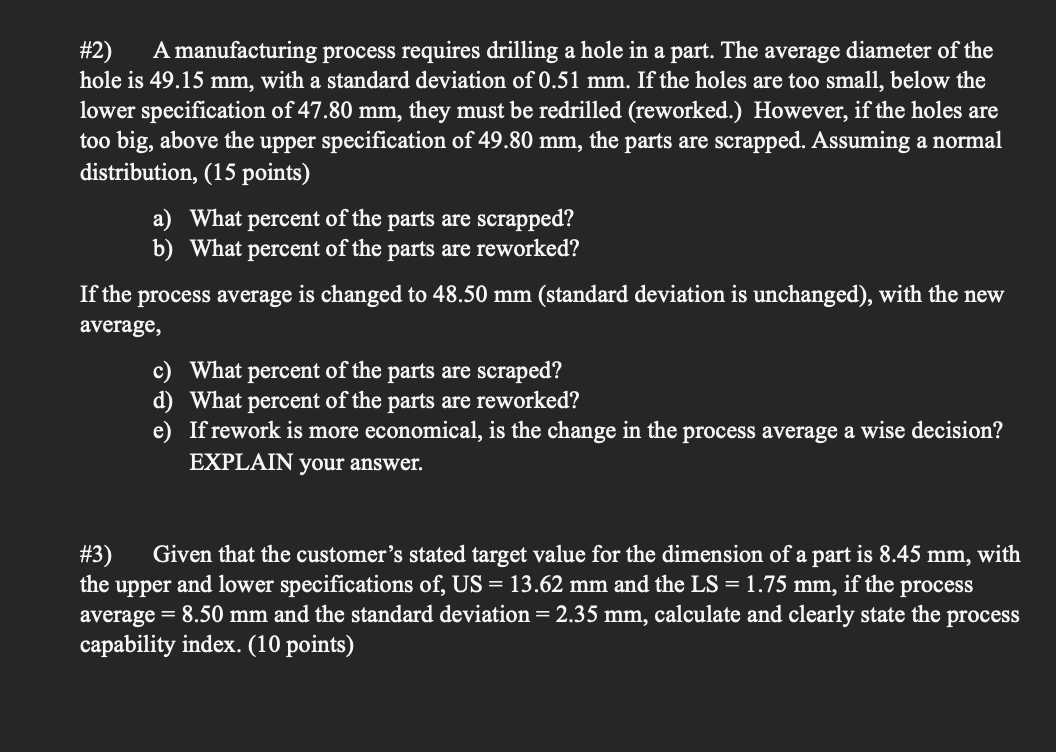
Question: # 2 ) A manufacturing process requires drilling a hole in a part. The average diameter of the hole is 4 9 . 1 5
# A manufacturing process requires drilling a hole in a part. The average diameter of the
hole is with a standard deviation of If the holes are too small, below the
lower specification of they must be redrilled reworked However, if the holes are
too big, above the upper specification of the parts are scrapped. Assuming a normal
distribution, points
a What percent of the parts are scrapped?
b What percent of the parts are reworked?
If the process average is changed to standard deviation is unchanged with the new
average,
c What percent of the parts are scraped?
d What percent of the parts are reworked?
e If rework is more economical, is the change in the process average a wise decision?
EXPLAIN your answer.
# Given that the customer's stated target value for the dimension of a part is with
the upper and lower specifications of US and the if the process
average and the standard deviation calculate and clearly state the process
capability index. points
Step by Step Solution
There are 3 Steps involved in it
1 Expert Approved Answer
Step: 1 Unlock

Question Has Been Solved by an Expert!
Get step-by-step solutions from verified subject matter experts
Step: 2 Unlock
Step: 3 Unlock
 Study Help