







Question: 2 A simple process has four stages - A. B. C, and D. The average amount of work needed to process items passing through these
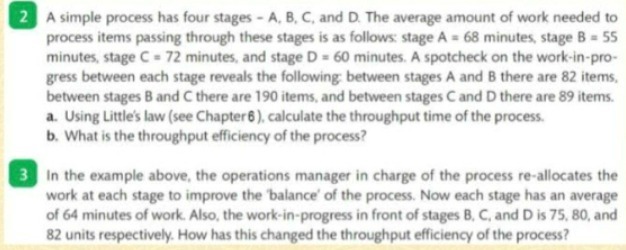
2 A simple process has four stages - A. B. C, and D. The average amount of work needed to process items passing through these stages is as follows: stage A = 68 minutes, stage B = 55 minutes, stage C = 72 minutes, and stage D = 60 minutes. A spotcheck on the work-in-pro- gress between each stage reveals the following: between stages A and B there are 82 items, between stages B and C there are 190 items, and between stages C and D there are 89 items. a. Using Little's law (see Chapter 6 ), calculate the throughput time of the process. b. What is the throughput efficiency of the process? 3 In the example above, the operations manager in charge of the process re-allocates the work at each stage to improve the 'balance' of the process. Now each stage has an average of 64 minutes of work. Also, the work-in-progress in front of stages B, C, and D is 75, 80, and 82 units respectively. How has this changed the throughput efficiency of the process
Step by Step Solution
There are 3 Steps involved in it

Get step-by-step solutions from verified subject matter experts
 Study Help