







Question: 2. A viscous fluid is being pulled through an open channel by a bottom wall moving with velocity V (in the x direction). The top
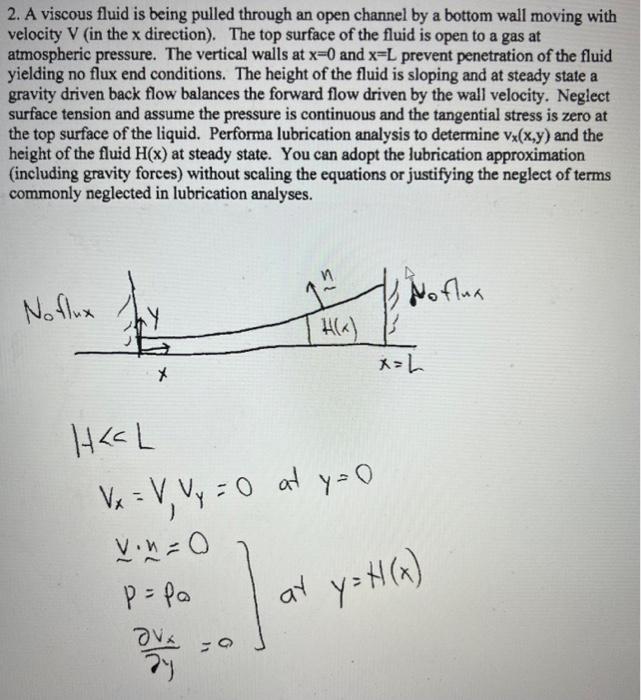
2. A viscous fluid is being pulled through an open channel by a bottom wall moving with velocity V (in the x direction). The top surface of the fluid is open to a gas at atmospheric pressure. The vertical walls at x=0 and x=L prevent penetration of the fluid yielding no flux end conditions. The height of the fluid is sloping and at steady state a gravity driven back flow balances the forward flow driven by the wall velocity. Neglect surface tension and assume the pressure is continuous and the tangential stress is zero at the top surface of the liquid. Performa lubrication analysis to determine vx(x,y) and the height of the fluid H(x) at steady state. You can adopt the lubrication approximation (including gravity forces) without scaling the equations or justifying the neglect of terms commonly neglected in lubrication analyses. 1CLVx=VyVy=0aty=0uv=0P=Payvx=0a1y=+1(x)
Step by Step Solution
There are 3 Steps involved in it

Get step-by-step solutions from verified subject matter experts
 Study Help