







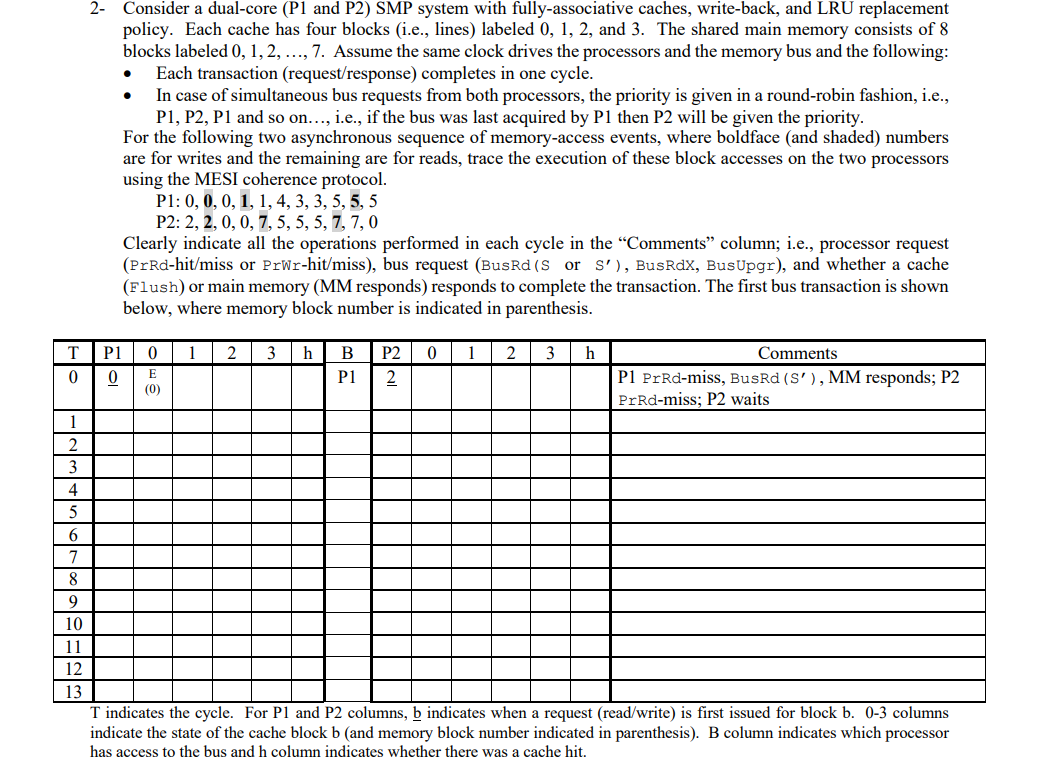
Question: 2 - Consider a dual - core ( P 1 and P 2 ) SMP system with fully - associative caches, write - back, and
Consider a dualcore P and P SMP system with fullyassociative caches, writeback, and LRU replacement
policy. Each cache has four blocks ie lines labeled and The shared main memory consists of
blocks labeled dots, Assume the same clock drives the processors and the memory bus and the following:
Each transaction requestresponse completes in one cycle.
In case of simultaneous bus requests from both processors, the priority is given in a roundrobin fashion, ie
and so on ie if the bus was last acquired by P then P will be given the priority.
For the following two asynchronous sequence of memoryaccess events, where boldface and shaded numbers
are for writes and the remaining are for reads, trace the execution of these block accesses on the two processors
using the MESI coherence protocol.
P:
P:
Clearly indicate all the operations performed in each cycle in the "Comments" column; ie processor request
PrRdhitmiss or PrWrhitmiss bus request BusRd S or BusRdX, BusUpgr and whether a cache
Flush or main memory MM responds responds to complete the transaction. The first bus transaction is shown
below, where memory block number is indicated in parenthesis.
T indicates the cycle. For P and P columns, indicates when a request readwrite is first issued for block b columns
indicate the state of the cache block and memory block number indicated in parenthesis B column indicates which processor
has access to the bus and column indicates whether there was a cache hit.
Step by Step Solution
There are 3 Steps involved in it
1 Expert Approved Answer
Step: 1 Unlock

Question Has Been Solved by an Expert!
Get step-by-step solutions from verified subject matter experts
Step: 2 Unlock
Step: 3 Unlock
 Study Help