



Question: 2. Consider an election with 4 candidates (A, B, C, D) and 9 million voters: ? 2 million Democrats with preferences A > B >
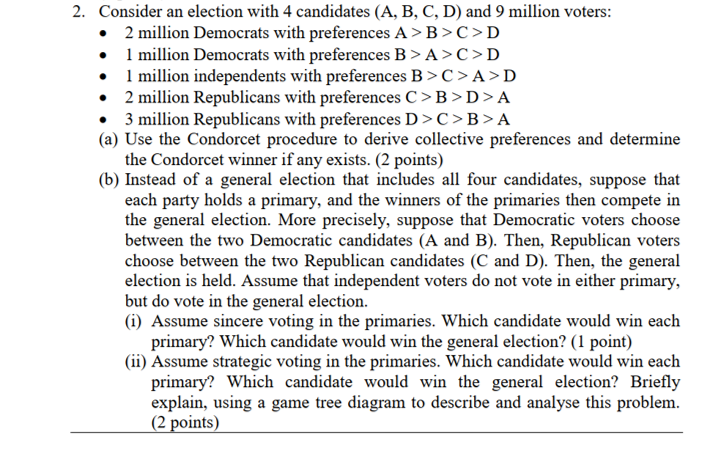
2. Consider an election with 4 candidates (A, B, C, D) and 9 million voters:
? 2 million Democrats with preferences A > B > C > D
? 1 million Democrats with preferences B > A > C > D
? 1 million independents with preferences B > C > A > D
? 2 million Republicans with preferences C > B > D > A
? 3 million Republicans with preferences D > C > B > A
(a) Use the Condorcet procedure to derive collective preferences and determine
the Condorcet winner if any exists. (2 points)
(b) Instead of a general election that includes all four candidates, suppose that
each party holds a primary, and the winners of the primaries then compete in
the general election. More precisely, suppose that Democratic voters choose
between the two Democratic candidates (A and B). Then, Republican voters
choose between the two Republican candidates (C and D). Then, the general
election is held. Assume that independent voters do not vote in either primary,
but do vote in the general election.
(i) Assume sincere voting in the primaries. Which candidate would win each
primary? Which candidate would win the general election? (1 point)
(ii) Assume strategic voting in the primaries. Which candidate would win each
primary? Which candidate would win the general election? Briefly
explain, using a game tree diagram to describe and analyse this problem.
(2 points)
2. Consider an election with 4 candidates (A, B, C, D} and 9 million voters: l 2 million Democrats with preferences A 3:- B 3* C 3" D 1 million Democrats with preferences B 3-" A 3* C 3* D 1 million independents with preferences B 13- C I} A 3- D 2 million Republicans with preferences [3 2: B is D 3-" A 3 million Republicans with preferences D 2* C is B 1* A a) Use the Condorcet procedure to derive collective preferences and determine the Condorcet winner if an}.r exists. [2 points} (b) Instead of a general election that includes all four candidates, suppose that each party holds a primary, and the winners of the primaries then compete in the general election. More precisely, suppose that Democratic voters choose between the two Democratic candidates {A and B}. Then, Republican voters choose between the two Republican candidates {C and D}. Then, the general election is held. Assume that independent voters do not vote in either primary, but do vote in the general election. (i) Assume sincere voting in the primaries. Which candidate would win each primary? Which candidate would win the general election? (1 point} (ii) Assume strategic voting in the primaries Which candidate would win each primary? Which candidate would win the general election? Briey explain, using a game tree diagram to describe and analyse this problem. (2 p_oints} A
Step by Step Solution
There are 3 Steps involved in it

Get step-by-step solutions from verified subject matter experts