







Question: 2. Estimating the elasticity metric. In this problem you create a standard model of how demand varies with the prices of a set of products,
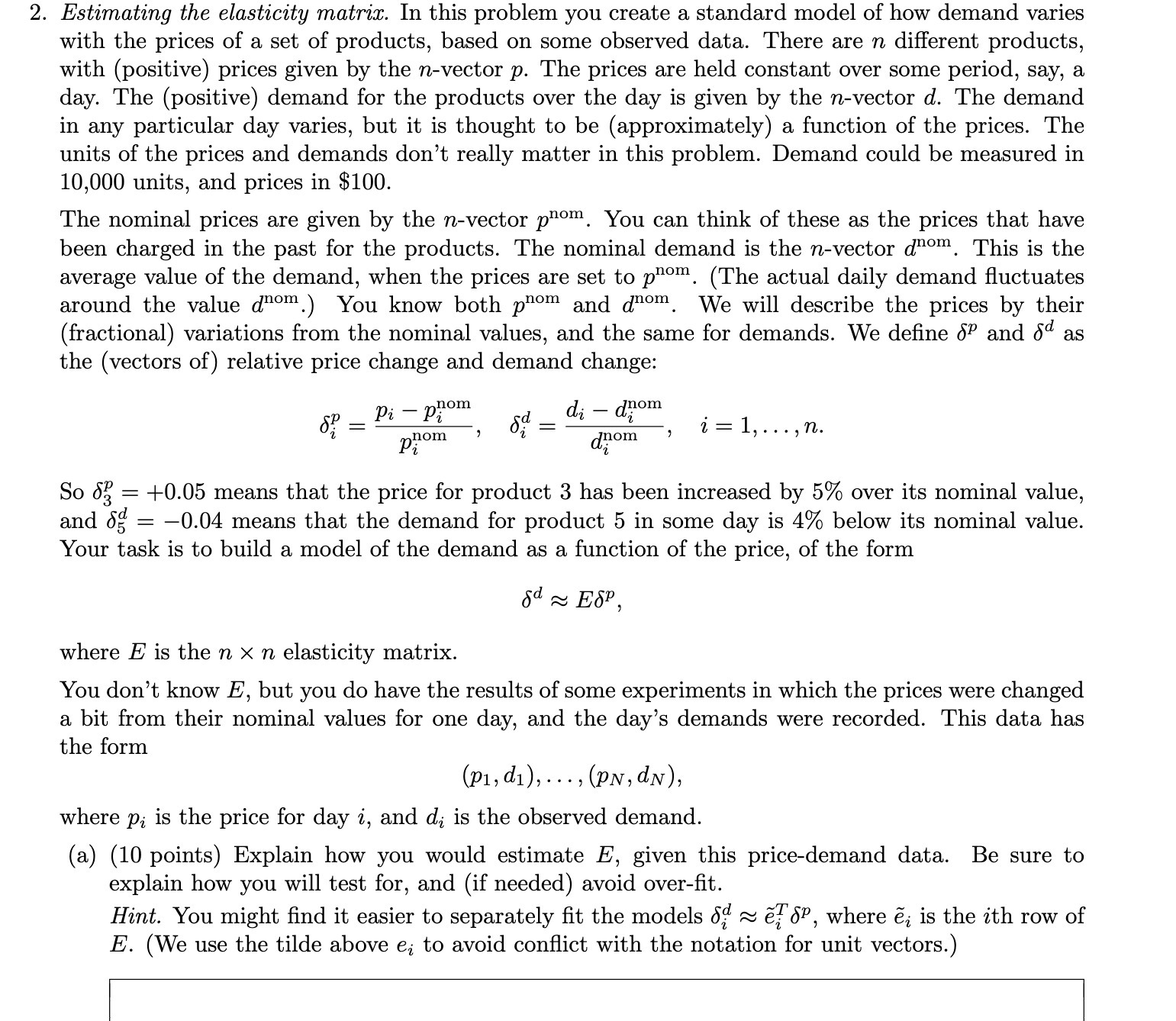
2. Estimating the elasticity metric. In this problem you create a standard model of how demand varies with the prices of a set of products, based on some observed data. There are n different products, with (positive) prices given by the iivector p. The prices are held constant over some period, say, a day. The (positive) demand for the products over the day is given by the nvector d. The demand in any particular day varies, but it is thought to be (approximately) a function of the prices. The units of the prices and demands don't really matter in this problem. Demand could be measured in 10,000 units, and prices in $100. The nominal prices are given by the nvector 19\"\". You can think of these as the prices that have been charged in the past for the products. The nominal demand is the nvector dnom. This is the average value of the demand, when the prices are set to pnom. (The actual daily demand uctuates around the value dm'm.) You know both pm\" and dmm. We will describe the prices by their (fractional) variations from the nominal values, and the same for demands. We dene 5p and 6d as the (vectors of) relative price change and demand change: 51": p,p;10m 6;? = w, i= 1...,n. 1', mom 1 dnom '1. Pi So 6g = +0.05 means that the price for product 3 has been increased by 5% over its nominal value, and 5g = 0.04 means that the demand for product 5 in some day is 4% below its nominal value. Your task is to build a model of the demand as a function of the price, of the form 5\" z E61\
Step by Step Solution
There are 3 Steps involved in it

Get step-by-step solutions from verified subject matter experts
 Study Help