







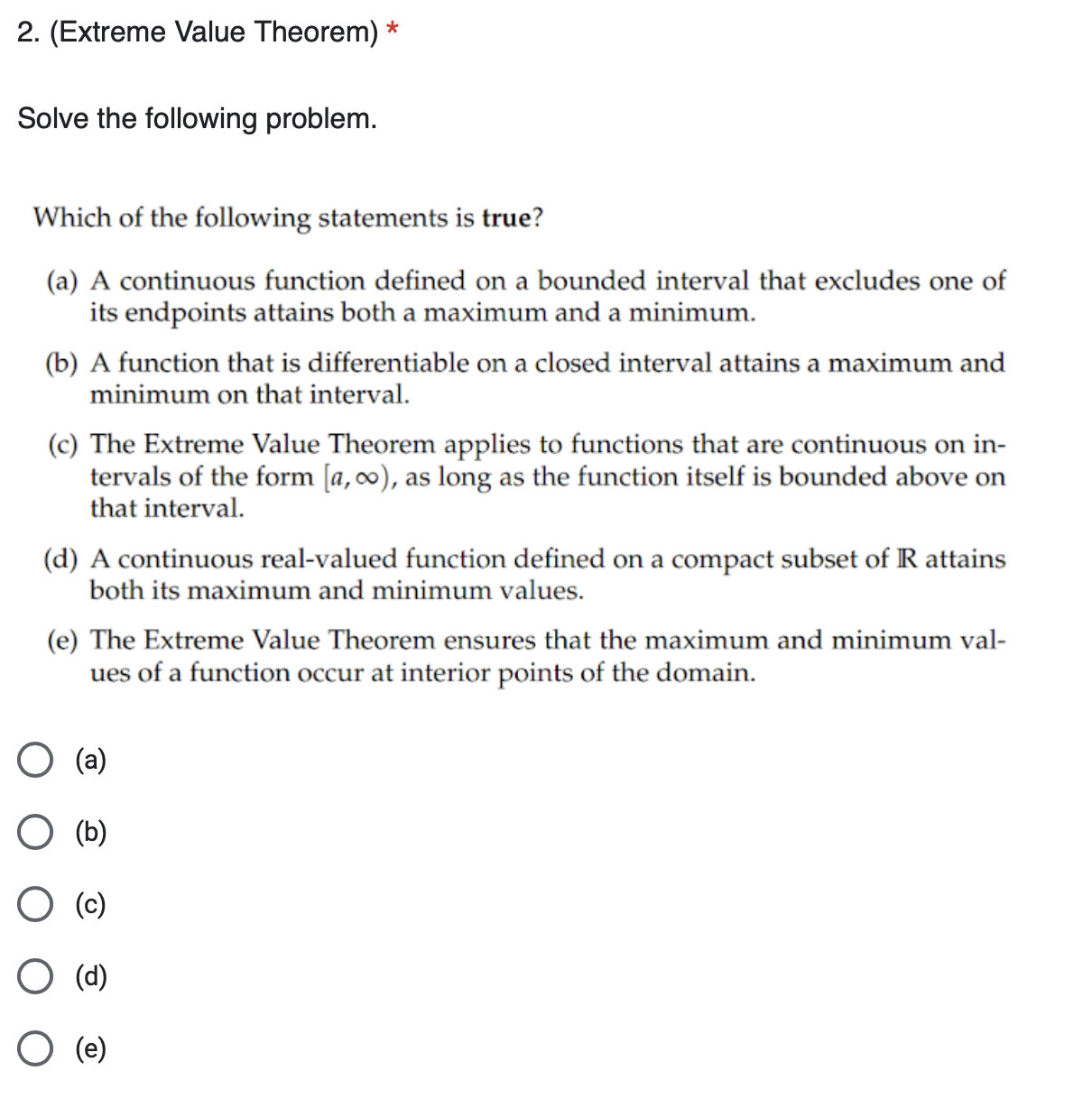
Question: 2 . ( Extreme Value Theorem ) * Solve the following problem. Which of the following statements is true? ( a ) A continuous function
Extreme Value Theorem
Solve the following problem.
Which of the following statements is true?
a A continuous function defined on a bounded interval that excludes one of its endpoints attains both a maximum and a minimum.
b A function that is differentiable on a closed interval attains a maximum and minimum on that interval.
c The Extreme Value Theorem applies to functions that are continuous on intervals of the form ainfty as long as the function itself is bounded above on that interval.
d A continuous realvalued function defined on a compact subset of mathbbR attains both its maximum and minimum values.
e The Extreme Value Theorem ensures that the maximum and minimum values of a function occur at interior points of the domain.
a
b
c
d
e
Step by Step Solution
There are 3 Steps involved in it
1 Expert Approved Answer
Step: 1 Unlock

Question Has Been Solved by an Expert!
Get step-by-step solutions from verified subject matter experts
Step: 2 Unlock
Step: 3 Unlock
 Study Help