







Question: 2. In this question, you'll examine the function f(x) = arccos(x). (a) Sketch the graph of cos x on [0, ?]. Label at least 4
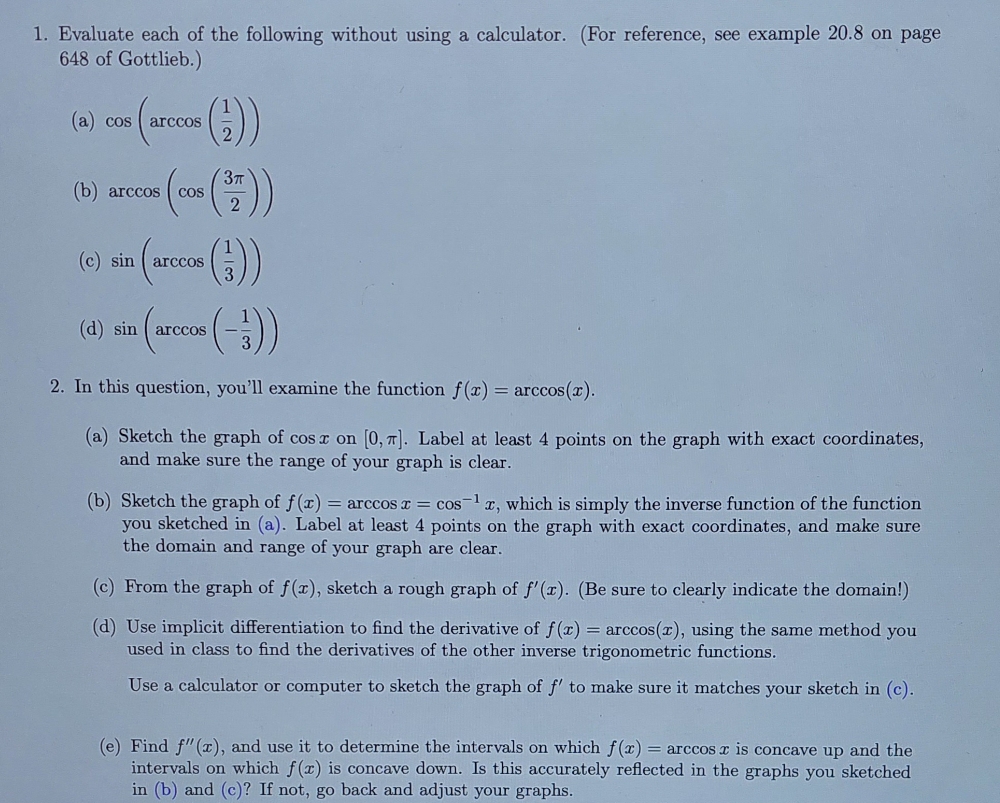
2. In this question, you'll examine the function f(x) = arccos(x).
(a) Sketch the graph of cos x on [0, ?]. Label at least 4 points on the graph with exact coordinates, and make sure the range of your graph is clear. (
b) Sketch the graph of f(x) = arccos x = cos?1 x, which is simply the inverse function of the function you sketched in (a). Label at least 4 points on the graph with exact coordinates, and make sure the domain and range of your graph are clear.
(c) From the graph of f(x), sketch a rough graph of f 0 (x). (Be sure to clearly indicate the domain!
(d) Use implicit differentiation to find the derivative of f(x) = arccos(x), using the same method you used in class to find the derivatives of the other inverse trigonometric functions. Use a calculator or computer to sketch the graph of f 0 to make sure it matches your sketch in (c).
e) Find f 00(x), and use it to determine the intervals on which f(x) = arccos x is concave up and the intervals on which f(x) is concave down. Is this accurately reflected in the graphs you sketched in (b) and (c)? If not, go back and adjust your graphs
.
![Sketch the graph of cos x on [0, ?]. Label at least](https://s3.amazonaws.com/si.experts.images/answers/2024/06/667679a893f08_424667679a867546.jpg)
1. Evaluate each of the following without using a calculator. (For reference, see example 20.8 on page 648 of Gottlieb.) (a) cos | arccos NIF (b) arccos COS 2 (c) sin arccos (d) sin arccos 2. In this question, you'll examine the function f (x) = arccos(x). (a) Sketch the graph of cosa on [0, 7]. Label at least 4 points on the graph with exact coordinates, and make sure the range of your graph is clear. (b) Sketch the graph of f(r) = arccosr = costr, which is simply the inverse function of the function you sketched in (a). Label at least 4 points on the graph with exact coordinates, and make sure the domain and range of your graph are clear. (c) From the graph of f(x), sketch a rough graph of f'(r). (Be sure to clearly indicate the domain!) (d) Use implicit differentiation to find the derivative of f (x) = arccos(r), using the same method you used in class to find the derivatives of the other inverse trigonometric functions. Use a calculator or computer to sketch the graph of f' to make sure it matches your sketch in (c). (e) Find f"(r), and use it to determine the intervals on which f(r) = arccos r is concave up and the intervals on which f(x) is concave down. Is this accurately reflected in the graphs you sketched in (b) and (c)? If not, go back and adjust your graphs
Step by Step Solution
There are 3 Steps involved in it

Get step-by-step solutions from verified subject matter experts
 Study Help