







Question: 2) Joint static analysis (4 marks) Refer to the schematic diagram of the knee joint provided below, where C denotes the effective centre of
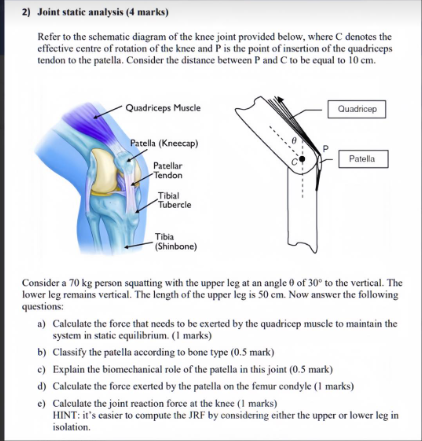
2) Joint static analysis (4 marks) Refer to the schematic diagram of the knee joint provided below, where C denotes the effective centre of rotation of the knee and P is the point of insertion of the quadriceps tendon to the patella. Consider the distance between P and C to be equal to 10 cm. Quadriceps Muscle Patella (Kneecap) Patellar Tendon Tibial Tubercle Tiblia (Shinbone) Quadricep Patella Consider a 70 kg person squatting with the upper leg at an angle 0 of 30 to the vertical. The lower leg remains vertical. The length of the upper leg is 50 cm. Now answer the following questions: a) Calculate the force that needs to be exerted by the quadricep muscle to maintain the system in static equilibrium. (I marks) b) Classify the patella according to bone type (0.5 mark) c) Explain the biomechanical role of the patella in this joint (0.5 mark) d) Calculate the force exerted by the patella on the femur condyle (1 marks) e) Calculate the joint reaction force at the knee (1 marks) HINT: it's easier to compute the JRF by considering either the upper or lower leg in isolation.
Step by Step Solution
There are 3 Steps involved in it

Get step-by-step solutions from verified subject matter experts
 Study Help